|
Kansas: The Cheyenne Bottoms
The Cheyenne Bottoms is a wetland located within the Central Great Plains ecoregion of North America and occupies about 41,000 acres (64 square miles, 170 square kilometers) within the state of Kansas. This wetland is the largest wetland found in the interior of the United States. This entire wetland is a natural land sink and of which the Cheyenne Bottoms Wildlife Area only constitutes 19,857 acres.
The Cheyenne Bottoms provides a critical stopping point and staging area for migratory birds to rest, feed and then continue from along the North American Central Flyway for millions of birds which migrate through the region annually.
Geography
The Cheyenne Bottoms, which lies entirely with Barton County, a jurisdictional district in central Kansas, is located within the Great Plains Region and is part of the Arkansas River basin. The primary inflows are two small local streams, Blood Creek and Deception Creek which flow into the Bottoms from the northwest. Too, there is a inlet canal entering from the southwest, which source is from Walnut Creek. The primary outflow is an outlet canal in the southeast, which flows to Little Cheyenne Creek, which then flows into Cow Creek, a tributary of the Arkansas River.
The entire wetland occupies a natural land sink which occupies some 64 square miles and contains the area of Cheyenne Bottoms Wildlife Area which is composed of about 31 square miles. The Bottoms is impounded and divided into a set of pools using a network of dikes.
Nearby highways include US 281, which traverses north-south just 2 miles to the west of the Bottoms. State Highway (SH) 4, which traverses east-west is just to the north of the Bottoms. SH 156 which traverses northeast-southwest enters the Cheyenne Bottoms through the southeast portion of the wetlands.
Kansas Forestry, Fish and Game Commission
This government agency was created to develop and care for the Cheyenne Bottoms. In August 1927, 14 inches (36 cm) of rain upstream turned the Bottoms Lake Cheyenne overnight which in turn caused flooding downstream of Little Cheyenne Creek.
Kansas politicians including Clifford Hope, Charles Curtis, Henry Allen and Arthur Capper made an unsuccessful plea to get federal money to convert it into a National Wildlife Refuge. Following the Pittman–Robertson Federal Aid in Wildlife Restoration Act of 1937, which taxed sporting arms and ammunition, funds became available to develop the Cheyenne Bottoms.
During 1952, there were the construction of dikes, roads and hunting blinds. Then, part of the area was opened to public hunting. In 1957, a new canal from the Arkansas River was built. However, relatively little water from the Arkansas was pumped into the wetland because of drought and claims by other entities on the water supply. In the 1990s, an extensive renovation subdivided the marshes. The renovations allowed the marshes to be more self-sustaining, although an adequate water supply and management of water levels continue to be critical problems.

Cheyenne Bottoms Information:
Description:
Location:
Coordinates:
38.469444, -98.655833
Elevation:
1,798 feet
Geographical Information:
Geographical Region:
Great Plains
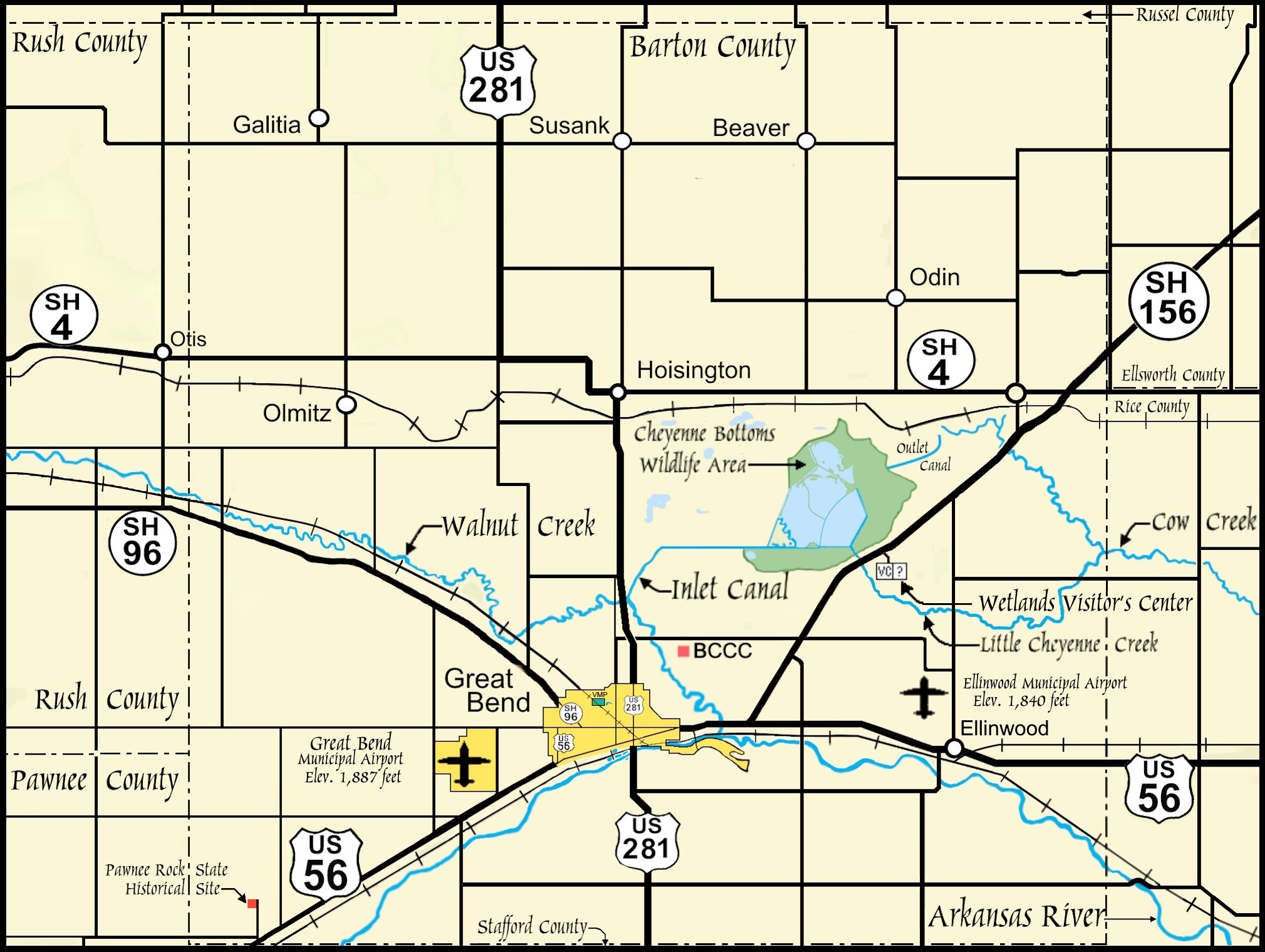
(m0maps-cheyenne-bottoms) The Cheyenne Bottoms Area Map
The Ancients
The Earth
The Modern Man
The Steps
|