|
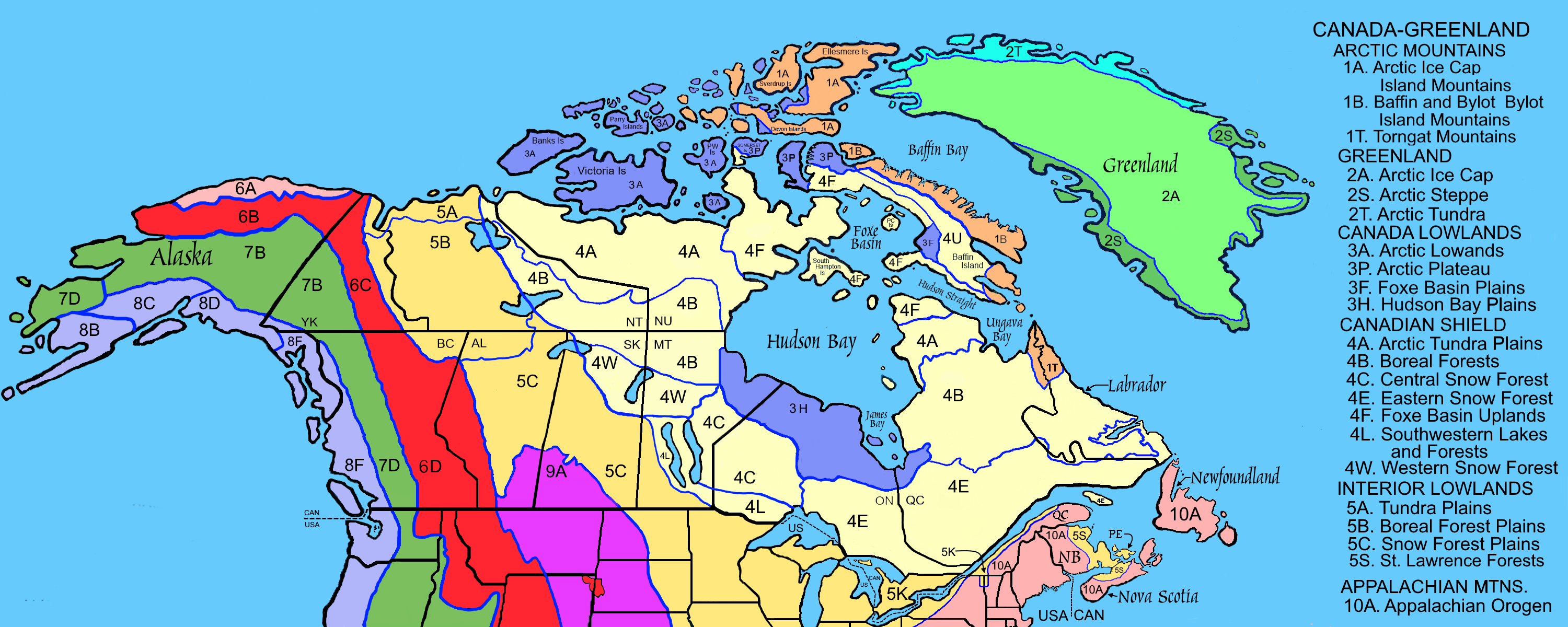
The Arctic Mountain Region, also called the Arctic Cordillera encompasses massive glaciated peaks rising through the icefields in Northern Canada, which mountain range is one of the coldest areas of the world. The deeply dissected ranges of the Arctic Cordillera stretch from the Ellesmere Island to the Labrador Peninsula, and extend as far south as northern Quebec. Large areas of these mountains are protected within the limits of national parks, wilderness area and other federal preserves.
Much of the land located in this geographic region remains treeless and has very little wildlife. The is the result of the harsh cold climate as well as the mountains being located north of the Arctic tree line.
There are no trees and very little wildlife in the Arctic Mountains region due to the harsh cold climate as well as being located north of the Arctic tree line. This region is mostly barren with vast areas of permafrost. There are contained in this region, metallic mineral resources including iron and zinc and fossil fuel resources such as coal.
Lady Franklin Bay Expedition (1881-1884)
The Arctic Mountains were first seen by modern man when the American explorer Adolphus Greely arrive by ship in 1881. The expedition, named the Lady Franklin Bay expedition, sailed on the steamship SS Proteus, beginning in 1882. The expedition followed the west coast of Greenland northward, into the arctic circle and continued further north and while still in 1882, reaching a new Northernmost Record of 83° 23′ 8" on Lockwood Island on the north tip of Greenland.
The expedition then moved westward to Ellesmere Island, built Fort Conger and began their research efforts. Later, during dog sledding explorations to the interior of Ellesmere Island, Greely sighted a mountain range, which was then named the Conger Range and, now located within the Quttinirpaaq National Park. The expedition camped along the north shore of Lake Hazen, a freshwater lake within the national park and within sight of the many ranges of the Innuitian Mountains.
Their encampment at Fort Conger lasted through 1882 and into 1883 until the expedition ended, Fort Conger was abandoned and then by August 1883 the expedition traveled south to Cape Sabine on Pim Island in the lower Nares Strait and await for supplies. Instead, with winter fast approaching, the USRC Bear, a steam power sailing ship, led by Captain Winfield Schely, was sent to rescue the Greely party. By the time the Bear together with the Thetis and Alert arrived on 22 June 1884, eighteen of the twenty-five men of the Lady Franklin Bay Expedition party had died, many perished from starvation, some from drowning, some from hypothermia and one was executed for repeatedly stealing food.
Greely and the other survivors were near death when rescued and one died during the homeward journey. The six survivors were venerated as heroes, even though the heroism was temporarily tainted by sensational accusation of cannibalism, accusations, which Greely adamantly denied.
Arctic Cordillera
The Arctic Cordillera is naturally geographically divided into three area and thus, this is how this information and photo galley will be presented. The three ecoregion will thus be the three divisions: (1a) Arctic Island Mountains, (1b) Baffin and Bylot Island Mountains and (1c) Torngat Mountains.
|