|
Lake Pene Oreille
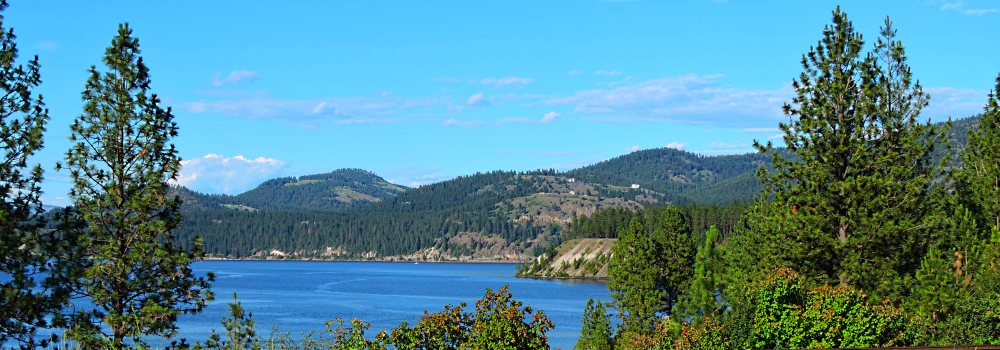
The Pend Oreille Lake, located in the northern Idaho Panhandle is the largest lake in the U.S. state of Idaho and the 39th-largest lake by area in the United States, with a surface area of 148 square miles (380 km2). It is 69 kilometres (43 mi) long, and 1,152 feet (351 m) deep in some regions, making it the fifth-deepest in the nation and having a volume of 43,939,940 acre feet, or 54 km3. The lake is fed by the Clark Fork River and the Pack River, and drains into the Pend Oreille River, as well as subsurfacely into the Spokane Valley–Rathdrum Prairie Aquifer. It is surrounded by national forests and a few small towns, with the largest population on the lake at Sandpoint. The majority of the shoreline is non-populated and all but the southern tip of the lake is in Bonner County. The southern tip is in Kootenai County and is home to Farragut State Park, formerly the Farragut Naval Training Station during World War II, of which a small part is still active and conducts U.S. Navy acoustic underwater submarine research.
The surrounding forests consist of ponderosa pine, Douglas fir, red cedar, poplar, quaking aspen, hemlock, paper birch and western larch. Local animal species include white-tailed deer, elk, gray wolves, moose, mice, squirrels, chipmunks, black bears, grizzly bear, coyotes, mountain goat, cougar and bobcats, along with bald eagles, wild turkeys, osprey, owls, hummingbirds, hawks, woodpeckers, ducks, and the mountain bluebird. The lake is a home for several species of migratory water fowl.
Pend Oreille Lake Information:
Lake Type:
Natural, Glacier cut
Water Discharge:
Controlled by Albene Dam downstream on Pend Oreille River
Primary Inflow:
Clark Fork River and Pack River
Primary Outflow:
Pend Oreille River
Water Discharge:
Lake Measurements:
43 miles long (69 kilometers)
Surface Area:
148 Square miles, (380 square kilometers)
Volumne:
12.95 cubic miles (53.95 km3)
43, 939,940 acre feet
Average Water Temperature:
Average Depth:
466 feet, (142 meters)
Deepest Depth:
1,152 feet (351 meters)
Shore Length:
Location:
Coordinates:
Outflow Location:
48.24115921501179, -116.61202795315484
Pend Oreille River
Inflow Location (primary):
48.14621545512404, -116.21050678636094
Clark Fork River
Inflow Location (secondary):
48.305767996490886, -116.37696560574302
Pack River
Surface Elevation:
2,060 feet, 628 meters
Geographical Information:
Geographical Region:
Rocky Mountains
History:
Lake Pend Oreille was glacially formed during the ice age. It is also believed that the eastern side of the lake was in the path of the ancient Missoula Floods. The lake sits at the south end of the Purcell Trench, carved by glaciers moving south from Canada. The eastern side of the glacier is believed to have formed the dam for the Missoula floods, at the point where the Clark Fork river enters the lake between the Cabinet and Bitterroot mountains. The lake is made slightly larger by the dam at Albeni Falls, just east of Oldtown; the dam is ninety feet (27 m) high and operated by the U.S. Army Corps of Engineers.
Along with Crater Lake, Lake Tahoe, Lake Chelan, and Lake Superior, Lake Pend Oreille is among the five deepest lakes in the United States.
The Ancients
The area around the lake is the traditional home of the Kalispel Indian peoples. David Thompson established a North West Company trading post on the lake in 1809. A Canadian fur trader in Thompson's party is believed to have given the lake its name. The words "Pend Oreille" are French for an ear-hanging or pendant. Ear pendants were characteristic of the Kalispel tribe. The lake is shaped much like a human ear when viewed from above or on a map. In 1846, Great Britain ceded the bulk of its claims to the Pacific Northwest pursuant to the Oregon Treaty.
First Migration
(The Algonquian Cultures)
Kalisispel (Pend Oreille)
Salish Language Interior
The Kalispel are a Native American tribe, also known as the Pend d'Oreilles, from the Columbia River basin region, with traditional lands in what are now parts of Idaho, Montana, Washington, and British Columbia. Historically, they relied on gathering roots, fishing, and hunting in a semi-nomadic lifestyle, and traditionally lived in earth-covered or mat-covered lodges. Today, the federally recognized Kalispel Tribe of Indians is headquartered in Washington and engages in various economic ventures and community initiatives.
Traditionally, their homeland comprised the drainage systems of the Flathead River, Clark Fork, and Pend Oreille rivers. It extended from roughly present-day Plains, Montana, westward along the Clark Fork River, to Lake Pend Oreille and Priest Lake in Idaho, and the Pend Oreille River in eastern Washington, a tributary of the Columbia River in British Columbia.
They lived in many bands, originally, it was eleven different groups in their historic lands. Today, these indigenous people are generally divided geographically and culturally in two groupings:
1. The Upstream People, or Upper Kalispel (Upper Pend d′s Oreille) who are commonly referred to as the Pend d′Oreille. They were also known as Kullyspelm (the "Camas People"). They are now enrolled in the federally recognized Confederated Salish and Kootenai Tribes of the Flathead Nation in Montana.
2. The Downstream People or Lower Kalispel (Lower Pend d′s Oreille) who are commonly referred to as the Kalispel. They were also known as Silkatkmlschi ("People Living along the Shore of the Broad Water"), because they lived by Flathead Lake ("Broad Water"). Today many are enrolled in the Kalispel Tribe of Indians in Washington. Some families are members of the Coeur d’Alene Tribe in Idaho.
Prior to colonization by European-Americans, Chewelah was home to a band of the Lower Kalispel people. The band was known as the Slet?éw?si, meaning "valley people". The Chewelah Band of Indians is currently part of the Spokane Tribe of Indians of Washington.
The Kalispel Reservation, located in Usk in Pend Oreille County, Washington. It was founded in 1914 and is 4,557 acres (18.44 km2) large, with the tribe′s headquarters is in Cusic, Washington. In 1809, David Thompson opened a trading post for the North West Company of Montreal within their homeland. The Upper Kalispel were forced onto an Indian reservation in Montana, while the Lower Kalispel remained on their homelands in Washington.
The Earth
The Modern Man
The Steps
|