|

|
|
|

|

|
|
The Colorado Plateau Desert
|
|
|
The Colorado Plateau Desert:
Utah


|
|
|
Colorado Plateau Desert
The Colorado Plateau desert region is roughly centered on the Four Corners area of the southwestern United States covering a total area in square miles making it rank third behind the Great Basin Desert and Chihuahuan Desert. This desert is also an ecoregion of the same name and is found in four states, Arizona, Colorado, New Mexico and Utah.
The nickname Red Rock Country comes from the brightly colored rock exposed from millennia of erosion. Some of the additional features found in the Colorado Plateau deare are domes, hoodoos, fins, reefs, river narrows, natural bridges, and slot canyons.
There is a concentration of parks located within the Colorado Plateau, including National Parks, National Monument and others. The for and type of park includes a large variety from ancient petroglyph, ancient stone stacker, arches, canyons, forests, fossils, and volcano. (See list below)
Colorado Plateau Desert Facts
Total Size:
130,000 square miles
Primary Drainage:
Colorado river, Rio Grande river
Secondary Drainage:
Green, San Juan, Little Colorado, Pecos rivers.
Biome:
High Desert with scattered mountain top forested areas.
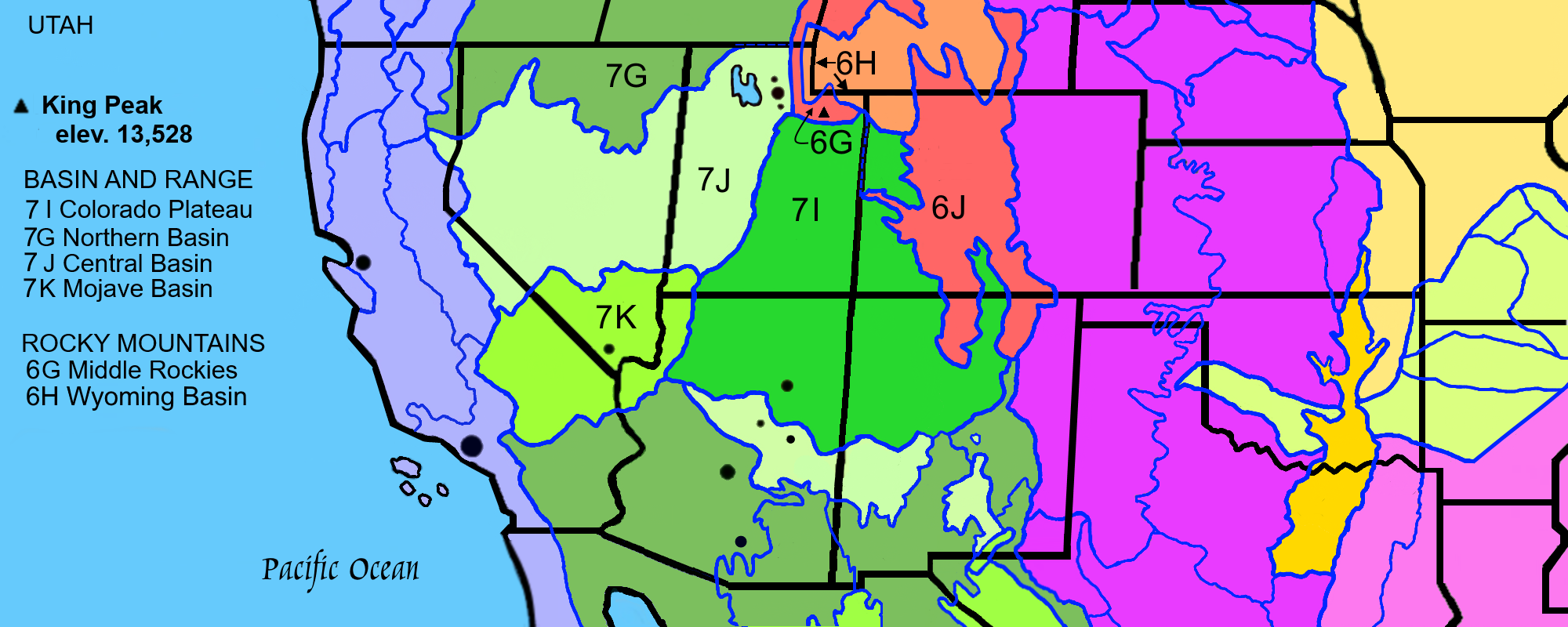
(m2cont-nam-00-utah) Basin and Range: Colorado Plateau Ecoregion, Utah
Colorado Plateau Desert: Utah
Location:
Geographical Region:
Basin and Range
With the only exception of the northeast area of Utah, which lies within the Wyoming Basin Ecoregion (3H), the rest of the state of Utah is within the Basin and Range Region.
In Utah, this large area known as the Colorado Plateau ecoregion (2I) is also referred to as the Colorado Plateau Desert.
The Colorado Plateau ecoregion takes up all of the area directly south of the Wyoming Basin along the state line with Colorado. As this ecoregion moves southward, it expands further and further westward almost to the southeast corner of Utah, where the Mojave Basin ecoregion comes in from the south and west.
To the west of the Colorado Plateau is the Central Basin ecoregion which not only covers much of western Utah but also covers much of Nevada as well as small portions of west-central California.
Also, the extreme northwest corner of Utah contains a small area of the Northern Basin Ecoregion.
|
| |
|
The 2018 Journey,
Utah Wyoming Basin
|
|
|
Entering from Wyoming
After leaving
Flaming Gorge, I continue south rising into the mountains and enter the high elevation of over 8400 feet in
Ashley National Forest where I find the aspen just entering fall foliage.
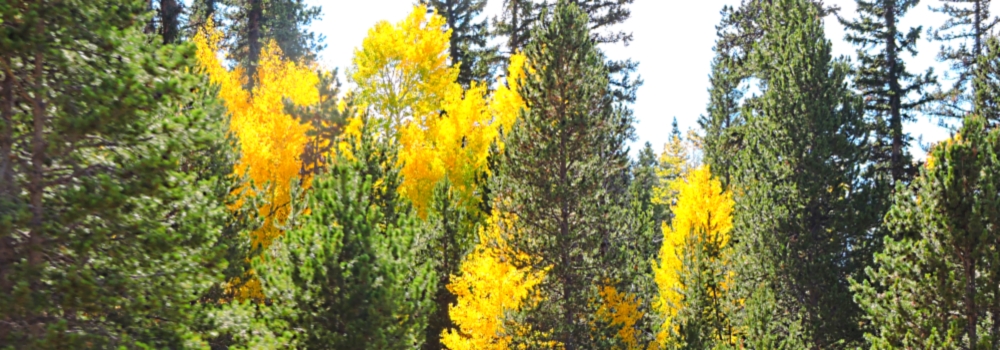
After numerous stops in the quaking
aspen forest, I continue to drive south on US 191 and soon begin loosing elevation. As the elevation drops below 7000 feet, the forest gives way to the desert scenery and I come to a large wash along the road.


Then, I drive down from the high elevation, stop at a view point over looking the Brush Creek Gorge and Red Fleet reservoir. Here, I get out of the jammer and take some photos. of the vast desert before me.


Continuing south on US 191, I soon come into Vernal where I plan to stop for the evening. The next morning, after filing my gas tank, and buying coffee, I continue my drive through the desert.
Driving south on US 191 out of Vernal, Utah, I drive through Fort Duchesnes, to Duchesne, Utah, turn left, cross Strawberry River then continue on US 191 up into Indian Canyon following a small creek.


(m2cont-nam-geol-de-ut-colorado-2018-0918.0924) Indian Canyon Creek Cuts Deep Into Canyon Floor
As I continue up the canyon, the creek begins to cut a deep stream bead alongside the road and as the box canyons continue to increase, so do the colorful quaking aspens.
At about ten miles into the canyon, I see a sign telling me that the highway follows the Left Fork of Indian Canyon, all along the elevation increases. Soon after that, I see another sign that indicates I am back in
Ashley National Forest and looking at my GPS see that I have driven up to the elevation of over 7500 feet. Here, the aspen begin to replace area where previous burns have occurred along both sides of Indian Canyon.


At about thirty miles from the Strawberry river, I come to a sign that tells me that I have reached the summit of the long climb up through Indian Canyon. The summit is 9114 feet.
I continue down from the summit to where US 191 meets US 6, cross the Price river, turn left into Price Canyon and drive towards Price, Utah.
It is at the junction of these two highways were most of the greenery ends and the dryer deserts browns take over. It is also here where I believe I have come to a different desert, the Southeast Utah desert.
|
| |
|
The 2018 Journey,
Utah Colorado Plateau Desert
|
|
|
Price Canyon
Upon arrive at the junction of US 191 and US 6, I cross the Price River and soon enter Price Canyon, beginning on a road I have traveled many times in the past. Too, I remember the sandstone pillars that are atop the mountain on the north side.
Upon arriving at the location of the pillars, I stop and take a few photos.


Later, I see a teepee atop the same ridge and photograph it as well. Then, with the Price river now to my west, I continue south on US 191.
Price River
Much below the towns of Price and Wellington, the Price river which has been meandering just west of US 191 now cuts a path eastward, flows under US 191 and continues eastward on it′s downward path to join with the Green River.
I notice the large canyon that it has cut through the mesa ridge just east of US 191 that I have been following. Now it is only a short way before arriving at the IH 70, which US 191 joins and travels east a short way.

Mesa Ridge End
Continuing south on US 101, the end of the sandstone mesa comes into view. Having traveled this path many times, I know that at the end of this mesa is the Green river canyon that crosses from north to south through a wide open valley.


One seeing the mesa end, it is only a short drive to IH 70.
The Green River
After a short run on IH 70, I cross the
Green River, now leaving it behind me. Soon after, I turn off of IH 70 back onto US 191 to continue my drive south with the Green river to my west. I will see the Green river only once more when I am in Canyonlands.

Below IH70, there are more wide open deserts flats, lined on either side by towering sandstone mesas. This area of Utah below the interstate is more akin to the Red Desert in southwestern Wyoming, a very dry and brown desert
Too, it is just a short drive now to my next stop for photos, the
Arches National Park.


Upon leaving Arches park, I soon cross the
Colorado River and soon after arrive in Moab, Utah and stop for the day. The Colorado River flows through this area after coming down from where it crosses into Utah just west of Grand Junction, Colorado.
Not far from Moab, both to the east of US 191 on SR 128 and to the west on SR 279 are several locations to see
petroglyph near the Colorado River.
|
| |
| |
|
To go back to Gallery Index, click on the down arrow.
|
|
|
Thank you for visiting
The Wayƒarers Journal.
| |
See Ya above the Treeline!
| |
This Page Last Updated: 31 May 2026
|
|
|
|
To continue to the next Episode Level page,
Click here

|
|
| |



