|
The Need for a New Light
After Matagorda Island Lighthouse began guiding traffic into Matagorda Bay in 1852, requests were made for additional lights to mark channels and obstacles in the bay itself. Complying with the demands, the Lighthouse Board successfully petitioned Congress in 1854 for funds to construct a light on the southern tip of Halfmoon Reef, a shoal on the eastern side of Matagorda Bay.
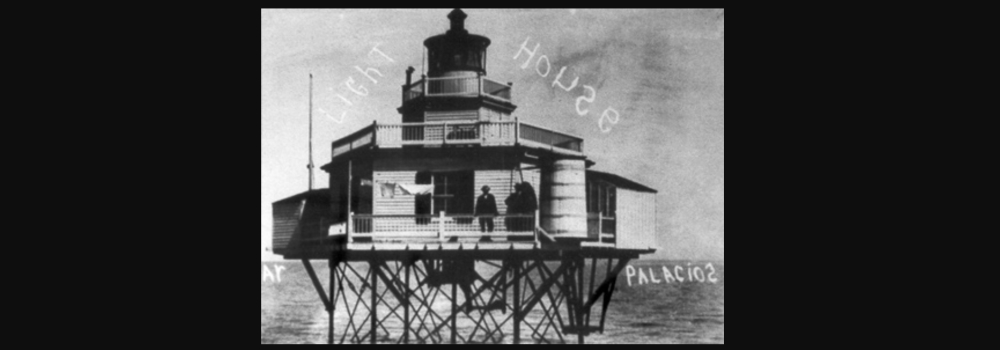
This Light called for the construction of a screwpile lighthouse and two years passed before the plans were finalized. The lighthouse would consist of a wooden, hexagonal structure, sixteen feet on a side, surmounted by a lantern room and supported by seven, twenty-five-foot iron piles. On one end, the piles had threads, two feet in diameter, which facilitated screwing the piles into the shoal to a depth of nine feet.
Construction of Halfmoon Reef Light
Early in 1858, the screwpiles arrived at Matagorda Bay, having been shipped to Galveston from Baltimore aboard the same vessel that carried the cast iron extensions for both the Bolivar Point and Matagorda Lighthouses. Halfmoon Reef Lighthouse was completed by July 1, 1858 and began operation.
A fixed white light produced by a sixth-order Fresnel lens shone from the lantern room, but those arriving in the gulf along the Matagorda Peninsula said that sand from the dunes would periodically obscure Halfmoon Reef Light, creating a flashing signature like that of the nearby Matagorda Island Lighthouse. This problem was corrected when a ruby red glass chimney was used in the oil lamp, changing the characteristic of Halfmoon Reef Light to red.
Demise and Sale of the Light
In 1942, after a hurricane tore the walkway from the lighthouse and left it sagging on its pilings. The Coast Guard decided to sell the structure rather than repair it. Bill Bauer and Henry Smith purchased the lighthouse, which they planned to use as quarters for the night watchman at their Point Comfort dredging business. Bill Bauer frequently visited the lighthouse as a boy with his father, who would transport shellfish harvested by local fishermen from the station to shore.
Aboard a 124-foot barge with a lifting crane and 34-foot steel beams, Henry Smith and a work crew set out to retrieve the lighthouse in 1943. As they were preparing the lighthouse for the move, military personnel arrived in a motorboat and ordered them to leave the area before the planned bombing practice set to begin in a half hour. The movers, however, were not willing to leave the lighthouse, and the bombing had to be delayed while the structure was salvaged. In the early 1960s, Pat Riojas II was a truck driver for Bauer Dredging, and he and his family actually lived in the lighthouse, located just inside the Bauer fence line.
New Home for the Light
In 1978, thirty-six years after purchasing the lighthouse, Bauer donated it to the Calhoun County Historical Commission for use as a museum and supplied a sizable trust fund for maintaining the structure. The lighthouse was transported across the Matagorda Causeway, and then restored the following year as an Eagle Scout service project.
In 1985, the lighthouse was placed atop its present piers, the encompassing porch was added, three flag poles were erected, and a Texas Historical Marker was unveiled at the site by Mr. and Mrs. Bauer, the generous donors of the lighthouse and the namesakes of the nearby community center. Today, the lighthouse sits alongside Highway 35, adjacent to Port Lavaca Bauer Community Center.
Halfmoon Reef Light
The Halfmoon Reef Light is located on the west side of Lavaca bay, just south of the first exit off the SH 35 bay bridge and near to the Lighthouse beach campground.
Year Construction Began:
1858
Year Construction Complete:
July 1, 1858
Year First Lit:
July 1, 1858
Year Moved:
1943
Lens Order:
Sixth-order Fresnel lens
Light Character:
Flashing white light with ruby red glass chimney
Tower Markings
Wooden, white hexagonal structure, sixteen feet on a side, with green roof, white tower and surmounted by a black lantern room.
Coordinates:
Foundation Elevation
Best View From:
Parking lot of rebuilt Light
|