|
New River Gorge, West Virginia
Today, as you look at the gorge from a distance, it appears as a pristine, natural environment. Like all environments, however, it is continually changing. The most drastic transformation occurred when lumbering, mining, and new towns all converged in the gorge in the late nineteenth century. This area played a vital role in the industrialization of the United States.
Within one hundred years, all industrial activities has ceased in the gorge, and nature slowly began to cover up most of the evidence of human exploitation.
To insure that the resources of the gorge would be protected, Congress established the New River Gorge National River in 1978. The NPS continues to conserve and interpret the outstanding natural, scenic and historic heritage in and around New River Gorge for the benefit and enjoyment of present and future generations.
The establishment, growth and ultimate demise of the towns of Fayette and South Fayette represent the general life cycle of the towns in the gorge. A mining company would open a coal mine and build company owned house and a store, thus creating a company town. Decades later, when the coal seam was exhausted or the mine closed because of change in the marketplace, people moved away, and the town ultimately was deserted.
History: The Early Years
An era of intense growth began in the area when the C&O railway linked Newport News, Virginia with Cincinnati, Ohio, in 1873, creating a virtual highway through the New River Gorge.
The railway provided the route for shipping coal to industrial centers in the Midwest and lumber to shipbuilding centers in the East. It also carried residents to the gorge and nearby towns, brought them current newspapers from far away cities and transported students to and from school each day.
Later, the town of Fayette was incorporated, and the coal company town provided miners with housing, the Blume Company Store, a school, post office, churches, railroad depot, four saloons and a hotel.
On the opposite side of the New River from Fayette, the twin town of South Fayette was established along the tracks of the C&O Railway and the only way to cross to the other side was a crossing some distance away from the towns.
Life bustled in the towns of the gorge for over sixty years, and the coal industry remained strong through World War II. In 1927, for example, West Virginia was the lead coal producing state, producing 28 percent of the nation′s coal.
Imagine the scene, traveling the railroad up the river gorge and seeing one coal mining town after another crowding the banks of every single curve of the river, Fayette, Kaymoor, Elverton, Nuttallburg, Caperton, Sewell, and Thurmond. All the above towns and many more sprouted up, with about one hundred people living in each town, and this because of the unique relationship between the coal industry, the railroad and the river gorge.
History: Change is Inevitable
Rapidly changing mining technology, alternative fuels and the change for steam to diesel powered locomotives ultimately dealt the final blow to the area.
The last coal mine in the gorge closed in the mid 1990s, and most of the miners had long left the river towns for work elsewhere.
The Fayette Station Bridge, 1889
The construction of the Fayette Station Bridge in 1889 provided a vital link to reach the county set of Fayetteville without having to make a dangerous and time-consuming ferry crossing.
After the bridge was completed, the two communities grew together over the years as one, although Fayette maintained its identity as a mining town, as South Fayette was seen as a railroad center. Also, several community facilities were shared by both towns including the post office, school, saloons and jail.
In the late nineteenth century, the construction of the Fayette Station Road was begun. This new road would provide a path from the top of the ridge down into the steep and narrow gorge to the railroad station. The construction of this road was a grueling task, as roadbeds were blasted into the rock sides of the gorge. After many years, the road was completed in 1928.
The New River Bridge: 1977
This bridge dramatically changed travel pattern in the area, because the Fayette Station Road was no longer the only way to cross the river. The modern bridge reduced a forty minute drive down into the gorge then back up, to a rapid drive across a straight highway span. Suddenly, entire communities on opposite sides of the river became closer.
The New River Gorge Bridge is 3030.5 feet long across the road. The arch has a span from one support to the support on the other side of 1700 feet making it longest single span arch bridge in the Western Hemisphere. The arch also has a 360 feet rise from the supports to the deck.
The New River Gorge Bridge is the second highest bridge in the United States and rises 976 feet above the New River. It took three years to construct and was completed in 1977, one year before the New River Gorge National River was authorized by Congress.
Although the New River Gorge bridge structure may look rusty, it is constructed of 44 million pounds of Cor-ten steel, a material with a rust like appearance that never needs painting. The huge piers that anchor the bridge at each end was made of 44 million pounds of concrete.
The New Station Road Bridge, 1998
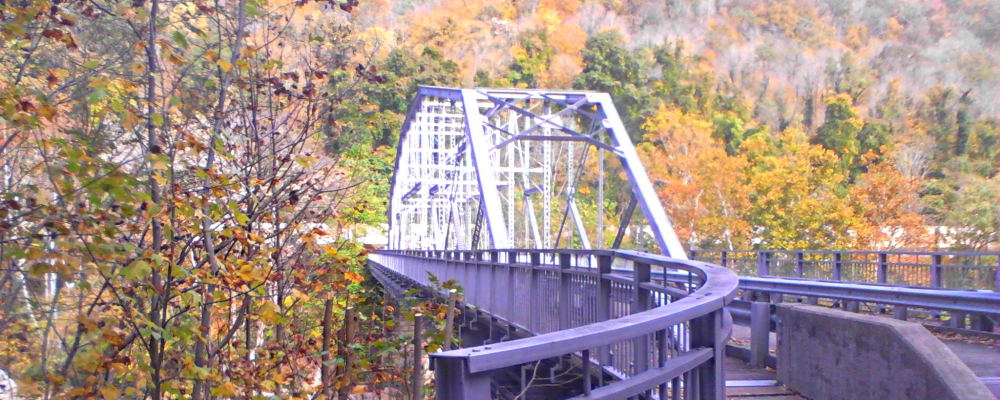
After The original bridge was closed to traffic in 1978 because of its deteriorated condition. Two decades later, plans were made and the old bridge was replaced with a bridge nearly the same in size and construction. However, the engineers of the replacement bridge changed the original design by adding walk ways on either side to insure pedestrian safety. The new bridge was dedicated on 8 November 1998, as the Tunney Hunsaker Bridge, but most in the area call it the Station Road Bridge.
The Station Road Bridge is still in operation to this day, and has even been know to host wedding photos for some of the locals.
National Park Status
The New River Bridge, the river and much of the Gorge was first established in 1978 as a National River. Today, the New River Gorge is no longer a National River in the national park service, instead, as of 2020, the New River Gorge National River has been redesignated as a National Park.
Of the 423 units in the National Park Service, there are 63 which hold the title of National Park of which the New River National Park is the newest
Geology
Coal is an organic rock that takes millions of years to form. The process began over 300 million years ago when the area was a vast tropical swamp. As plants died in the hot humid environment, they decomposed in the swampy stagnant water. Over several million years, climate changes and continental uplift drained the basin and the swamps turned into peat bogs. As millions more years passed, layer upon layer of sediment, thousands of feet thick, covered the bogs. The immense pressure and weight from the sediment ultimately compacted the peat into coal.
The rich coal seams of the New River basin were thousands of feet underground until the Teays River, a precursor of the New River, started to flow north from the Appalachians. Over one hundred million years, through ice ages and thaws, the Teays flowed through the area channeling down through the sedimentary rock on the basin and exposing the strata of coal an other rocks that ha been deposited million of years earlier.
|