|
Coordinates:
45.937260, -124.018860
First Lit:
21 January 1881
Light Signal:
One white flash every five seconds.
Decommissioned:
01 September 1957
Cost to Build:
$123,492.82 (2020: $3.75 million)
Replaced By:
Red Whistle Buoy (one mile seaward)
Lighthouse Elevation
Foundation: 30 feet
Lens Elevation: 133 feet
Best Viewed From:
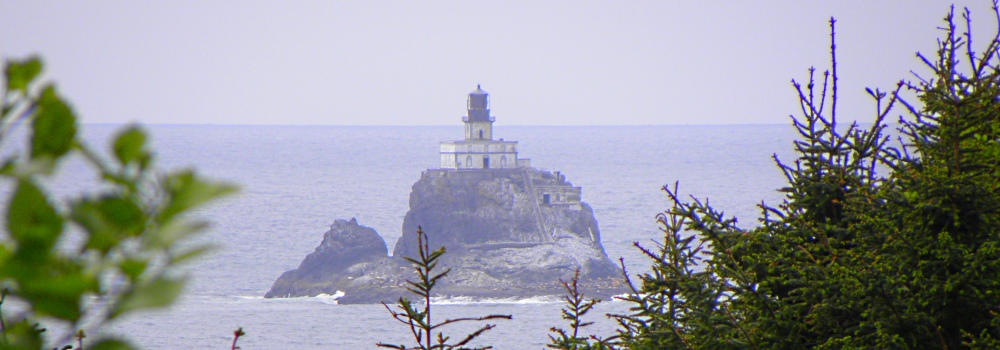
Ecola State Park. Also seen from Cannon Beach and Seaside.
NOTE:
Tillamook Rock is private property and not open to the public
The Terrible Tilly Story
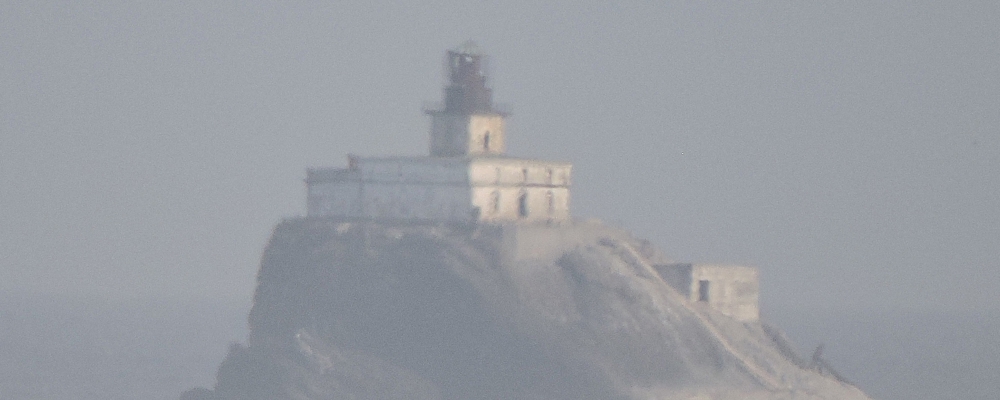
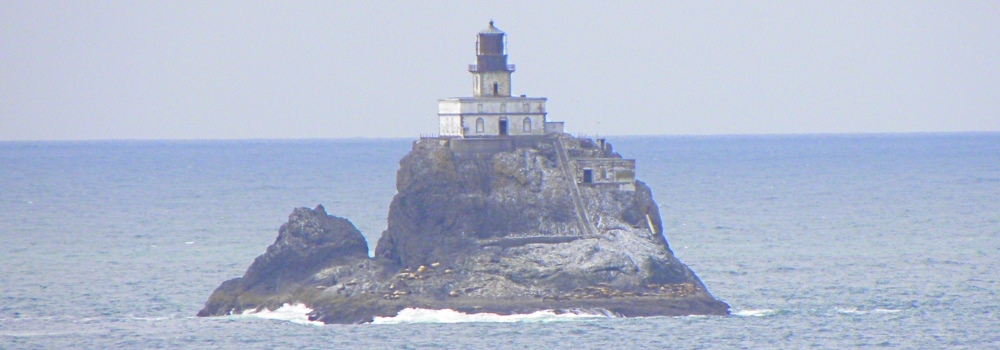
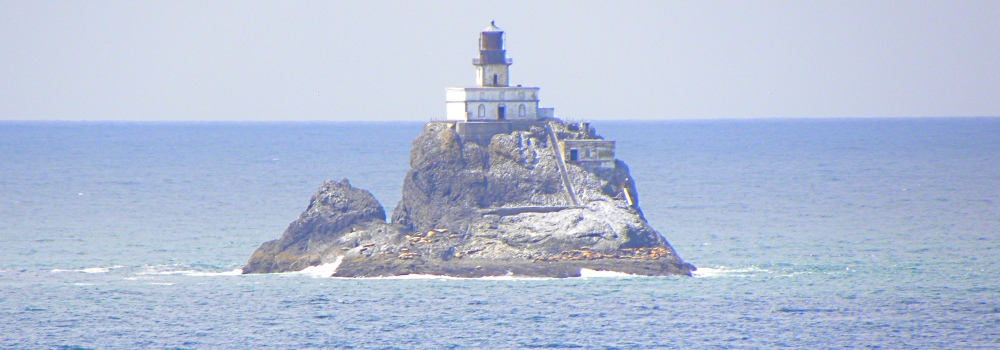
The structure at Tillamook Rock Light included an attached keepers quarter and a 62 foot tower that originally house a first order Fresnel lens with an incandescent oil vapor lamp. The light has a visibility range of 18 nautical miles or 21 miles.
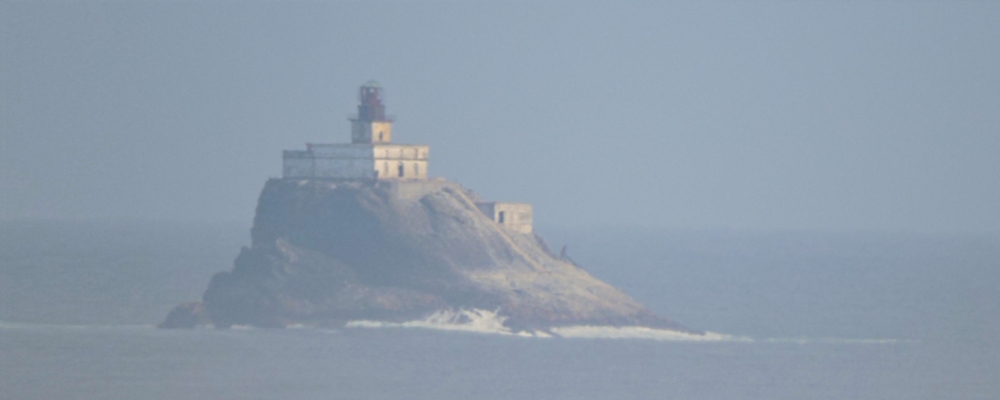
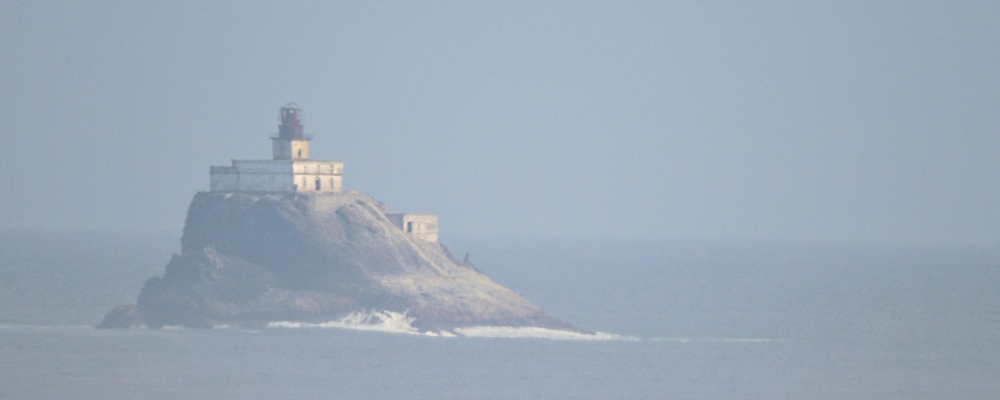
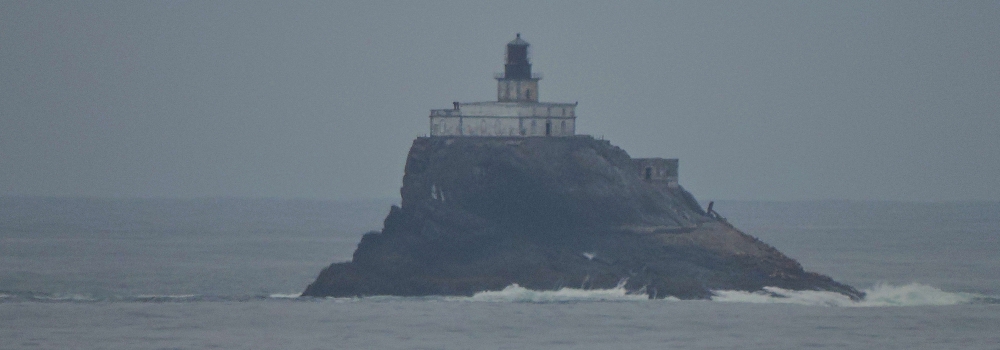
Tillamook Rock Light, known locally as Terrible Tilly or called by some, just Tilly is an offshore lighthouse in Oregon. It is located on a basalt rock about 1.2 miles offshore from Tillamook Head and sits about 20 miles south of the mouth of the Columbia river.
The US Congress commissioned the construction in 1878, construction began in 1880, and took over 500 days to complete.
During the beginning of January 1881, when the Tillamook Rock Light was nearing completion, the barque Lupatia was wrecked near the rock during inclement weather. The Lupatia, a British bark (a three masted square-rigged ship), bound for Portland after making the long crossing from Hiogo, Japan, which on 03 January 1881 wrecked at Tillamook Head just three weeks before the Light began operation. The Lupatia sank killing the 16 crew members, twelve of which were found by the lighthouse workers the next day on the beach. There was one survivor from the Lupatia, the ship′s dog, an Australian shepherd, found the next morning on the beach near the bodies of the crew, exhausted from swimming ashore in the strong currents and frigid water.
Operating this Light proved to be one with the worst weather conditions and the most dangerous commute for both the keepers and the suppliers.
After the decommission of this Light, the structure has been used as a Columbarium until its license was revoked in 1999. Today, it remains privately owned and is not available for access.

(m4light-or-tillamook-tilly)
Photo Credit: Library of Congress
Tillamook Rock Light, c. 1881
History of the Construction
After congress commissioned the Light, a survey was done but the initial assessment determined that access to Tillamook Rock was severely limited if not impossible. The surveyor H. S. Wheeler was ordered to continue and during his second assessment, he was able to land on the rock but unable to move his equipment onto the rock. He made due with the use of a tape line to make a preliminary survey in early 1879.
He returned with that initial survey which stated that considerable blasting would need to be done to make a smooth place atop the rock before a foundation could be laid and that the lighthouse would prove to be far to expensive and difficult than anticipated.
In September 1879, a third survey was ordered, headed by John Trewavas. When he arrived at the Tillamook Rock, he was swept into the sea when attempting to land. His body was never recovered.
Then, in October 1879, Charles Ballantyne was next to attempt the construction with the first four workmen to land on the rock with supplies and a temporary shelter. Other supplies and workmen were transferred to the rock by means of a line run from the mast of the Corwin to the rock.
The conditions for work were miserable but the workmen succeeded to blast the top of the rock to make a suitable place to put the foundation, and in May 1880, a derrick was constructed for transporting men, supplies, building materials and stone for construction of the lighthouse.
Once the foundation was installed, atop the foundation was built the keepers, a one-story housing structure measuring 48 feet by 45 feet. In the middle of the housing structure, a square 35 foot brick tower was next constructed and finally, built at the top of the tower, an eight foot high lantern was installed to house the lighthouse lens.
The Tillamook Rock Light was completed in January 1881 at a cost of almost $125,000 and at the time was the most expensive west coast lighthouse ever built.
The Keepers
Duty at Tillamook Light was difficult even at the best of times and the keepers were completely isolated from the mainland even though they could see the lights in the nearby towns on the mainland. The head keepers that were assigned to the station during the nearly seventy-seven years the light was lit were only four in number, but there were others who served with the head keepers because a crew of four was kept on the rock to care for the needs of the ocean besieged stone building and to maintain the ever so important beam of light that flashed out from atop that rock.
The first head keeper at Tillamook Rock Light was Albert Roeder but he was only on the rock for four months.
Other keepers include: William Dahlgren (1901-1919), Robert Gerloff (1903-1928), George Wheeler (1929-1952). Also, on 1945, James Gibbs arrived at Tillamook Rock and served as keeper for just one year and from his short time on the rock, he later wrote a book called Tillamook Rock in which he relates his experiences aboard the station.
When his tour was over, he wrote, "I somehow knew I was going to miss the natural surroundings; the untamed, changing seascape and the moods of weather. Above all, I would miss the ocean, a capricious destroyer yet a thing of beauty."
The last keeper, Oswald Allik who began serving on the Rock in the late 1930s was the keeper who switched off the light in 1957 and ended the operation of one of the most expensive Lights ever in the history of west coast lighthouses. Oswald Allik was then assigned to the Heceta Head Light where he served until 20 July 1963 as the last keeper of that Light as well.
On September 1, 1957, the US Coast Guard closed the Tillamook Rock Light for ever, which was by then the most expensive lighthouse in the country to maintain, and had been made obsolete by modern radar and communications technologies.
The Storms
The weather at Tillamook Rock Light was often very inclement, with storms pounding the lighthouse so hard that the windows were eventually cemented over and replaced with small portholes. Sometimes, the storm winds would reach more than a hundred miles and hour.
Some of the storms severely damaged the Light or its facility. A storm in 1897 cut the newly installed phone cable. A storm in 1912 tore away 100 tons of the western side of the rock.
In October 1934, severe damage was done to the lighthouse a storm by large boulders that were pitched into the lighthouse. During that storm, the lens was smashed, water poured into the station and the derrick was destroyed. The keepers eventually installed a temporary light. The station survived but the necessary repairs were not completed until nearly six months later at a cost of over $12,000.
|