|
The Salt Lake Desert is a large dry lake in northern Utah and is located between the Great Salt Lake and the Nevada border. It is a subregion of the larger Great Basin Desert, and noted for white evaporite Lake Bonneville salt deposits including the Bonneville Salt Flats. Following a railway completed across the desert at Bonneville Salt Flats in 1910, the flats were first used as a speedway in 1914. The world records for highest land speeds are regularly broken here at the salt flats.
There is several small mountain ranges which occupy the edges of this desert, such as the Cedar Mountains, Lakeside Mountains, Silver Island Mountains, Hogup Mountains, Grassy Mountains, and Newfoundland Mountains. Also, just across the state line in Nevada on the western edge of the desert, there is Pilot Peak in the Pilot Range.
Desert Climate
The Great Salt Lake Desert experiences a desert climate with hot summers and cold winters. The desert is an excellent example of a cold desert climate. The elevation of this desert is 4,250 feet above sea level, which makes temperatures cooler than the lower elevation deserts, such as the Mojave.
Due to the high elevation and aridity (extremely dry), temperatures drop sharply after sunset. Summer nights are comfortably cool. Winter daytime highs are generally above freezing, and winter nights are bitterly cold, with temperatures below freezing and often dropping into the negative number.
Most of the desert receives about 8 inches of annual precipitation, when including both rain and snow, even though snowfall is quite rare.
and includes unusual plants adapted to the dry conditions
Great Salt Lake
The Great Salt Lake is the largest saltwater lake in the Western Hemisphere and the eighth-largest terminal lake in the world. It lies in the northern part of the state of Utah and has a substantial impact upon the local climate, particularly through lake-effect snow. It is a remnant of
Ta-Maschilamek Menuppek, now know as Lake Bonneville, a prehistoric body of water that covered much of western Utah.
The surface area of Salt Lake can fluctuate substantially due to its low average depth of 16 feet. In the 1980s, the surface area of the lake reached a historic high covering about 3,300 square miles, and at that time, the West Desert Pumping Project was established to mitigate flooding by pumping water from the lake into the nearby desert.
In 2021, after years of sustained drought and increased water diversion upstream of the lake, the surface fell to its lowest recorded area at 950 square miles, even below the previous low set in 1963.
Salt Lake Desert Information:
Total Size:
21,500 square miles
Primary Drainage:
Bear river, Jordan river, Weber River
Biome:
Xeric hypersaline flats, endorheic basin
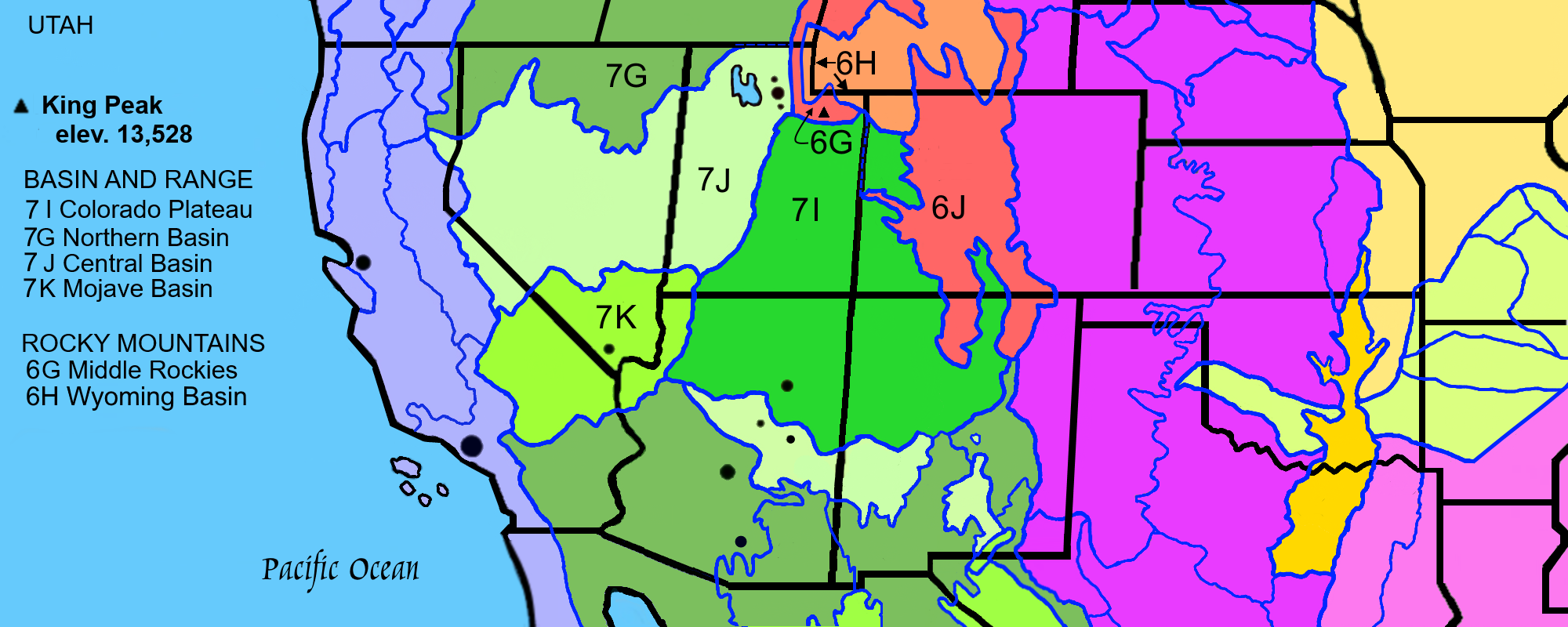
(m2cont-nam-00-utah) Basin and Range Region: Central Basin Ecoregion, Utah
Salt Lake Desert: Utah
Location:
Geographical Region:
Basin and Range
|