|

|
|
|

|

|
|
The First Migration: The Algonquian People
|
|
|
The
Path of Joktan


|
|
Joktan, Elisheva his wife, their thirteen sons and their son′s families, upon leaving the area known today as Mesopotamia, then proceeded to accomplish something that no one had yet ever done before, that is to journey across a vast uncharted region of the Earth, known today as the continent of
Asia.
Furthermore, this family was the first to migrate across a land bridge, which according to the claims of this world′s
wise men, occurred during the close of what they call the last glacial period, or what is more commonly referred to as the
Last Ice Age, which claim, methinks is totally suspect.
Nonetheless, that land bridge, also known as
Beringia did become exposed above sea level, methinks, owing to the increasing amounts of ice accumulating at the poles, which event, slowly over the course of many years resulted in the lowering of ocean levels in as much as two, three or possibly four hundred feet. Thus, with the lowering of the sea level, this would likely had contributed to the ever expanding shore line, and the eventual increasing of the Beringia land area to as much as one or two hundred miles in width.
Despite any contrary opinions, this first migration of the ancient wayfarers, across the land bridge did occur. Yes, these first wayfarers did arrive onto the North American continent and subsequently traveled inland through the many areas of the continent, continued to as far east as the eastern coast lands.
Furthermore, the people of this first migration are believed to have ultimately spread throughout the entire western hemisphere and today, these same people are those who are the modern Native American Cultures living on the North American Continent and which are known today as the Algonquian cultures.
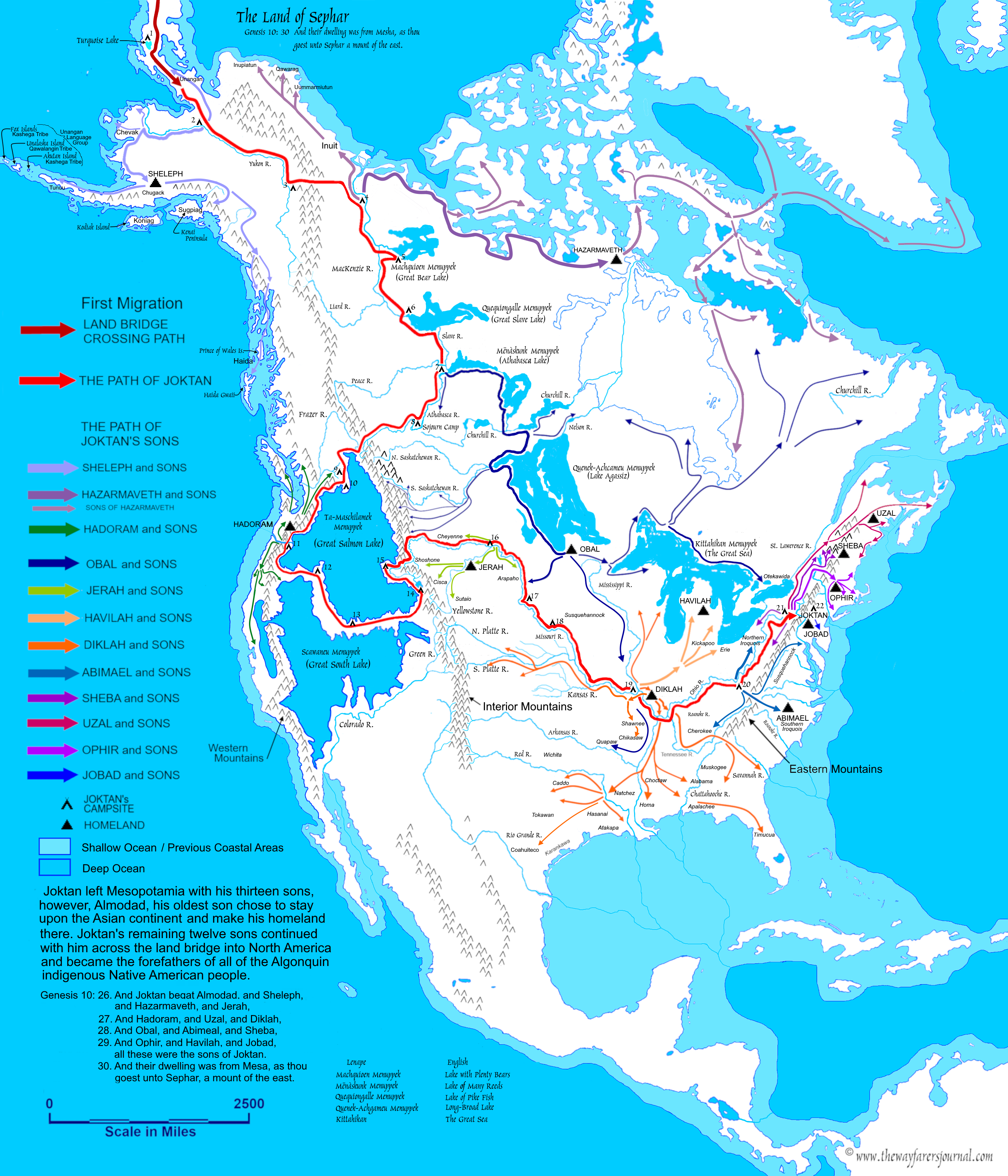
(m0-maps-2026-0814.1200) The First Migration, the Algonquian Map
Upon considering the above map, notice how the Beringia land area, as well as all of the North American continent might have looked like during the time of the first migration. Notice that on this map, you will see pale blue coastal areas which today are the coastal shallow tidal region, most of which remain less than two hundred feet deep, and most likely would have been part of the land area of the North American continent when the elevation of the oceans were much lower.
|
| |
|
The Algonquian People:
The First Born
|
|
|
Almodad, the Firstborn
Long before Joktan and his multi-generational family caravan have reached the eastern coast of the land now known as Asia, Joktan′s firstborn, Almodad, approaches Joktan one evening at the fire of gathering, to inform his father that when the morning call to prepare for Journey On was sounded, that he and his family will not be joining the caravan, but, instead will remain behind and search this land for a suitable location to call their homeland. Joktan then replied that instead of the planned departure in the morning, He, and the entire family will not depart, but will instead remain at this campsite so that all of the many people may have opportunity to bid Almodad and his family farewell.
So, for several days, all of the nation, each separate family, consisting of Almodad′s brothers, his sisters, his nephews, his nieces, even their grandchildren, would approach Almodad′s camp in order to bid a fond farewell to Almodad, to his wife Zeruiah, and to the many sons and daughters of Almodad and Zeruiah.
Then, Almodad, his wife and all of their children, the entire tribe, depart from Joktan, and from Elisheva, the wife of Joktan, mother of Almodad, and from all of the siblings of Almodad, and all of his sibling′s families so that they may depart their family and settle in the area now known as the
East Asia continent.
Then, when the last words of farewell had been said, then Joktan, kissed his firstborn son Almodad farewell, kissed Zeruiah, Almodad′s wife farewell, kissed all of their sons and daughters farewell, knowing well that they would likely never see each other again until God restores the Paradise. After that fond farewell, Joktan then departed from that camp, resumed his journey across the northernmost bridge of land and continued down into the new continent, a grand and beautiful land.
Almodad was Joktan′s firstborn, but he departed before the crossing of Berigia, making his homeland instead upon the southern coastal areas of the
Asian Continent.
Stories have been told that Almodad had many sons and grandsons; and this people became many nations, tribes, and clans of indigenous people throughout all of Southeast Asia; in the lands from Australia to Japan and from Polynesia and New Guinea to Indian and quite likely China and much more.
We can only hope that when the day arrives when the Most High God returns the People of God to a restored Paradise, that we will be their to hear all of their stories.
|
| |
|
The Algonquian People:
The Journey On
|
|
|
Subsequent to the departure of Almodad, Joktan and his family, a large nation of people begin their journey across the then Beringia land bridge, stopping first at a pristine turquoise lake, which has, on the north edge, multiple hot springs. Following an extended stay here, the nation continues eastward, unbeknownst to them at the time, onto what will later become known as the North American continent.
During this nation′s Journey On, what lies ahead on the pathway are: a large land mass with vast heavily forested wilderness areas are replete with all manner of game animals; a land intersected with mighty waterways, all of which are teeming with large fish; and a landscape so diverse that it pales in comparison to all they have forwent. As the journey continues afoot, at various times, another of Joktan′s sons would choose to depart from his father so as to select a homeland location or to travel on a different pathway in search of one. Each time another of his sons chooses to depart company from their father and mother, Joktan would then sound out the call to Cease from the Journey On, and thus, the entire nation would make camp and remain encamped for the next several weeks in order that Joktan and Elisheva, before any such parting occurs, could spend an extended time period with that soon to be outbound son and his family.
Joktan calls for the Ceease from the Journey On because he knew that when any of his sons would choose to leave the main contingent and to walk upon a path different than his own, it was likely that this would be the last time that he would see that son, neither the wife of his son, nor any and all of those who were his grandsons and granddaughters.
Thus, Joktan would announce to the entire nation, that this camp will not be one that he will leaving soon, but be a camp where at he would continue to camp here for many days in order that he can spent time with the outgoing son as well as with all of that son′s family, give them each one last goodbye, and most importantly, so that Joktan will have the opportunity to sit by the fire of gathering with these of his grandsons and great grandsons in order to tell them the stories that were told to him by Joktan′s great-great grandfather, Shem, who spoke to Joktan The Words of the Story Keepers.
The Words of the
Story Keepers
Thus, at the end of each day, after the evening fires were set aflame, Joktan would send his invite to all of his family, but especially the grandchildren to meet him at the fire of gathering and there to listen to the words he would speak.
Thus, each evening, when all of the family of Joktan had come together at the fire of gathering, he would begin with speaking the words: "Long ago, Shem asked my older brother and myself to enter his tent and take a seat, and then said to both of us, ‘The God of the Heavens, the True God, whose name is Yehoweh came to me in a dream last night to tell me who I am to choose to be the next Story Keeper.’"
Joktan continued, "Shem said that God had told him that he should choose both of the sons of Eber because God will send each of these two sons to a land of his choosing, but each in separate directions to different homelands where these two sons of Eber, the one being Peleg and the other being his brother Joktan shall be the Story Keeper to the people there in that one′s homeland. Shem then told Peleg that he was to travel to the West all the way to the land by the sea to make his homeland there; and then he told me, Joktan that I was to make my way East to an ocean, then North to a bridge of land which I must cross and afterwards search the land on the opposite side for a homeland for myself and each of my sons who accompany me."
Joktan would then continue speaking the words of the Story Keeper to his sons and their families: Yes, the most high God is the one who commissioned me to tell the story of our people, and that He gave me the assignment to carry on the work of Story Keeper and commanded me and told me that I must continue to tell all the people the words until I am no longer able to walk over the mountain.
Then, Joktan would say, The words of the Story Keeper begins with the Story of Seth, whose story begins: "Many Moons ago, there was only endless space wherein dwelt Elanàn′tuwit, God the great spirit. Nothing else existed and everywhere there was silence. However, Elanàn′tuwit, whose name is Yëhohshu′à had abundant joy and immeasurable peace."
In this manner, Joktan continued speaking until he had completed The Story of Seth, and only then would he begin the next one, the Story of Lamech, and in like manner, the Story of Shem and when those three stories were spoken, Joktan finally would continues with his story, until the entire account of the Story Keeper was spoken to this large gathering of his family. Each evening, all of them came to the fire of gathering to hear and learn the entire story of the Story Keeper, all of the stories, from the Story of Seth down to this present day, which was the Story of Joktan.
Once each of his sons had left upon their own life journey, then Joktan would continue upon his Journey On and move even further into the land they had been traveling across, until that day when each and every one of the twelve sons had chosen a homeland. Then, when his youngest son had chose his homeland, Joktan would set up his campfire not too far away.
Algonquian Homelands
Joktan fathered thirteen sons, twelve of who came with Joktan when he crossed the Bering Sea land bridge with the intent to find a suitable location to settle and raise their families.
The native Americans who have the ancestry of Algonquian are those who settled in a variety of places on the North American continent. Historically, these people were prominent along the Atlantic Coast, from New Brunswick, Prince Edward Island, Nova Scotia and New England to as far south as the Carolinas. Further they spread along the coast and into the interior of Quebec, Newfoundland, Ontario and up to Hudson Bay. Parts of Alberta, Saskatchewan, and all of Manitoba provided home for them.
Many settled around the Great Lakes, along the Ohio and Mississippi rivers. Some of these natives settled in area now known as Michigan, western Ontario, Wisconsin, Minnesota, and North Dakota. Other tribes lived in present day Wyoming, Colorado, southwestern Nebraska, northwestern Kansas and north central Montana.
Yes, the Algonquian peoples were widespread and numerous across the North American continent for an untold number of moons, even long before other wayfarers arrive in subsequent migrations (the
Second Migration and the
Third Migration) across the land bridge.
Migration from Eastern Lands
At a much later date, the indigenous people witnessed from across xahèli kitahikàn kchinkwehëlak (the great ocean of the sunrise), the arrival of never before seen immense wind driven ships.
This is when the first Europeans arrived on the shores of North America in ships, two of what were then known as a Caravel, a medium size ship from that era which had a single-deck, three masts, square rigging wooden ship, which displaced some sixty tons, had an 18 foot bean and had a 56 foot deck length. The third ship although a larger ship, known as a carrack (or nao) was also considered a medium size ship having one deck with raised structure at the bow (forcastle) and stern (sterncastle), three masts, square rigging, displaced about 108 tons, an 18 foot beam, but had a 58 foot deck length. This third ship served as the flagship and carried the commanding officer of the fleet of the three ships.
Those three ships, carrying the first Europeans, arrived upon the eastern shores of North America after crossing the Atlantic ocean and subsequently became instrumental in beginning a large scale migration across that ocean, of these Caucasian people from the lands known today to be the homeland of the Sons of Japheth (Genesis 10:1). Further, these three ships were soon after followed by many more ships which people began to build their homeland. These new migrants then began to fight for their new homelands with weaponry far greater than anything the Algonquian peoples could even imagine, which caused the indigenous people to begin their long retreat toward the western areas of the continent.
Too, due to the fact that these Sons of Japheth had developed such great weaponry, the war was won quickly and then all of those left of the Algonquian Peoples were required to vacate their established homelands and forced to travel during heinous and horrific set of conditions to lands considered uninhabitable by the Sons of Japheth, lands located in the
interior lowlands region, known today as Oklahoma.
Algonquian Today
The word Algonquian is used today to describe a large group of separately recognized tribes of indigenous people, but also includes a larger group of people who are related culturally and linguistically, which people form the larger Algic language grouping.
Many of the Algonquian language people call themselves Anishnabe, which means original person. Referring to an original person would mean in their language that these are those people who left Mesopotamia and were the first people to journey east in search of a suitable homeland, and the first people who came across the land bridge into North America.
Further, these are the people, all of which include the many tribes and languages which are descendants of the Sons of Joktan, who was the Son of Eber, Son of Salah, Son of Arphaxad, Son of Shem, who was Noah′s Son.
|
| |
|
The Algonquian People:
Sheleph Unangax̂
|
|
|
Sheleph′s Homeland
Yes, in fact, upon arriving at what is now known as the Yukon River and making camp upon its banks for the night (see campsite #2), it is during the first evening in this camp, that Sheleph and his wife approach their parents and tell them that they have discussed the matter and both have agreed that it is from this campsite where all of their family will depart from the nation, and from here, begin their separate path in this new land. Sheleph speaks to his father Joktan and mother Elisheva saying: "This river is overflowing with large fish, and the forests are abundant with large animals, many of which we have already enjoyed at our cook fire. In fact, we would be amiss if we do not continue here in this intensely forested land along this turquoise river and here search for the perfect location which region will become a permanent homeland for us, our children and all of theirs for generations to come.
Therefore, Joktan, stays here in this camp for nearly two weeks along the bank of this heavily forested river, while he bestows upon Sheleph, his wife and their sons and daughters and even some grandchildren, every one, well wishes to follow them during their search for a homeland.
After Joktan packs out to continue upriver towards the distance mountains, only then do Sheleph and his family travel downriver, then west to the coast of what is now known as western Alaska.
Sheleph had six sons. He and his sons move both northward and southward along the coast, even along what is now known as the coastal lands of Alaskan, Canadian and Russian until he comes upon a place where he finally settles.
Sheleph then calls his homeland by the name of his first born son, Unangam and Sheleph is to become the father of those known as today as the Aleutian indigenous peoples and who speak all speak the Unangax̂ language and/or its several dialects. Even to this day, this area is still referred to as the Aleutian peninsula.
|
| |
|
The Algonquian People:
Hazarmaveth
|
|
|
Hazarmaveth′s Homeland
Joktan and all the nation, when the leave camp three, a river camp, cross over a low pass to the eastern side of the mountains and begin their descent to the river valley below. After only a few days of travel, the nation arrives at another large river (now known as the MacKensie River), turn southward along the west bank and begin walking upstream. In just a short distance, Joktan sends out a call to all the tribes to stop and make camp along this river.
After camping for two days here, Hazarmaveth is the next son to approach Joktan, to inform his father that he and his wife have chooses to depart the nation so that his family may, instead of following the river south upstream with the nation, may walk north to locate the coast towards the north. When Hazarmaveth decides to turn southeast, some of his sons, who speak the Inuit language decide to journey northwest along that coast and soon after that find a suitable location for their homeland.
Later, as Hazarmaveth continues to the southeast, he camps along a large bay and decides to make this his home. Some time after that, his son, Inuitut leaves and settles on an island he calls Inuktitut island after one of his younger sons, which island name is later changed to Baffin Island. These later came to be known as the eastern Eskimo indigenous people.
With Hazarmaveth now moving away from the camp, Joktan with his remaining sons, packs out of that camp and travel southeast, following rivers upstream most of the way
Thus, Joktan and his remaining sons continue southeast along a wide river and lakes for a long period.
Sons of Hazarmaveth
Hazarmaveth had fifteen sons
Inuit Language
Alaskan Inuit:
Iñupiaq Language
1. Qawaraq
2. Inupiatun
3. Uummarmiutun
Canadian Inuit (Western):
Inuvialuktun Language
4. Siglitun
5. Inuinnaqtun
6. Natsilingmiutut
Canadian Inuit (Eastern):
Inuktitut Language
7. Nunatsaivummiutut,
8. Nunavimmiutitut
Baffin Inuit:
9. Qikiqtaaluk,
10. Qikqtaaluk
Nunavut Inuit:
11. Aivilimmiutut
12. Kivarrirmiutut
Greenlandic Inuit:
Kalaallisut Language
13. Kalaallisut
14. Tunumiisut
15. Inukutn
|
| |
|
The Algonquian People:
Obal
|
|
|
Obal′s Homeland
At one lake, which has been named Yutalizahelihitkuk, Joktan makes camp between two rivers and is planning to take the second waterway upriver upon the morrow towards the mountians. Here while in this camp, his son Obal approaches Joktan to tell him that he will not be leaving upriver with Joktan but wants to stay here in these well watered lowlands to continue fishing from the multitude of lakes.
When Obal departs from the camp, he moves further to the southeast along the lowland lakes region, in an area with an immense forest along a large lake, one with much game in the forest and big fish in the lake. Here, his descendants become the primary homeland for those who today are know as the Algic language people.
Sons of Obal
Obal had fourteen sons.
Siouan Nation
Western Missouri Valley Tribes
Crow (Apsáalooke)
North Central InteriorTribes
Anisinaabeg,
Anicinàpek,
Anishinaabe,
Chippewa, Ojibwa, Salteaux
Innu:
Montagnais: Eastern and Central
Nataskinan: Atikamekw, Naskapi
Eastern:
East Cree, Moose Cree, Eastern Swampy Cree
Western:
Woodland Cree, Rocky Cree, Western Swampy
Plains Cree:
Hochunk: Chiwere, Ioway, Oto, Misuria, Winnebago
Gros Ventre
Naskapi
Sauk
10. Siskai or Siksikai′tsitapi
(The People)
North Lower Interior Tribes
(Great Sioux Tribe)
11. Ochethi Sakowiŋ
(French: Sioux)
a. Dakota:
Thíhuŋwaŋ (Eastern Santee)
Dakhodiapi, Dakhota
Mdewakantonwan (MN), Sisitonwan (Siseton, SD),
Wahpetonwan, Wahpekute
b. Lakota:
Bdewákaŋthuŋwaŋ (Teton Division)
Titunwan
Northern:
Hunkpapa,
Sihasapa (Blackfoot-Sioux) Not the same as Algonquian Blackfeet.
Central:
Itazipcola (Sans Arc), Mniniconjou, O′ohenounpa (Two Kettles)
Southern:
Oglala, Sicangu
c. Nakota:
Iháŋkthuŋwaŋna(Western Dakota)
Ihanktonway (Yankton), Ihanktonwana (Yanktonai)
Bearspaw, Chiniki, Wesley (Goodstoney)
Stoney (CAN), Assiniboine (MT, CAN)
Southeastern Interior Siouan Tribes
12. Catawba
(Virginian Siouan)
Catawba, Ofo, Tutelo, Saponi, Woccon, Waccamaw
Occaneechi, Manahoac, Monacan, Cheraw
Waxhaw, Congaree, Sugaree, Shakore, Keyauwee, Sewee
13. Dhegiha
(ancient Ha´ke tribe)
Chiwere, Kansa, Osage, Omaha, Ponca,
Quapaw
14. Biloxi
Tanêks-ya (First People) Extinct Language
Tunica-Biloxi, (Avoyelles Parish, Louisiana)
Biloxi, Tunica, Mosopelea (Ofo, Ofogulua), Avoyel
|
| |
|
The Algonquian People:
Hadoram
|
|
|
Joktan Turns Southwest
After camping there between the rivers for some time, Joktan then leaves the flat lowlands lakes region and began walking upriver, southwest back towards the mountains that previously have been contiguous in the west but now there appears to be a large gap in the mountains in this direction.
As he follows this river upstream towards the mountains which route takes him to a low pass across the mountains and down the other side towards a very large lake far below.
Joktan travels down from the gap and along the shores of Ta-Maschilamek Menuppek (Great Salmon Lake) where the nation continues to travel southeast and in time came upon another mountain range, They would make camp along the lake each day, fishing daily for the large fish from this lake and after nearly two moons, the caravan comes upon the outlet of this large lake.
Upon their arrival at this lake, they found it to be teaming with a large fish that was similar to the trout that they have previously become accustom to, but these were not trout. Catching the fishing was easy, and the fish only take a short time on the fire before they can enjoy a meal. At one point in their travel around this lake, there was a great earthquake, after which the lake began to flow into a fissure under the mountains and in time, the fissure grew into a large tunnel flowing under the mountains at that locatuon.
When Joktan and his family arrive at the outlet to the lake, a lake they were now calling Ta-Maschilamek Menuppek, which in English means Not-Trout Lake, the entire nation crossed over a huge earthen bridge that was standing above the tunnel.
After the people had all cross over the river, Joktan calls out for the entire nation to stop along side the lake outlet and make camp. Here, the people while enjoying a great feast of fresh fish, they gave much thought about this lake and the river that was now flowing out of it directly under the mountain and this gave cause for them to give thanks and praise to the most high God who created this place of rest and abundant food.

Sons of Hadoram
Hadoram had twelve sons.
1. Alsea (Alsean language): Coosan, Siuslaw
2. Chinook (Chinookan language):
Lower Chinook, Catsop, Upper Chinook, Kathlamet,
Multnomah, Watlala, Wasci-Wishram, Willapa, Wahkiakum, [Tchinouk]
3. Kalapuya (Kalapuyan language coast): Kalapuya, Yoncalla
4. Maidu (Maiduan language): Maidu, Chico, Konkow, Nisenan
5. Salish (Salishan language coastal): Chehalis, Chimakum, Cowichan,
Cowlitz, Duwamish, Esquimalt, Halalt, Homalco, Klallam, K′omoks,
Klahoose, Lamalcha, Lummi, Lyackson, Muckleshoot, Musqueam,
Nisqually, Nooksack, Penelakut, Pentlatch, Puyallup, Qayqayt,
Quileute
Saanich, Samish, Sauk-Suiattle (Southern and Northern Lusshootseed)
Sawhewamish, Scia′new. Semianmoo, Shishalh, Siletz, Skagits,
Shoalwater Bay Tribe, Skokomish, Sliammon, Snaw-naw-as, Snohomish,
Snokomish, Snoqualmie, Snuneymuxw, Songhees, Squamish, Squaxin,
Stillaguamish, Stolo, Stz′uminus, Sul′axbixw, Suquamish, Swinomish,
Tsawwassen, Tsleil-Waututh, T′Sou-ke, Tulalip, Xacuabs
Wakashan: Ditidaht, Haisla, Heiltsuk, Huu-ay-aht,
Makah, Nuu-chah-nulth,
Nutka, Oowekyala, Pacheedaht
7. Tsimshian (Tsimshianic language): Tsimshian Coast, Tsimshian Southern,
Gitksan, Nisgaa
8. Wiyot (Wiyot language): Wiyot, Wishosk, Soulatluk, Yurok
9. Wintu (Wintuan language): Wintu, Nomlaki, Patwin
10. Yokuts (Yokuts language): Choinumni, Chukchansi, Gashowu, Hometwoli,
Keechyi, Lakisamni, Merced, Palewyami, Tachi, Wukchumni
11.
Utia: (Utian Language)
Miwok,
Ohlone,
Costanoa,
Mutsun
3. Kalapuya (Kalapuyan language (plateau):
Klamath, Kalapuya, Kootenai, Yahooskin
Modoc, Molala, Santiam, Kathmath
5. Salish (Salishan language interior):
Chelan, Coeur d′Alene, Columbia, Colville, Entiat, Flathead,
Kootenai, Lake, Lillooet, Methow, Nespelem, Okanagan,
Pend Oreille (Kalispel), Sanpoil, Shuswap, Sinkaietk,
Sinkayuse, Spokane, Thompson River, Wenatchee
12. Saptin (Sahaptin language):
Cayuse, Cowlitz, Dock-spus, Kittitas, Klickitat, Lower Snake,
Molalla, Nez Perce, Palus, Skinpah, Tenino, Tygh, Umatilla,
Walla Walla, Wanapum, Warm Springs, Wasco, Wyam, Yakima
|
| |
|
The Algonquian People:
Jerah
|
|
|
The Lake Camps
Joktan and the nation, began to move west again across the isthmus of land making camp several times as the the people fished each day. At the camps, most of the fish was cleaned, salted, air dried and then slow smoked to preserve the meat it for when the people left this lake.
It was here at this camp when this earthen bridge came to be called, Taiachquoan Ju Eluwantowit (The Bridge from God).
Upon Leaving camp at The Bridge from God
When the call came to break camp Joktan lead the way across to the eastern side of the lake, then he continues eastward towards the mountains in the distance. Rocky Mountains, across the interior of the continent and finally into the Appalachian Mountains. Along his path, some Sons departed from this route and remained in the region of the upper Missouri river, other Sons traveled down the Mississippi valley to the lower coastal plains, other Sons departed and traveled to the interior lowland to areas below the Great Lakes.
However, his four youngest sons waited until arriving in the mountains in the eastern parts of the continent and then spread out from there into the southern and the northern parts of the Appalachian Mountains. Finally, Joktan and his youngest son, Jobad settled in the area along the river that Jobad named the Lenapei Sipu, (meaning River of the Original People) and this area latter came to be called the Lenapehoking.
Eventually, these first wayfarers spread out through the eastern parts of this continent and developed into a variety of cultures. Of these, the cultures included the Algonquian speaking people.
Sons of Jerah
Jerah had five sons.
North Central Interior Region Tribes
|
| |
|
The Algonquian People:
Havilah
|
|
|
Sons of Havilah
Havilah had ten sons.
Lower Great Lakes Region
1. Illinois
2. Kickapoo
3. Meskwaki (Fox)
4. Maumee
5. Miami
6. Menomini
7. Odawa
8. Ojibwe
9. Potawatomi
10. Sauk (Fauk)
|
| |
|
The Algonquian People:
Diklah
|
|
|
Sons of Diklah
Diklah had thirteen sons.
Inland Southwest Gulf Coastal Plains:
South Texas Coast, Northcentral & Northeast Mexico
1. Coahuilteco (Coahuiltecan):
Comecrudan: Pacal, Pajalat, Pakawa, Orejon, Quems,
Quepano, Tamaulipecan, Xarames
Karankawa: (Karankawan) Coapites, Cocos, Copanes, Cujanes,
Kopano, Kohani, Coca
Tonkawa: (Tonkawan) Aranma, Cava, Cantona, Emet, Ervipiame,
Mayeyes, Payaya, Sana, Toho, Tohaha, Yojaune
Western Gulf Coast Coastal Plains:
Eastern Atacapa:
Hiyekite Ishak (The People of the Sunrise)
Louisiana
Atadapa Tribes:
(Alligator Band), (Snake Band), (Heron Band),
Eastern Atacapa:Opelousas, Otse, Teche
Western Atacapa:
Hikike Ishak, (The People of the Sunset)
Texas
Atacapa Tribes:
Akokisa, Bidai, Deadose, Ordoquiza, Patiri, Tiacopsel,
Western Inland Gulf Coastal Plains:
Kansas, Nebraska, Texas, Arkansas, Oklahoma, Louisiana
Northern Caddoan:
Nebraska
Caddoan Tribes:
Arikara,
Pawnee, Kichai, Wichita
Kansas
Caddoan Tribes:
Akwits, Taovaya, Tawakoni,
Kitsai, Wichita
Southern Caddoan:
Arkansas
Caddoan Tribes:
Cahinnio, Kadohadacho, Tula
Louisiana
Caddoan Tribes:
Adai, Doustioni, Kadohadacho,
Natchitoches,
Ouachita, Yatasi
Oklahoma
Caddoan Tribes:
Kadohadacho, Hasinai, Hainai, Anadarco (Nadaco), Nebedache
Cahinnio, Yatasi
Texas
Caddoan Tribes:
Adai, Eyeish, Hainai, Hasinai, Kadohadacho (Cadodacho), Nabedache,
Nabiti, Nacagdoche, Nacono, Nadaco, Nanatshho, Nasoni,
Natchitoches,
Neche, Nechaui, Flechazo, Panimaha, Peti Caddo (Petacado),
Taovayas, Tawakoni-Quiscat, Tuacana, Yscanis, Waco
Western Inland Gulf Coastal Plains
Mississippi River Valley Plains Ecoregions:
Arkansas
Tunica Tribes:
Coligua, Calpista, Palisema, Tutilcoya, Utainague, Anoixi, Quipana, Tanico
Aminoya, Taquanate, Tutilpinco, Anilco,
Louisiana
Tunica Tribes:
Avoyel (Avoyelles), Biloxi (Yoron), Koroa, Tioux
Yazoo,
Mississippi
Tunica Tribes:
Tunica (Tonica, Tonnica, Thonnica), Chakchiuma
Casqui, Pacaha, Aquijo, Quizquiz, Quigate,
Inland Eastern Gulf Coastal Plains:
Eastern Muskogean:
Alabama
Muskoge Tribes:
Alabama, Koasati, Natchez, Mikasukis, Taensa (Tensas
Western Muskogean:
Mississippi
Muskoge Tribes:
Acolapissa, Chickasaw,
Choctaw (or Chahta), Chacato
Southeast Gulf Coastal Plains:
Florida Panhandle:
Apalachicola, Aute, Ayubale, Bacica, Bacuqua,
Chatoto, Chacato, Chactoo, Chalot, Cupayca,
Ibitachuco, Iniahica, Orchete, Ocuia, Ospalaga, Patali,
Talimali, Talpatqui, Tomoli, Uzela, Yapalaga, Ychutafun, Yecambi
Inland Central Gulf Coastal Plains:
Alabama, Georgia, Mississippi, Tennessee, Florida (Hills and Valleys)
Alachua, Black, Miccosukee, Muklasa, Seminole
Mayaca, Jororos, Mayajuaca, Mayaimi, Mocoso,
Pensacola, Chatato, Pohoy,HItchiti
Tequesta
Western Gulf Coastal Plains:
Florida (Southern)
Jece Chiefdom,
Guacata, Jaega, Jece, Jobe, Oathaque, Surruque
Tekesta, Calusa
Alafaes, Alafaia, Elafay, Costa
Amacano, Caparaz, Chine, Pacara
Florida (Eastern)
Florida (Tampa Bay)
South Atlantic Coastal Plains:
Florida and Georgia
Acuera, Aqua Fresca, Arapaha, Ibi, Itafi, Mocama,
North Utina, Ocale, Oconi, Onatheagua, Osochi, Potano,
Tucururu, Utina, Yufera, Yustaga
Akoroa, Courouais, Koroa, Tioux, Yazoo,
Georgia (Savannah River), South Carolina
Yuchis, Cusabo
|
| |
|
The Algonquian People:
Abimeal
|
|
|
Sons of Abimael
Abimeal had fifteen sons.
Northern Iroquois Nations
1. Onondaga
Syracuse, New York
One of the Five Original Nations of the Iroquois Confederacy
2. Seneca
1. Seneca Nation (New York)
2. Tonawanda Band (New York)
3. Seneca-Cayuga Nation (Oklahoma)
4. Six Nations of the Grand River (Ontario, CAN)
One of the Five Original Nations of the Iroquois Confederacy
3 Mohawk
Mohawks of Kahnawa:ke (Quebec, Canada)
Mohaak Council of Akwesasne (Ontario/Quebec and New York)
Saint Regis Mohawk Tribe (Hogansburg, New York)
Mohawks of the Bay of Quinte (Ontario, Canada)
Mohawks of Kanesatake (Quebec, Canada)
Six Nations of the Grand River (Ontario, Canada)
One of the Five Original Nations of the Iroquois Confederacy
4. Oneida
Lower Cayuga (Ontario)
Upper Cayuga (Ontario)
Seneca-Cayuga (New York and Oklahoma)
One of the Five Original Nations of the Iroquois Confederacy
5. Cayaga
Otekawidan
One of the Five Original Nations of the Iroquois Confederacy
6. Erie (Erielhonan)
Assimilated into Seneca and other tribes
Extinct as of mid 1600s
7. Wendat (French: Huron)
Canadian Huronian, Wendat, Wyandot,
Attignawantan, Attigneenongnahac, Arendarhonon, Tahontaenrat
Tionontati (Petun)
8. Stadaconan (St. Laurence Iroquians, or Laurentian)
Distinct Language group on St. Laurence
Assimilated into Mohawk and Huron tribes
9. Attawandaron
(French: Nuetral)
Aondironon, Ongniaahraronon, Wenrehronon
10. Wenro (Wenrohronon)
Wyandotte Nation (Oklahoma)
Southern Iroquois Nations
The Cherokee Nation (1794-1907, Oklahoma)
Eastern Band of Cherokee Indians (North Carolina)
United Keetoowah Band of Cherokee Indians (Oklahoma)
12. Meherrin
Weapemeoc: Pasquotank (Paspatank), Perquimanas, Poteskeet, Yeopin
Chowanocs: Chawanoke, Machapunga, Moratuc
Pamouik, Aauascogok, Secotan, Pomelooc
Roanokee, Croatoan, Dasamonqueponke
Neusiok: Coree, Coharie
13. Nottoway (extinct language)
Upper Nottoway (Cheroenhaka)
Nansemond, Pamunkey, Patawomek, Rappahannock,
Mangoak
14. Susquehannock
Conestoga, Minguas, Andaste, Nanticoke, Accawmacke
Powhattan: Pamunkey, Mattaponi, Chickahominy, Nansemond,
Rappahonnock, Moratoc
Chesepiooc, Cheasapeake, Chowanoke
Now extinct as a tribe
15. Tuscarora
Chickahominy: Upper Chickahominy
Mattaponi: Upper Mattaponi
Pomuik (Pamlico), Coree, Bay River
Croatan, Hatteras, Machapunga
Nansemond, Neusiok
|
| |
|
The Algonquian People:
Sheba
|
|
|
Sons of Sheba
Sheba had four sons.
Northeast Inland
2. Mahican
4. Sokoki
|
| |
|
The Algonquian People:
Uzal
|
|
|
Sons of Uzal
Uzal had six sons.
Upper Northeast Coastal Atlantic
1. Maliseet (Wolastoqiyik)
2. Micmac
3. Mi′kaq (Mi′kmaq)
4. Passamaquoddy
5. Penobscot
6. Beothuks
|
| |
|
The Algonquian People:
Ophir
|
|
|
Sons of Ophir
Ophir had seven sons.
Middle Northeast Atlantic
1. Mohegan
2. Narraganset
3. Pennacook
4. Pequot
5. Quiripi
6. Wampanoag
7. Wopanaak
|
| |
|
The Algonquian People:
Jobad
|
|
|
Sons of Jobad
Jobad had three sons.
Lower Northeast Atlantic
Delaware Nation (autonym:
Lenape)
1. Munsee:
Minisink, Navasink, Raritan, Hackensack, Rockaway,
Canarsee, Tappan, Wiechquaeskeck, Rechgawawank,
Sinsink, Nochpeem, Wappenger, Esopus
2. Unami:
Sewapois, Siconese, Naraticonck, Mantaes, Armewarmex,
3. Unalachitgo:
Atsayonch, Remkoki, Sankhikan
|
| |
| |
|
To go back to the Gallery Index, click on down arrow.
|
|
|
Thank you for visiting
The Wayƒarers Journal.
| |
See Ya above the Treeline!
| |
This Page Last Updated: 31 October 2026
|
|
|
|
To continue to the next Episode Level page,
Click here

|
|
| |



