|
Mojave Information:
The Mojave Desert is a xeric (very dry) desert in the rain shadow of the Sierra Nevada mountains in the Southwestern United States and is located in southeast California, southwest Nevada, with small portions extending into Arizona and Utah. This desert is named for the indigenous Mojave people, who are a
Uto-Aztecan language people of the Cochimí family group.
Geography
The Mojave Desert displays typical basin and range topography, generally having a pattern of a series of parallel mountain ranges and valleys. The Mojave Desert contains various silver, tungsten, iron and gold deposits. It is also the site of Death Valley, which is the lowest elevation in North America. The Mojave Desert is often colloquially called the high desert, as most of it lies between 2,000 and 4,000 feet in elevation.
The Mojave Desert, together with the Sonoran, Chihuahuan, and Great Basin deserts, forms a larger North American Desert. Of these, the Mojave is the smallest and driest. The Mojave Desert is bordered to the west by the Sierra Nevada mountain range and the California montane chaparral and woodlands, and to the south and east by the Sonoran Desert. The boundaries to the east of the Mojave Desert are less distinctive than the other boundaries because there is no presence of an indicator species, such as the Joshua tree (Yucca brevifolia), which is endemic to the Mojave Desert.
Flora
The Mojave Desert is distinguished from the Sonoran Desert and other deserts adjacent to it by its warm temperate climate, as well as flora and fauna such as ironwood (Olneya tesota), blue Palo Verde (Parkinsonia florida), chuparosa (Justicia californica), spiny menodora (Menodora spinescens), desert senna (Cassia armata), California dalea (Psorothamnus arborescens), and goldenhead (Acamptopappus shockleyi). Along with these other factors, these plants differentiate the Mojave from the nearby Sonoran desert.
Fauna
The Mojave Desert has 50 mammal species, more than 200 bird species, 36 reptile species, 3 spedies of amphibians and 3 species of fish. Also, there are numererous species of insect and arachinids.
Species in the Mojave Desert include:
bats,
Bighorn sheep,
black-tailed jackrabbits,
burrowing owls,
coyote,
desert tortoise,
giant desert hairy scorpion,
gila monster,
greater roadrunner,
mountain lion,
mule deer,
pupfish,
white-tailed antelope squirrel
Biome:
The Mojave is a high, xeric (very dry) desert shrubland.
Drainage:
Primary: Colorado river
Secondary: Mojave river
Total Size:
47,877 square miles
Size of Mojave Desert in Utah:
About 3,000 square miles
Location:
The Mojave Desert is located within the rain shadow of the Sierra Nevada mountains in the Southwestern United States found in southeast California, southwest Nevada, with small portions extending into northwest Arizona and southwest Utah
Geographical Region:
Basin and Range
Ecoregion: 2K
Mojave Basin
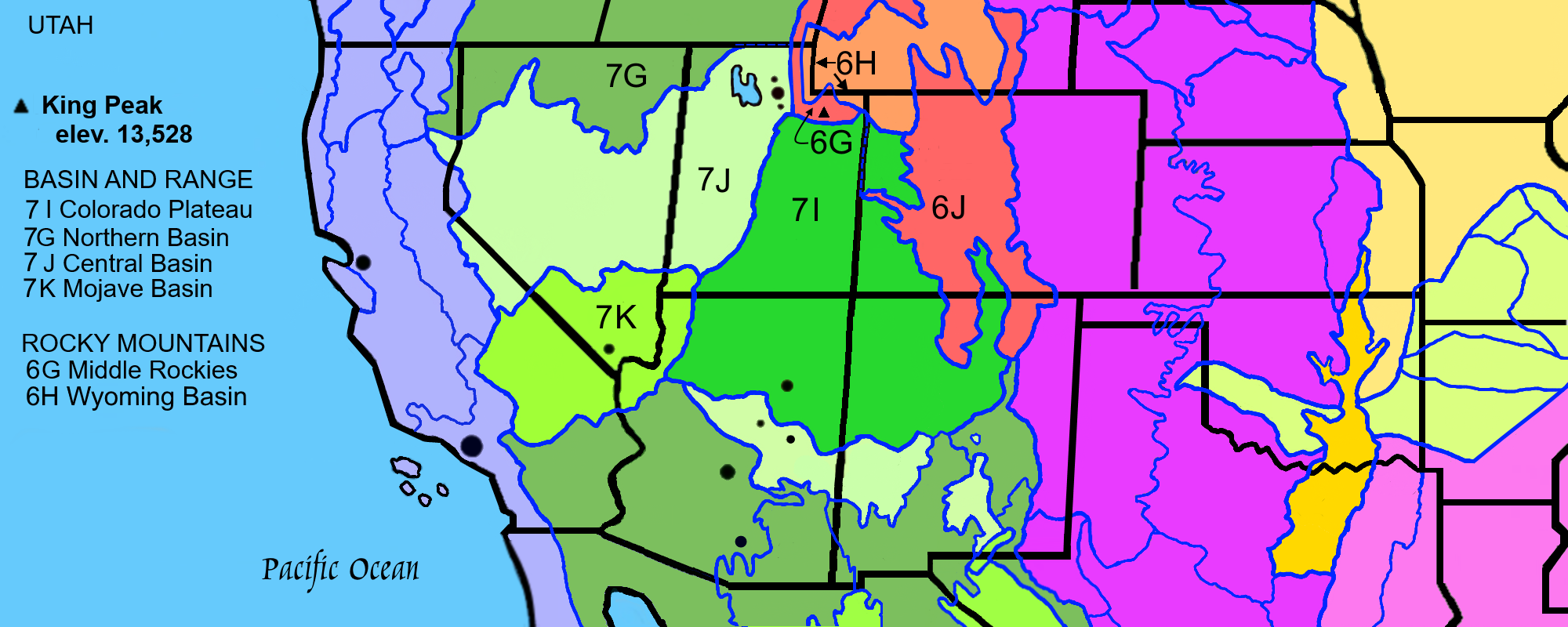
(m2cont-nam-00-Utah) Basin and Range Region: Mojave Basin Ecoregion, Utah
|