|
When traveling through the scattered cactus and mesquite of the desert southwestern United States, it is difficult to believe that this almost treeless ecosystem are home to a species of woodpeckers. Nevertheless, the Ladder-backed woodpecker, once known as the cactus woodpecker is attracted to this region. Like most other woodpeckers the ladder-backed woodpecker bores into tree-trunks with its chisel-like bill to hunt for insects and their larva, but it also feeds on fruit produced by cacti. Other ecosystems where these woodpeckers can be found are pinyon pine and pinyon-juniper forests.
Like other small birds of arid habitats, the Ladder-backed woodpecker can be quite inconspicuous, extremely quite, and thus require time and patience to spot.
Ladder-backed woodpeckers nest in cavities excavated from tree trunks, or when in more arid environments a large cactus works well too. The female lays between 2 and 7 eggs, which are plain white. The eggs are incubated by both sexes, but the nesting period and other details are unknown.
The ladder-backed woodpecker is a non-migratory species and is found year-round in its native range, which extends from southwestern United States to Central America. However, some populations may move short distances within their range in response to changes in food availability or to avoid harsh weather conditions. The range of this woodpecker has expanded in recent years as a result of human-mediated habitat changes, including the planting of mesquite trees and the expansion of deserts and brushlands.
Thus, this woodpecker is considered as a distinctive and important bird species that plays a roll in controlling inside populations. Despite its small size and weight, the Ladder-backed woodpecker is a valuable species for both ecological and aesthetic reasons.
Taxonomy:
Kingdom:
Animalia
Phylum:
Chordata
Class:
Aves
Order:
Piciformes
Family:
Picidae
Genus:
Dryobates (Picoides)
Species:
scalaris
Common Name:
Ladder-backed Woodpecker
Conservation Status:
LC
Subspecies:
D. s. cactophilus
Description
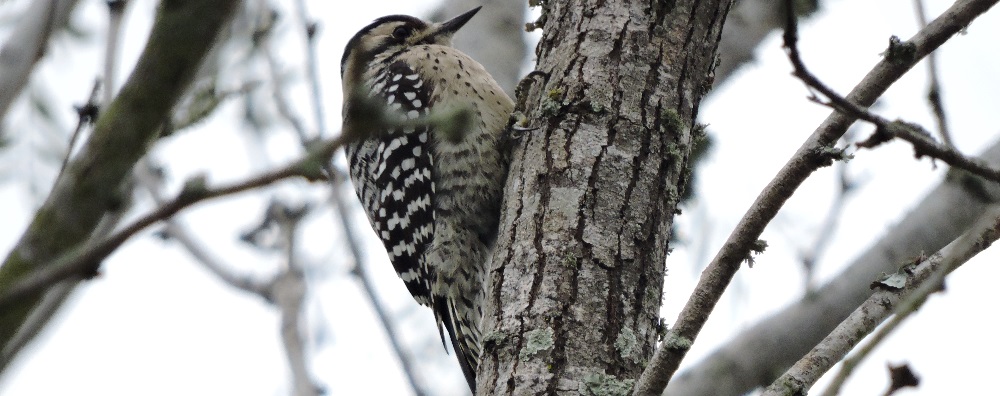
The ladder-backed woodpecker is a small woodpecker about 6 1/2 to 7 1/2 inches (16.5 to 19 cm ) in length. It is primarily colored black and white, with a barred pattern on its back and wings resembling the rungs of a ladder. Its rump is speckled with black, as are its cream-colored underparts on the breast and flanks. Southern populations have duskier buff breasts and distinctly smaller bills. Off-white face and underparts, narrow black cheek stripe and black side spots. The male has a red cap. No wing patch.
The ladder-backed woodpecker is very similar in appearance to Nuttall′s woodpecker, but has much less black on its head and upper back, and the range of the two species only intersects a minimal amount in southern California and northern Baja California. Hybrids are known.
Length:
6 1/2 - 7 1/2 inches (16 - 19 cm)
Wingspan:
12-13 inches (33 cm)
Weight:
0.7 - 1.7 ounces (21 - 48 grams)
Male:
Adult males have a red crown patch that extends from the eye to the back of the head.
Female:
Red crown patch is lacking in females but they has a buff patch in front of the eye
Juvenile:
Red crown patch is smaller in immatures.
First Year:
Habitat:
The ladder-backed woodpecker is fairly common in dry brushy areas and thickets throughout its rather large range. Widespread in desert cactus, brush, woods and towns. Forages in trees, shrubs cactus and on the ground.
It inhabits both
mesic and
xeric habitats, but it favors the latter, which include mesquite brush lands and riparian woodlands. It also frequents urban parks and suburban areas, especially where there are lots of backyard suet feeders.
Range:
The golden-fronted woodpecker is found year-round over the southwestern United States, from southwestern Oklahoma through central Texas, north to extreme southern Nevada and extreme southeastern Colorado, and south onto the Mexican Plateau as far as Jalisco, San Luis Potosí, and Hidalgo. It is a casual visitor to New Mexico and East Texas, and has been recorded once each in Michigan and Florida.
The species can be found year-round over the southwestern United States (north to extreme southern Nevada and extreme southeastern Colorado), most of Mexico, and locally in Central America as far south as Nicaragua.
Numerous in west and north Texas, New Mexico, Arizona and south California.
Migration (spring and fall):
Breeding (summer):
The golden-fronted woodpecker usually remains paired year-round, and is territorial even outside the nesting season. In Texas it breeds between March and July, and often produces two broods per year. Both sexes excavate the nest cavity in the trunk or limb of a tree, both live and dead trees. It also sometimes uses utility poles, fence posts, and nest boxes. The cavity is usually between 7 and 30 feet (2 and 9 meters) above the ground. Most clutches are of four or five eggs, and both sexes incubate. The incubation period is 12 to 14 days and fledging occurs about 30 days after hatch.
Winter:
All Year:
Habitat
Description
Texas State Parks
Falcon state park is in the region known as the World Birding Center which has about a dozen birding parks, including state parks. Close by to Falcon state park is a private wildlife refuge know as Salineño. Methinks, of all the birding parks in the region, this one offers the opportunity for seeing the greatest variety of tropical birds.
|