|
Great Basin Desert Information:
Description:
The term Great Basin is one that is applied not only to the desert of the same name but is most commonly defined by the hydrographic region. (A hydrographic region is an area that currently has or has in the past contained a single body of water.) However, the term Great Basin also describes numerous other physiographic aspects including: biomes (life communities), biologic (fauna), endorheic (internal contained watersheds), ecoregions (geographic), ethnographic (cultures), floristic (flora), typographical (land mass layout), and other terms.
The Great Basin Desert, however, is primarily defined by plant and animal communities, and the desert boundaries itself approximate the hydrographic Great Basin, however, the desert boundaries do not include the southern panhandle extension into the Mojave desert which the hydrographic basin does include.
The Great Basin Desert is located within the
Basin and Range geographical region, primarily in the area of the northern region of the North American Desert, (see map below) and which is characterized as a desert landscape having wide valleys bordered by parallel mountain ranges, which are generally oriented in the north-south direction. Within the Great Basin desert, there are more than 33 mountain peaks having summits higher than 9500 feet. Too, most of the valleys in this basin region have 3500 feet or higher elevations marking their bottommost elevations.
Biomes
Primary: Desert and xeric shrubland
Others: Alpine communities; Montane communities; Pinyon-Juniper communities; Riparian communities; Salt deserts; Shadescale-dominated saline basins; Lahontan and Tonopah playas; Lahontan salt shrub basin; Lahontan sagebrush slopes; Lahontan uplands; upper Humboldt plain, Carbonate sagebrush valleys; central Nevada high valleys; central Nevada mid-slope wood and brushlands; Central Nevada bald mountains; and the Tonopah basin
Fauna:
over 200 bird species
over 100 mammal species
Flora:
over 800 species
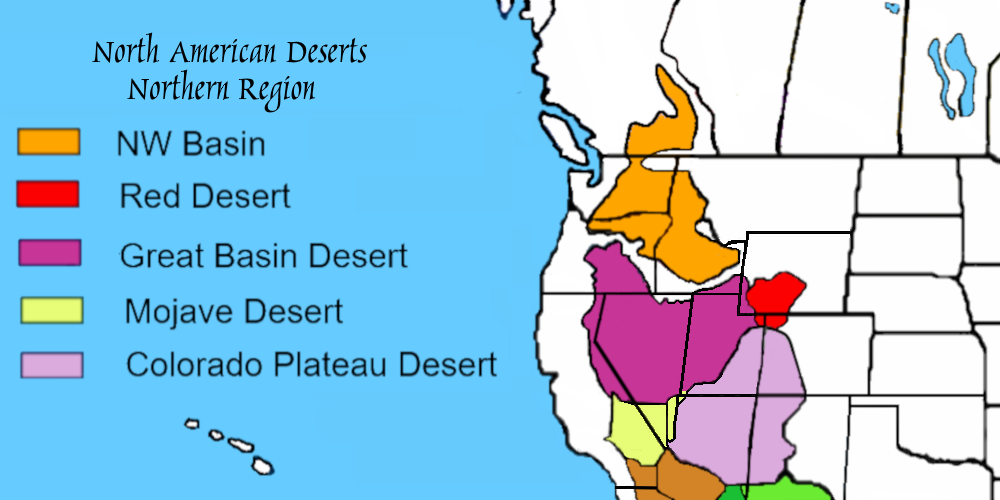
(m0-maps-deserts-north) Northern Region Deserts
Geography:
The Great Basin desert covers an arid expanse of about 190,000 square miles (492,000 square km) and is bordered by the Sierra Nevada range on the west in California, the Wasatch Mountains on the east along the Utah-Wyoming border, the Columbia Plateau, (which is also called the Northwest Basin) to the north, the Colorado Plateau desert to the southeast and the Mojave Desert on the south.
Hydrographic Region:
The Great Basin hydrographic region (see map below) is the largest area of contiguous endorheic watersheds in North America, which watershed has no outlet or connection to any ocean. It spans areas of southern Idaho, much of northwest Utah, nearly all of Nevada, areas in southwest Oregon, parts of both eastern and southern California and a small area in southwest Wyoming.
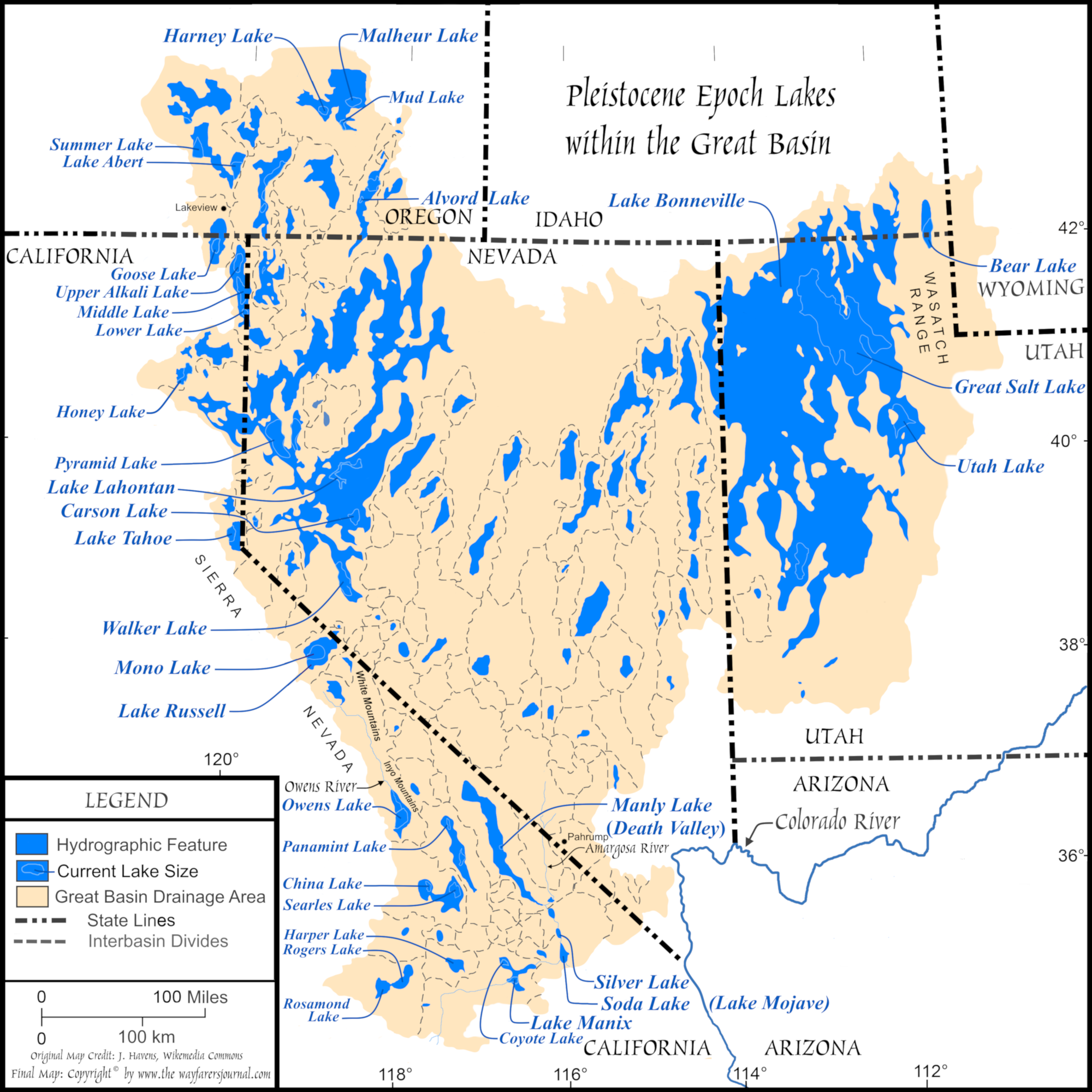
(m0-maps-greatbasin) Hydrographic Region
Although, what follows in the next section, is to be called the first migration, methinks that it may not have been the first migration due to the belief that there could have been many actual migrations both before and after what is herein called the first migration.
In order to have some kind of understanding of how the North American continent was populated by the indigenous peoples who had been here for centuries before the Europeans arrived, I will assume (a word I use cautiously), that the below First Migration was actually the first major migration so as to allow for other smaller migrations to occur simultaneously, before and/of after. Further, the Second and Third migrations also should be considered Major Migrations as well.
Thus, in doing so, I can now describe three separate well known and well documented migrations of people from that traveled from the continent of Asia to the then brand new North American frontier.
The First (Major) Migration
Sometime after 2200 BCE, when the first migration of the indigenous people onto this continent occurred, this region, known now as the Great Basin, was reported by those of that first migration, to have been completely under an inland sea. In fact, during that original migration from the Asian continent, Joktan and his sons, after crossing the Beringia land bridge and beginning their travels onto the North American continent, eventually came upon this large inland sea, an immense body of water which they called the
Great South Lake. In their travels, they had seen many large bodies of water, both on the Asian continent as well as in this new land after their crossing the northern land bridge. The reason why Joktan and his family called it the Great South lake, and not just the Great Lake, is because it was not the only large inland sea in the area. Truth be told, they had just circumnavigated another great sea just to the north of the Great South Lake, one which they had called the Great Salmon Lake.
Further, after circumnavigation the Great Salmon Lake, they were to arrive at the newly cutout passage which today is known as the Columbia River Gorge. However, at the time of their passage along and beside these two great seas, there still existed a remarkable land bridge, known by most all of these indigenous people from these lands as the
Bridge from God.
These people, who came to this continent to settle North America were the first to arrive, who traveled by foot, who carried their little ones on their shoulders, and who were searching for a place that could be the home for their descendants. This people as a nation are the ones who settled across this land, beginning from what is now known as Alaska into this continent, even along the east coast, as well as down throughout the interior all the way to the Gulf coastal regions. As they spread out, each tribe choose a homeland and there made that land their place to raise their families.
The Second (Major) Migrations
In not more than one hundred years after Joktan and his family, now known as the Algonquian indigenous people, settled North America, another migration begins. This second migration brought an entirely different family of travelers onto the North American scene. These too, became a nation of indigenous people, and it is these one who are now know as the Uto-Aztecan speaking indigenous people.
These indigenous people followed the same track as had the Algonquian, first leaving the Asian continent, then crossing the Beringia land bridge and then traveling down into the new continent until arriving at what still remained of the Great South Lake found by the previous Algonquian travelers, now arriving sometime around 2000 BCE to build their homes.
However, now, the Great Salmon Lake was completely drained and the large inland sea, know previously as the Great South Lake, had drained out over half of its waters. Still, this new group of settlers choose to begin building homes not far from the banks of this large lake, a lake which these new arrivals called in their language, Atezcati Cahuilla, which, in English translate roughly to means Lake of the People.
Thus, these new arrivals upon the scene began building their homes, mostly by stacking stones within the many overhanging cliffs within their homeland. These became what later was to be called by the moderns, the
Desert Cultures or more commonly called the Cliff Dwellers of the Colorado Plateau.
Now, however, of all of what they had accomplished during the centuries of their inhabitation, the only remains of those of the Uto-Aztecan speaking people are the stones that they had so marvelously stacked. Yes, we all know about these people are the ruins that were left behind. But where did the people who built them go?
There are all still here, still building homes for their families, still hunting for their meet and raising crops, but now, they are living their lives on the reservations that the invading European armies relegated them to live on. You can see my list of these people at:
Uto-Aztecan People Today, many of whom live from central Mexico througth Central America.
The Third (Major) Migration
Unbeknownst to anyone now, the actual time when this Third Migration occurred is lost in the millenniums that have afterwards proceeded without stopping. Methinks, it would have likely followed fast on the heals of those who had gone before, and most likely sometime before Shem dies in 1868 BCE, possibly even as early as 1950 BCE, just some fifty of fewer years after the Uto-Aztecan people arrive on the North American continent.
But, who were these people who traveled from Asia, across the the Beringia land bridge, down into and settling from Alaska, down along the Pacific coastal regions and even as far as the areas of the Great Basin region where at the time of their arrival, only
remnants of the Great South Lake remains. In fact, by the time these arrived, the area of the Great Basin was not much different that we see it today, an area where many of the previously large lakes have dried up from evaporation.
These people, this third migration, were those who were of the Athabascan speaking cultures, of which many of the moderns now believe were seven tribes, which developed into the severn cultures, which cultures are reflected in their presence to this day, including:
1. Deg Xit'an and the Holikachunk tribes who are believed to be the originators of all of the Athabaskan language groups.
2. The Yukon Cultures.
3. Canadian British Columbia cultures.
4. Canadian Eastern Cultures.
5. Canadian Northern Plains Cultures.
6. US Pacific Coast Cultures.
7. US Southern Cultures.
|