|
Genus Quercus
The genus quercus (Latin for Oak Tree) include more than 500 living species of Oak Trees. The genus quercus is native to the Northern Hemisphere, and includes deciduous and evergreen species. These species that have evergreen foliage are normally called Live Oaks. This term, live oak does not necessarily indicate the the different species with live oak in their name are closely related, just that they have evergreen foliage.
The fruit is a non-valved nut (usually containing one seed) called an acorn. The husk of the acorn in most oaks only forms a cup in which the nut sits. Other members of the family have fully enclosed nuts.
Southern Live Oak (Quercus virginiana)
The southern live oak is an evergreen oak tree endemic to the Southeastern United States. Though many other species are loosely called live oak, it is the southern live oak that is particularly iconic of the Old South. Many very large and old specimens of live oak can be found today in the Deep South region of the United States.
A large number of common names are used for this tree, including Virginia live oak, bay live oak, scrub live oak, plateau oak, plateau live oak, escarpment live oak, and Roble in Spanish. It is also often just called "live oak" within its native area, but the full name "southern live oak" helps to distinguish it from other live oaks, a general term for any evergreen species of oak.
Georgia, in 1937, designated the southern live oak as the official tree of the state.
Taxonomy:
There are several common names are used for this tree, including Virginia live oak, bay live oak, scrub live oak, plateau oak, plateau live oak, escarpment live oak, and roble, (the Spanish word for oak). It is also often just called live oak within its native area, but the full name southern live oak helps to distinguish it from other live oaks, a general term for any evergreen species of oak.
Kingdom:
Plantea
Phylum:
Angiosperm
Class:
Eudicotyledon
Clade:
Eudictos
Clade:
Rosids
Order:
Fagales
Family:
Fagaceae
Genus:
Quercus
Species:
Virginiana
Common Name:
Southern Live Oak
Conservation Status:
LC
Subspecies:
Q. virginiana fusiformis (Escarpment live oak)
Q. virginiana geminata (Sand live oak)
Q. virginiana minima (Dwarf live oak)
Description
Although live oaks retain their leaves nearly year-round, they are not true evergreens. Live oaks drop their leaves immediately before new leaves emerge in the spring. Occasionally, senescing (biological aging) leaves may turn yellow or contain brown spots in the winter, leading to the mistaken belief that the tree has oak wilt, whose symptoms typically occur in the summer. Defoliation of a live oak may occur sooner in marginal climates or in dry or cold winters.
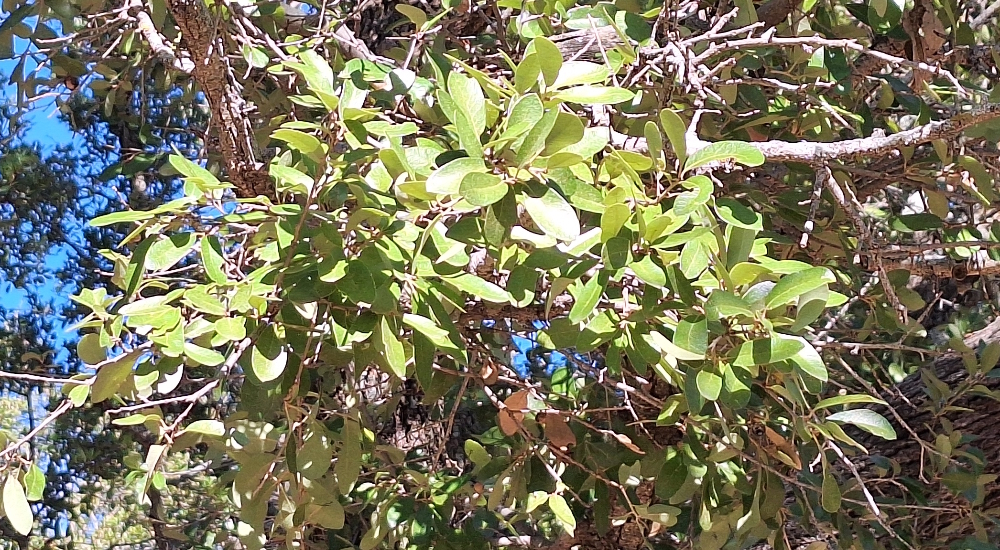
The bark is dark, thick, and furrowed longitudinally. The leaves are stiff and leathery, with the tops shiny dark green and the bottoms pale gray and very tightly tomentose (epidermal outgrowths of various kinds), simple and typically flattish with bony-opaque margins, with a length of 3/4 to 6 inches Long (2–15 centimetres) and a width of 3/8 to 2 inches (1–5 centermeters), borne alternately.
The male flowers are green hanging catkins (a slim, cylindrical flower cluster, or spike with inconspicuus of no petals) with lengths of 3 to 4 inches (7.5–10 centermeters). The acorns are small, from 3/8 to 1 inch long, (1–2.5 centermeters), oblong in shape (ovoid or oblong-ellipsoid), shiny and tan-brown to nearly black, often black at the tips, and borne singly or in clusters.
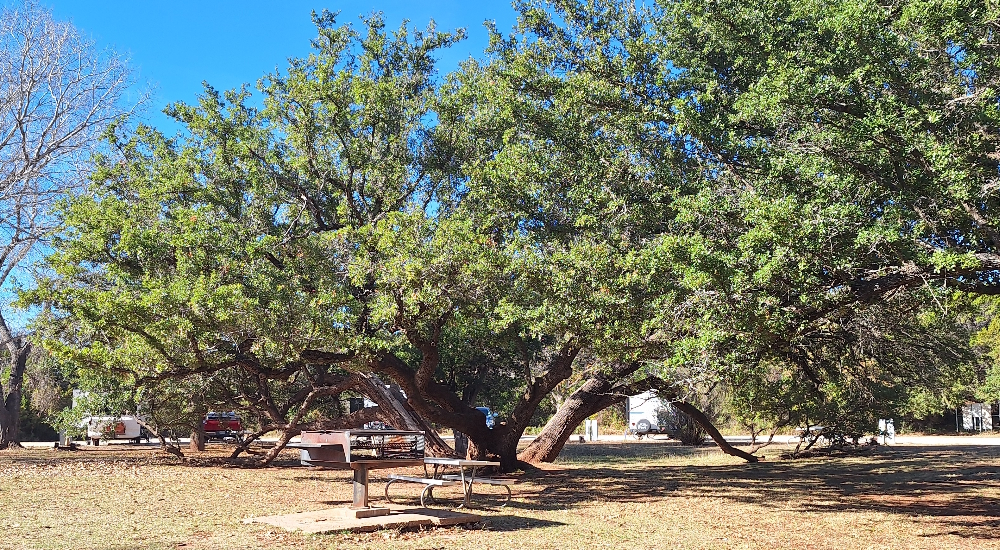
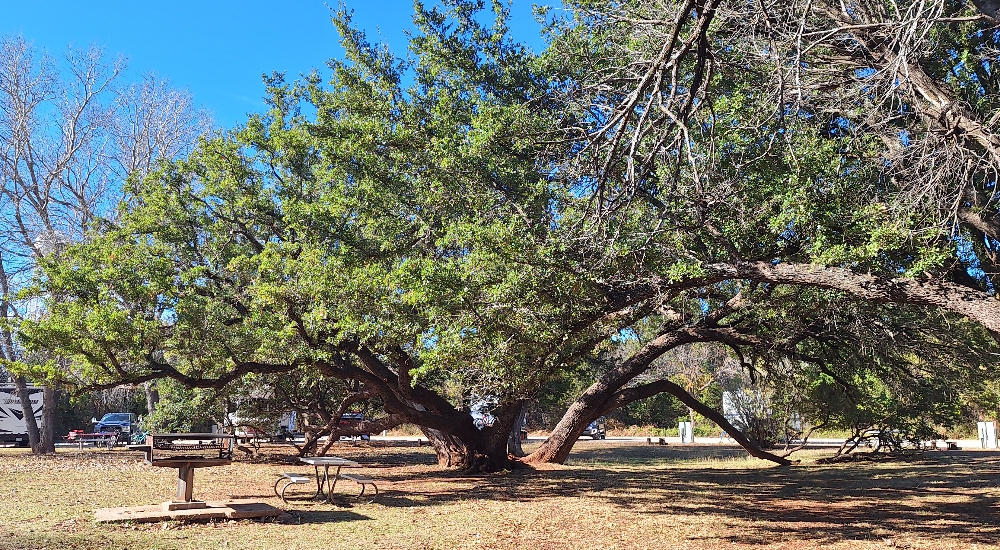
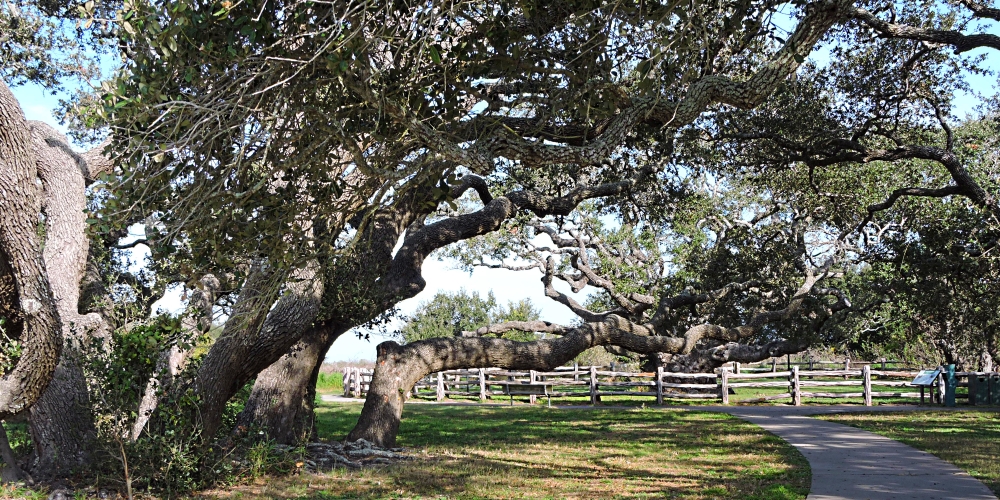
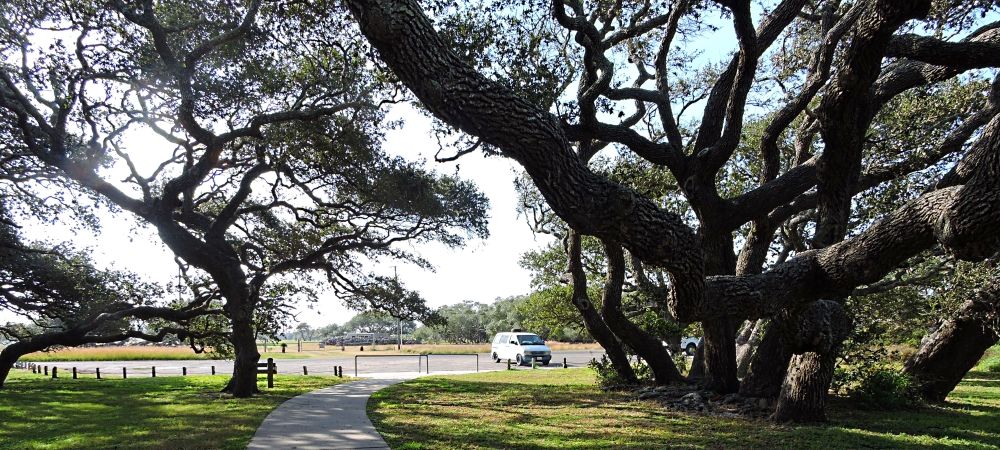
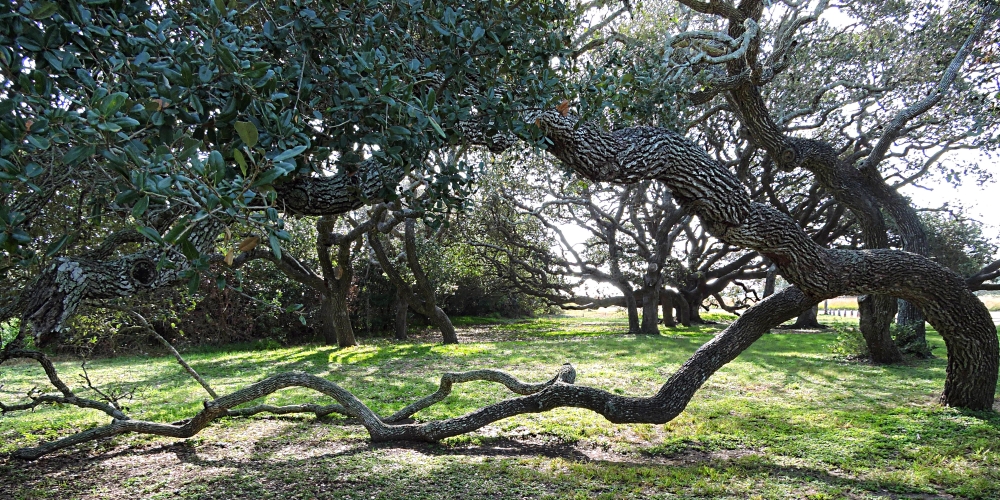
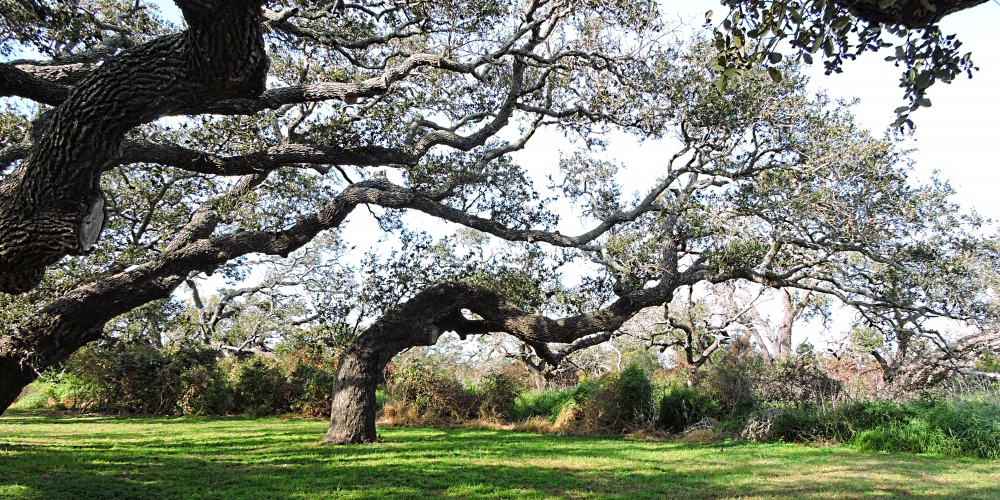
Depending on the growing conditions available, live oaks vary from a shrub-size to large and spreading tree-size. A typical open-grown tree grows to 66 feet in height (20 meters), with a limb spread of up to about 90 feet, nearly 27 meters. Their lower limbs often sweep down towards the ground before curving up again. They can grow at severe angles. It has been said that native Americans would bend saplings over so that they would grow at extreme angles, to serve as trail markers.
The root of the southern live oak is a deep taproot that anchors it when young and eventually develops into an extensive and widespread root system. This, along with its low center of gravity and other factors, makes the southern live oak extremely resistant to strong sustained winds, such as those seen in hurricanes.
Habitat:
Along the coastal plain of the Gulf of Mexico and south Atlantic United States, live oak is found in both single and mixed species forests, dotting the savannas, and as occasional clumps in the grasslands along the lower coastal plain. Live oak grows in soils ranging from heavy textures (clay loams), to sands with layers of organic materials or fine particles. Live oak can be found dominating some maritime forests, especially where fire periodicity and duration are limited. Live oak is found on higher topographic sites as well as hammocks in marshes and swamps. In general, southern live oak hugs the coastline and is rarely found more than 300 feet (90 meters) above sea level.
Live oaks grow across a wide range of sites with many moisture regimes, which range from dry to moist. Live oak will survive well on both dry sites and in wet areas, effectively handling short duration flooding if water is moving and drainage is good. Good soil drainage is a key resource component for sustained live oak growth. The usual precipitation range is from 25 to 65 inches of rain annually ( 650–1,650 millimetres), preferably in spring and summer with the soil pH usually acidic, ranging between pH of 5.5 and 6.5.
Range:
The live oak can be found in the wild growing and reproducing on the lower coastal plain of the Gulf of Mexico and lower East Coast of the United States. Its native range begins in southeast Virginia, and then continues south in a narrow band through North Carolina along the coast to the interior South Carolina coast, where its range begins to expand farther inland. The range of live oak continues to expand inland as it moves south, growing across southern Georgia and covering all of Florida south to the northernmost Florida Keys. Live oak grows along the Florida panhandle to Mobile Bay, then westward across the southernmost two tiers of counties in Mississippi. Live oak grows across the southern third of Louisiana, except for some barrier islands and scattered parts of the most southern parishes. The range of the live oak continues into Texas and narrows to hug the coast until just past Port Lavaca, Texas, where it expands inland through much of central Texas.
Outside of the US South, there are a few location where this species is found including most of central Texas, a small area in southwestern Oklahoma, the northernmost mountains in the Sierra Madre Oriental in Mexican states of Coahila, Nuevo Leon and Tamaulipas.
Famous Specimens
A live oak on Tyler Avenue in Annapolis, Maryland or one on Cherrywood Lane in Bowie, Maryland is the northernmost known mature specimen, although a number of saplings can be found growing around nearby Towson.
Multiple healthy young examples can be found in the Bolton Hill neighborhood of Baltimore.
Oak Alley Plantation , Vacherie, Louisiana (30.00428, -90.775933) 1839 CE, 186 years old
Oldest Specimens
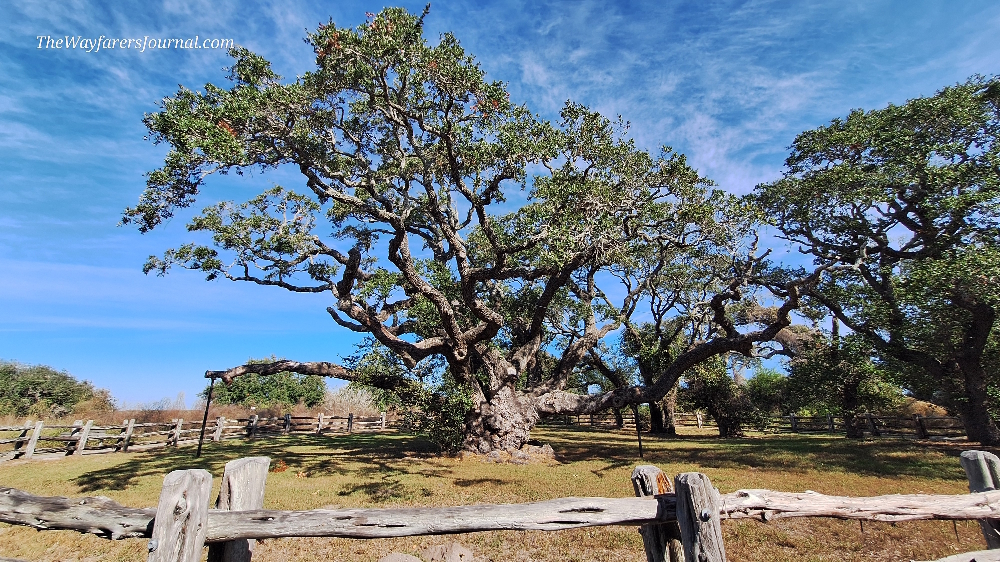
1,000 - 2000 Years Old
possibly the oldest extant live oak in the world
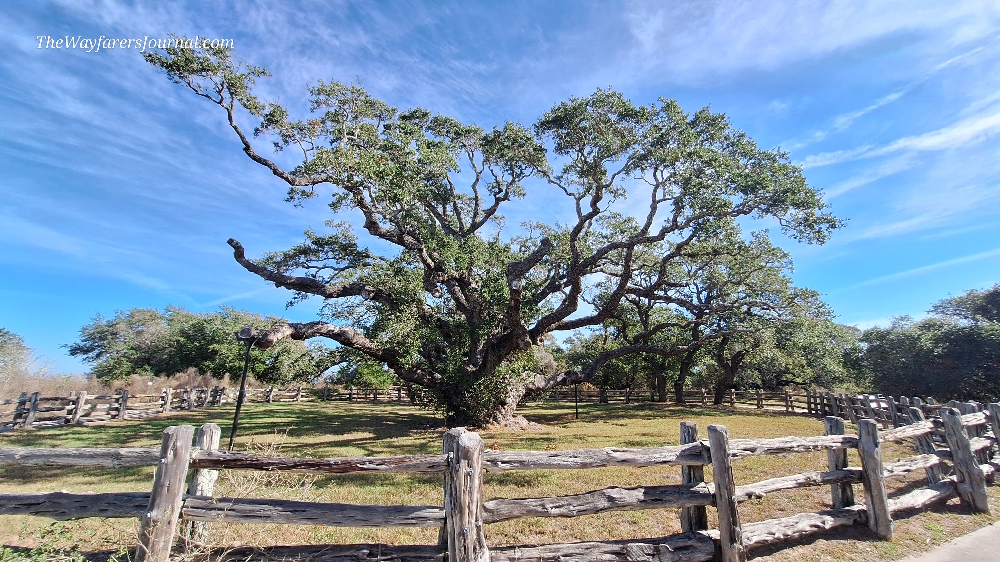
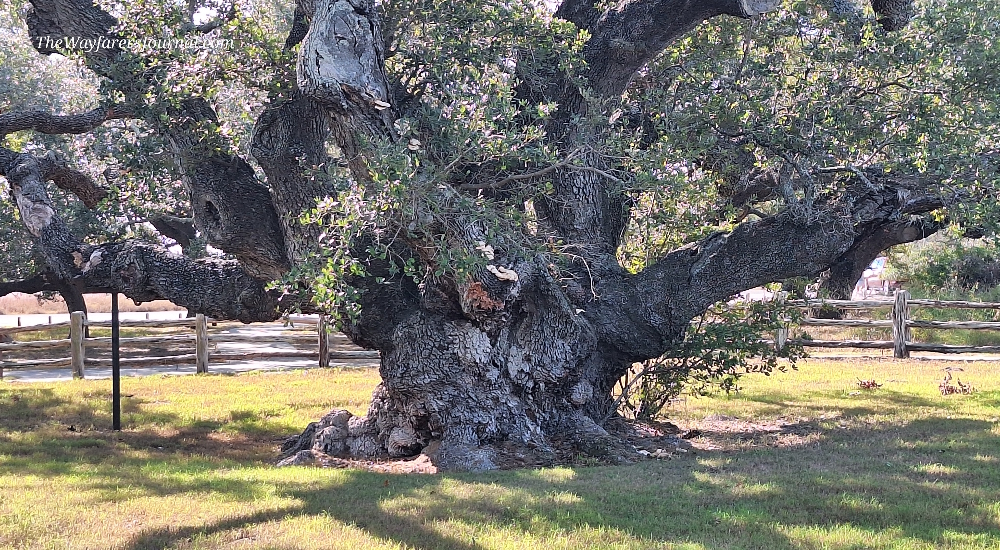
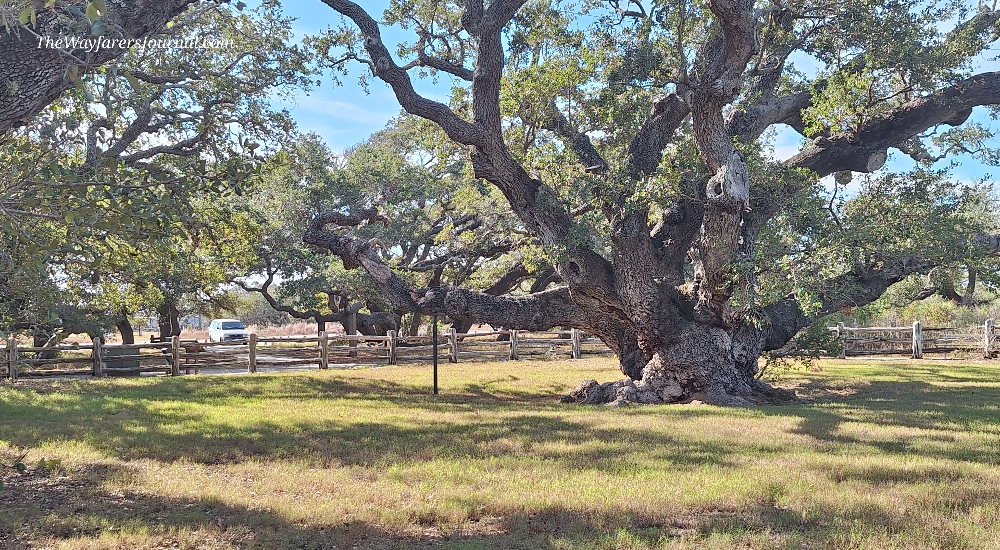
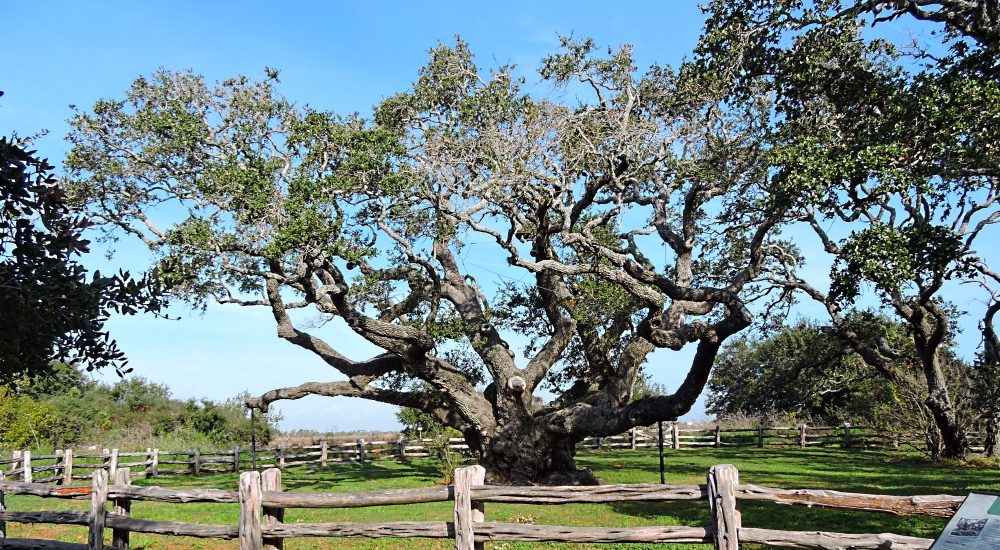
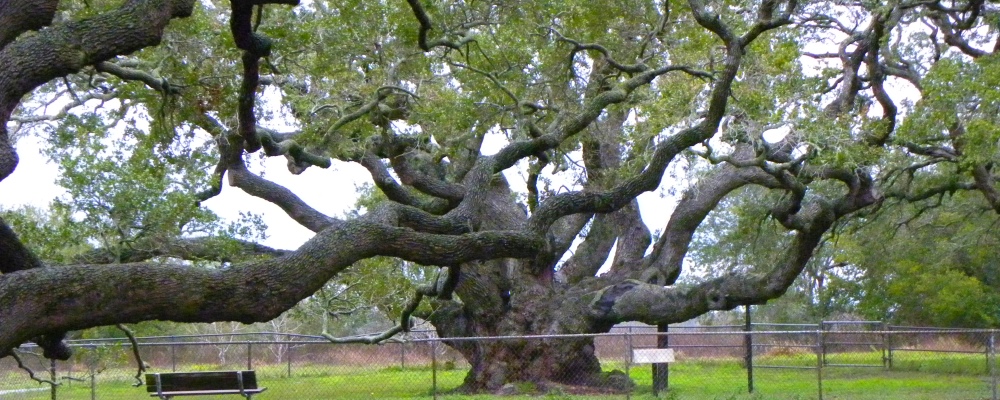
Name: The Big Tree in Rockport, Texas
Agency: Texas State Parks, Goose Island SP
Location Tree: 28.152524, -96.976654
Girth: 35.1 feet, Height: 45 feet; Crown: 90 feet.
1000+ Years Old
Name: The San Bernard Oak
know as the Official State Champion in Texas
Agency: San Bernard NWR, Brazoria County, Texas
Visitor Center: 28.9141129, -95.5781502
Location Tree: 28.919885315969776, -95.60108281970504
Girth: 32.2 feet, Height: 67 feet; Crown: 100 feet.
900 Years Old
The Lover′s Oak is in Brunswick, Georgia.
Agency: Brunswick Old Town Historic District
Location Tree: 31.14236, -81.48655
Girth: 40.9 feet, Height: feet; Crown: feet.
800 Years Old
McDonogh Oak in City Park, New Orleans, LA
Agency: New Orleans, Louisianna City Parks
City Park: 30.001667, -90.092778
Location Tree: 29.98398516, -90.0953014
Girth: 25+ feet, Height: feet; Crown: 155 feet.
Ancients: Chitimacha and Chahta Yakni (Choctaw) peoples.
500 - 1,000 Years Old
Seven Sisters Oak in Mandeville, LA, largest southern live oak in Louisiana.
Agency: Private Property
(30.367222, -90.09875)
Girth: 39.6 feet, Height: 57+ feet; Crown: 153 feet. (2016)
500+ Years Old
Grandma′s Oak in Columbus, Texas
Agency: Private Property Walnut Street (Old US 90)
Location Tree: 29.7065727, -96.5513098
Girth: 28.1 feet, Height: 61 feet, Crown: 114
500+ Years Old (1487)
The Friendship Oak, Long Beach, Mississippi.
Agency: Gulf Park Campus, University of Southern Mississippi
Location Tree: 30.351769, -89.136094
Girth: 19.8 feet, Height: 60 feet Crown: 155 feet (2011)
480+ Years Old (1545)
The Airlie Oak in Wilmington, NC, largest extant oak in North Carolina.
Agency: Airlie Gardens
Location Tree: 34.2140812, -77.8294574
Girth: 21 feet, Height: 70 feet; Crown: 104 feet.
400+ Years Old
Angel Oak On Johns Island, South Carolina.
Agency: Angel Oak Park, City of Charleston, SC
Location Tree: 32.7170653, -80.0804252
Girth: 28 feet, Height: 66.5 feet; Crown: 187 feet.
300 - 500 Years Old
The Baranoff Oak, Safety Harbor, Florida
Agency: Baranoff City Park
Location Tree: 27.9912639, -82.6889611
Girth: 20 feet, Height: feet; Crown: 160 feet.
Known as the oldest live oak in Pinellas County, FL.
300+ Years Old
The Duffee Oak, is the oldest landmark in Mobile Alabama.
Agency: private developer
Location Tree: 30.68608, -88.06202
Girth: 31 feet, Height: 48 feet; Crown Spread: 126 feet.
189 Years Old
The Boyington Oak, in Mobile, Alabama,
Agency:
Location Tree:
Girth: feet, Height: feet; Crown: feet.
Known for the folklore surrounding its origin.
180 Years Old
The Bland Oak, Sydney, Australia,
Agency: Oakdene Park, Fairfield City Council
Location Tree: -33.8797, 150.9617
Girth: feet, Height: 43 feet; Crown Spread: 98 feet.
One of the oldest trees in the city and largest oak the country.
134 Years Old
The Century Tree, planted in 1891, in College Station, Texas,
Agency:
Location Tree: 30.61591141846318, -96.34139490407395
Girth: feet, Height: feet; Crown: feet.
It has been declared a Famous Tree of Texas by the Texas Forest Service.
It is a campus landmark on the campus of Texas A&M University
187 Years Old
The Cellon Oak, Alachua, Florida.
Agency:
Location Tree:
Girth: 30 feet, Height: 85 feet; Crown: 160 feet.
345 Years Old
The Big Oak in Thomasville, Georgia.
Agency: City of Thomasville, GA
Location Tree: 30.841114, -83.981721
Girth: 27.9 feet, Height: 72 feet; Crown Spread: 169 feet. (2019)
500 Years Old
The Treaty Oak in Austin, Texas
Agency: Treaty Oak Park, Austin, Texzs
Tree: 30.2713, -97.7555
Girth: feet, Height: feet; Crown: feet.
Vandalized in 1989, but survived although major pruning was required.
250 Years Old
The Treaty Oak in Jacksonville, Florida
Oldest living thing in the city.
Agency: Jessie Ball duPont Park, Jacksonville, FL
Location Tree: 30.317, -81.6581
Girth: 25 feet, Height: 70 feet; Crown: 145 feet.
Lanier's Oak in Brunswick, Georgia,
Named after poet Sidney Lanier.
Agency:
Location Tree: 31.155667409171095, -81.4791905776719
Girth: feet, Height: feet; Crown: feet.
The Evangeline Oak along the bank of Bayou Teche in St. Martinville, Louisiana
Agency: Evangeline Oak Park, Martinville, LA
Location Tree: 30.12167890543881, -91.82756876511904
Girth: 29.5 feet, Height: feet; Crown Spread: feet.
200+ Years Old
The Emancipation Oak, on the campus of Hampton University in Virginia,
(37.023163, -76.330374)
Agency:
Location Tree:
Girth: feet, Height: feet; Crown: 98 feet.
|