The Wayƒarers Journal ©

The Journal

The Wayƒarers

The Selƒ

The Journey

The Burden

The Mountain

   The Ancients

     First Wayfarers
     Mound Builders
     Rock Art

       Cave Paintings
       Geoglyphs
       Petroglyph

        Arizona
        California
        New Mexico
        Utah

       Pictograph
       Rock Relief

     Stone Stackers
     Fossils

   The Earth
   The Life
   The Modern Man
   The Nonpareils
   The Steps
   The Way

The Appendix

The Wayƒarer
The Mountain
Go to bottom of this page
THE PETROGLYPH
Petrified Forest National Park, Arizona

The Petrified Forest Petroglyph Go Down Go Back
The Petrified Forest National Park has evidence from the over 600 archeological sites in the national park that suggests the earliest inhabitants of the park arrived during the second migration of those wayfarers who crossed Beringia into the western hemisphere. There are two Folsom type spear points, the earliest first wayfarer artifacts found in the park which are at least that old.

Petrified Forest Petroglyph Information:
The Wayƒarers Arrive
During the Early Basketmaker Era, nomadic groups arrived in this desert area and established seasonal camps in the Petrified Forest from which they hunted small game such as rabbits, pronghorn antelope, deer and also harvested seeds from ricegrass and other wild plants.
Around 150 BCE, they started growing corn in this area and as their farming techniques improved, these desert wayfarers, around 1 CE, began to construct small storage bin to store their excess crop harvest. Then, by 50 CE, some of these desert wayfarers built shallow pit-houses in the Petrified Forest area and began to stay here year-round.
In this time period, petroglyphs and other rock art indicate a ceremonial structure, and the groups appear to be increasingly connected to larger communities.
Description:
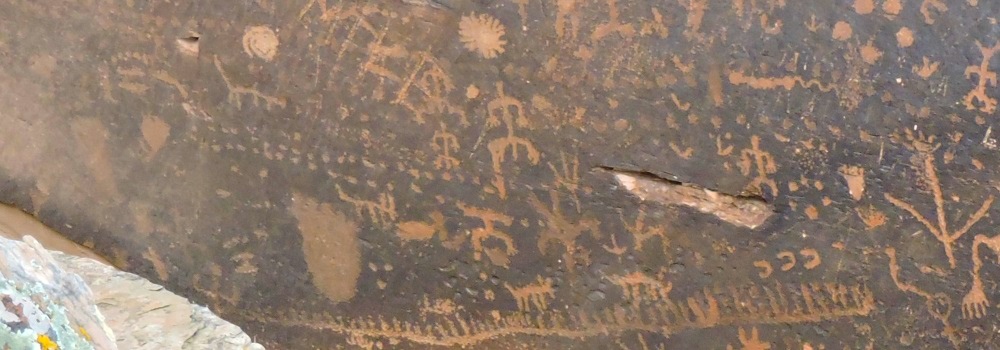
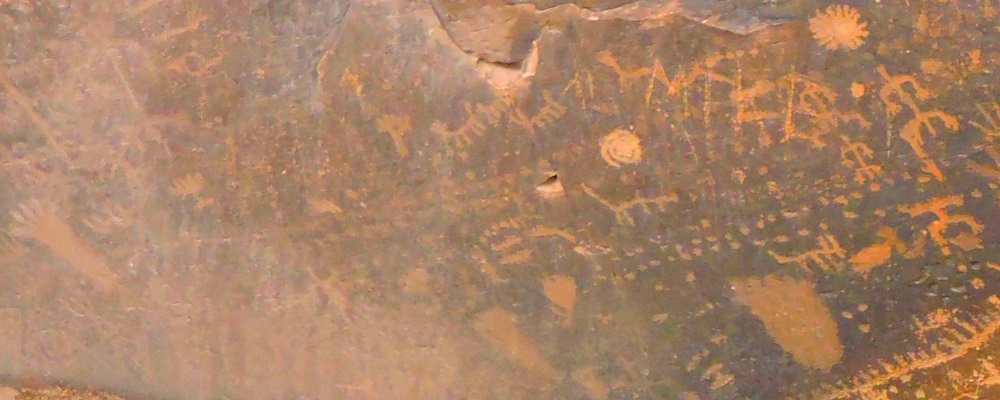
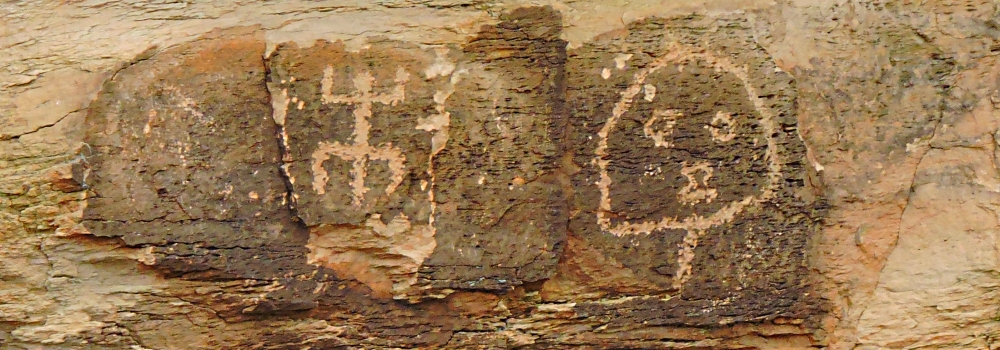
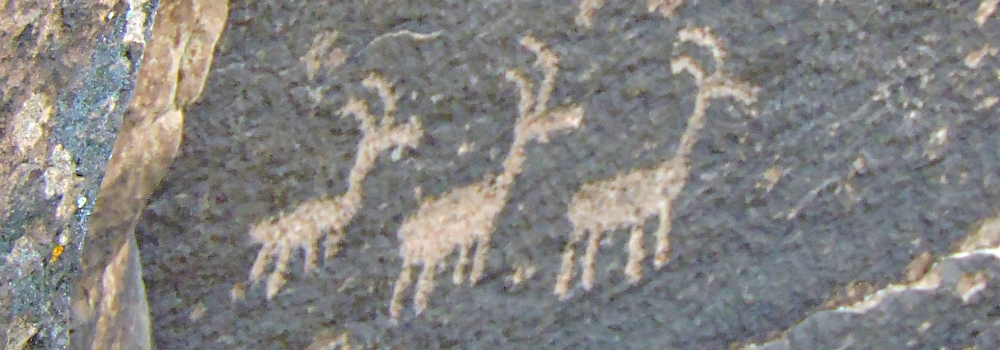
At Newspater Rock, Puerco Pueblo and other sites within this national park, petroglyph and other images, symbols, or designs have been scratched, pecked, carved, or incised on rock surfaces, often on a patina known as desert varnish.
Of the more than 600 archeological sites that have been found within the boundaries of the Petrified Forest National Park, those at both Newspaper Rock and Puerco Pueblo, which sites boasts of over 650 separate petroglyph, are thought to be between created from between 100 BCE and 1400 CE.
Location: Newspaper Rock
Coordinates: 34.9619275, -109.7989046
Elevation: 5413 feet
Location: Puerco Pueblo
Coordinates: 34.9760020, -109.7939401
Elevation: 5359 feet

Geographical Region

Ancient Steps:
Abundant archeological evidence gives insight into ancient civilizations that once roamed or lived in what is now the Petrified Forest National Park and the Painted Desert. The evidence shows that prehistoric cultures of the ancient Anasazi, Mogollon and Hohokam had experienced on these lands over varying periods of time. These ancient peoples were not considered as specific Indian Tribes, but are ancestors of some of the Tribes who live today in the Southwest such as the Hopi, Navajo and Zuni.
More than one thousand archeological sites have been identified and studied in both the Petrified Forest and the Painted Desert, but still less than half of the National Park has been surveyed so who knows what future discoveries will be uncovered that remain secretly buried under the surface.

Campgrounds:
Cottonwood Campground, Canyon de Chelly National Monument
El Morrow National Monument
Gallo Campground (36.032396, -107.895079), Chaco Culture NHP
Apache-sitgreave National Forest
Coconini National Forest
Blue Water State Park
Homolovi State Park
Lyman Lake State Park
The Petrogltph in
Petrified Forest NP
(m1rock-petro-az-petrified-2014-0520.1408) The Petrified Forest National Park

The 2016 Journey, Petrified Forest Petroglyph Go Down Go Up
Newspaper Rock Petroglyph, Part One
Arriving at the parking lot, I walk the short distance to the observation area that has wooden railing marking the area to keep out of. A raven is perched on the railing as if waiting for a handout from a human. I walk to the railing and look down from the ledge to the pile of rocks below. There is a notable dark varnish on the surface of most of the flat rocks in the area and several spot are etched with petroglyph figurines.
The Petroglyph
at Newspaper Rock
(m1rock-petro-petrified-2016-1104.1048) Petroglyph at Newspaper Rock Overview
The Petroglyph
at Newspaper Rock
(m1rock-petro-petrified-2016-1104.1048) Petroglyph at Newspaper Rock
The Petroglyph
at Newspaper Rock
(m1rock-petro-petrified-2016-1104.1048) Petroglyph at Newspaper Rock
The Petroglyph
at Newspaper Rock
(m1rock-petro-petrified-2016-1104.1048) Petroglyph at Newspaper Rock
The Petroglyph
at Newspaper Rock
(m1rock-petro-petrified-2016-1104.1048) Petroglyph at Newspaper Rock
The Petroglyph
at Newspaper Rock
(m1rock-petro-petrified-2016-1104.1048) Petroglyph at Newspaper Rock

Puerco Pueblo Calendric Petroglyph Site, Part Two
This type of petroglyph is described as a location where a petroglyph is located to be used to indicate an important event in the annual calendar. A very common type of calendric petroglyph was one which during an equinox or solstice, sunlight from the rising sun would flow down a clef in a rock, through a window in a home or some other spot and then the light would shine on a particular petroglyph or other drawn object.
Why would these ancient people want to mark the date of a solstice or other calendar event? These people depended on solar calendars to plan their lives around the changing seasons. There very existence depended on knowing when to plant their crops or when to expect summer rains.
The Petroglyph
at Puerco Pueblo
(m1rock-petro-az-petrified-2016-1104.1123) Calendric Petroglyph with Sunlight Pointer
The above photograph with the sunlight pointer touching the petroglyph as shown can only be taken once a year, and that time is nine in the morning of the summer solstice which, on our calendar is normally on June 21st.
The Petroglyph
at Puerco Pueblo
(m1rock-petro-az-petrified-2016-1104.1124) Calendric Petroglyph, shown by Arrow
And yet, who would have known to look on the dark side of this rock for a ray of light that indicates which day is the longest day of the year. For someone to have noticed the small ray of light striking the rock on this day must have been very knowledgeable of the celestial calendar, very aware of when to look for such an indicator. Then he would have to had been at that spot the next summer solstice with the tools in hand to make the small circle at the precise spot at the right time.
Even today, the importance of annual calendar event play an important role in the lives of contemporary indigenous communities where the year is divided into two by the summer and winter solstices.

Puerco Pueblo Petroglyph, Part Three
The Petroglyph
at Puerco Pueblo
(m1rock-petro-az-petrified-2016-1104.1125) Petroglyph at Puerco Pueblo
The Petroglyph
at Puerco Pueblo
(m1rock-petro-az-petrified-2016-1104.1126) Petroglyph at Puerco Pueblo
The Petroglyph
at Puerco Pueblo
(m1rock-petro-az-petrified-2016-1104.1127) Petroglyph at Puerco Pueblo
The Petroglyph
at Puerco Pueblo
(m1rock-petro-az-petrified-2016-1104.1128) Petroglyph at Puerco Pueblo
The Petroglyph
at Puerco Pueblo
(m1rock-petro-az-petrified-2016-1104.1129) Petroglyph at Puerco Pueblo
The Petroglyph
at Puerco Pueblo
(m1rock-petro-az-petrified-2016-1104.1130) Petroglyph at Puerco Pueblo
The Petroglyph
at Puerco Pueblo
(m1rock-petro-az-petrified-2016-1104.1131) Petroglyph at Puerco Pueblo
The Petroglyph
at Puerco Pueblo
(m1rock-petro-az-petrified-2016-1104.1132) Petroglyph at Puerco Pueblo

To go back to the Gallery Index, click on down arrow. Go Back Go Up

Thank you for visiting The Wayƒarers Journal.

See Ya above the Treeline!

This Page Last Updated: 31 July 2026


To continue to the next Episode Level page, Click here go to top
 
The Wayƒarers Journal © ::: Come Join the Journey ™
by Thom Buras
Come Join the Journey ™