|
Ancient Graffiti?
Many would say yes that the petroglyph, one form of rock art is graffiti. However, others claim that these different forms of rock art, especially the petroglyph, are in fact ancient written communications, but that we have yet to solved the code for understanding their communication.
Rock Art: The Meaning
There are many of the wise men of this world that claim the petroglyph is part of the religion of the ancients, as some of the figures are representations of their gods. For instance, one specific image of indigenous American Rock Art is Kokopelli, often depicted as a humpbacked flute player, some depictions with four feathers or antenna-like protrusions on his head. This rock art figure is believed to be a fertility deity, a trickster god and also a god which represents the spirit of music. Some petroglyph of this deity is often seen carrying unborn children on his back.
Yet, included in the realm of petroglyph and pictograph are numerous other images, many having no apparent connection to religion, images which are more inclined to be the representation of significant components of the indigenous people′s cultural life, accomplishments, experiences and/or heritage.
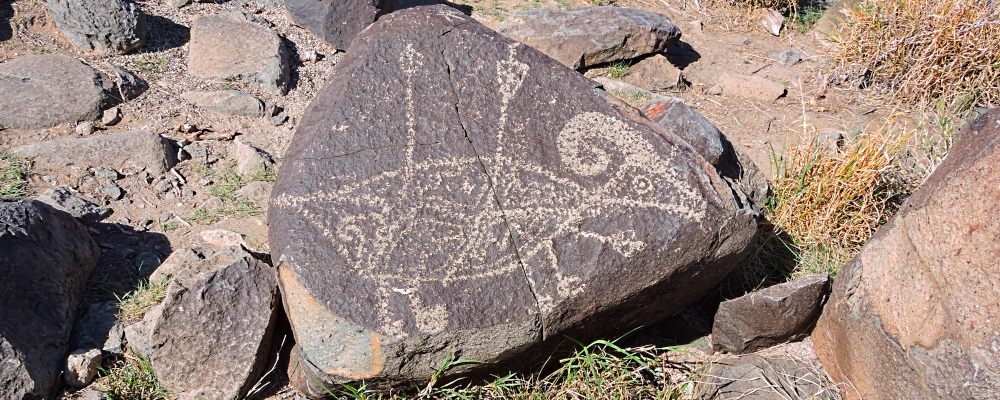
(m1rock-petro-nm-threerivers-2016-0316.1010) Three rivers petroglyph site. Mountain goat with three arrows.
Rock Art: The Forms
There are many forms of ancient rock art, which include the well know petroglyph and pictograph. However, rock art also includes cave paintings, geoglyphs and rock relief, all of which are included as the subject of this gallery.
A wide variety of techniques have been used in the creation of Rock Art, however, in some scientific circles, Cave Paintings are not included as part of Rock Art. Still I include that Cave Painting are Rock Art, simple because the definition of Cave Painting is A type of ancient art placed on the walls and ceiling of caves. Thus, to my understanding that means Cave Painting are art on the rock walls and ceilings, thus, Rock Art.
In archaeology, rock art is human-made markings placed on natural stone. Rock art is a global phenomenon that is found in numerous culturally diverse cultures, regions, and populations of the entire inhabited earth and throughout all of the millenniums of human history.
The defining characteristic of rock art is that it is placed on natural rock surfaces, and thus is distinct from artworks placed on constructed walls and those that are free-standing sculpture. As such, rock art is a form of landscape art, and includes designs on boulder, cliff faces, cave walls, cave ceilings, and on ground surface rock.
Such artwork is divided into several categories including:
(1)
Cave Paintings (Parietal Art, painted on walls and ceilings)
(2)
Geoglyph (formed in ground rock, positively or negatively)
(3)
Petroglyph (carved into the rock surface)
(4)
Pictograph (painted onto a rock surface)
(5)
Rock Relief (carved into solid rock)
Both cave painting and pictograph are painted onto rock walls, the primary difference is the location. Cave walls provide much more protection from the elements whereas the pictograph are open to the elements and often fade over time, sometimes even completely away.
Furthermore, there are another type of rock art, one which could likely be included in the Petroglyph category, although not yet recognized as such. What is this type of rock art? This rock art would serve the same purpose of a common modern practice of marking a grave site with a rock tombstone that has been inscribed with the name and/or other information about the person buried beneath that stone. Personally, I have gone back to the site of where the tombstones for both my Father and Mother are located. To my knowledge, I am not sure of why I go there, but many others would go to visit the graves of their parents and/or other family members for a variety of deeply personal, emotional, and cultural reasons, primarily centered on maintaining a connection with them, finding comfort, and honoring their memory.
Too, it is very likely that these visits serve as a vital part of the grieving process and a way to maintain a normality in life without having those persons as a part of it going forward.
Nevertheless, what is that tombstone that is not yet recognized as such? And why is it instead called a Runestone?
The Infamous Tombstone
In the eastern area of Oklahoma, two miles northeast of of the town of Heavener, Oklahoma is a 55 acres park, previously registered as a State Park, but for some reason unbeknownst to me, the state of Oklahoma depreciated that state park, dropping the park from their list of State Parks, currently at 38 parks covering over 80,000 acres. The Runestone Park ownership was subsequently transferred to the city of Heavener, Oklahoma, who currently operates the Runstone Park as a municipal park and manages it with a non-profit volunteer organization.
Furthermore, the Runestone Park and the city of Heavener, Oklahoma, are both in the eastern Oklahoma
Interior Highlands Region, where both the city personnel and the park staff are promoting the concept that Runestone Park is a location which provides evidence of Norse Viking exploration, saying that in this eastern region of Oklahoma, there are a total of at lease five Norse Runestones; (1) The Hevener Runestone discovered in 1923; (2) The Poteau Stone discovered in 1967; (3) The Shawnee Stone; (4) The Pawnee Stone; (5) another Runestone located on private property and/or other Runestones near Heavener, Oklahoma.
Furthermore, some, like Gloria Farley, a kindergarten teacher and author, who advocate for the Viking origin theory, and who in a published written work has elaborated her beliefs that the local chiseled stones are the result of a Viking expedition to eastern Oklahoma. Too, there are some wise men who have opted to believe the so-called runestones were carved by Scandinavian immigrants in the 1800s. Furthermore, others believe that these chiseled inscriptions were created by non other than the local
Indigenous Native People.
After decades of research concerning the matter of how and where from the indigenous people came from to populate the North American continent, upon personally examining these Heavener Runestones, I personally came to the conclusion, the one which I told to the storekeeper-host of the Heavener Runestone Park, whose name is Stacy, that these stones were carved by none other than the ancient indigenous Native Americans who had migrated into the eastern areas of Oklahoma and made this area their homeland.
The Real Viking Settlement.
L'Anse aux Meadows, located at the northern tip of Newfoundland, Canada, (51.5963903, -55.5333562) is a UNESCO World Heritage Site that contains the only authenticated Norse settlement in North America. Dating to approximately 1,000 CE, this archaeological site provides the earliest evidence of European presence in the North American Continent, and predates Christopher Columbus by roughly 500 years.
Who chiseled the Heavener Runestone?
The indigenous Native American people who lived in the land where the Heavener Runestone was found are from the nation of Diklah, and specifically the sons of
Caddo. Furthermore, it is more likely that if the Heavener Runestone is actually and ancient relic, then it was not of Viking origin, but of Caddoan origin.
How did these indigenous Native Americans come to arrive in the mountainous region of eastern Oklahoma?
The sons of Diklah, which in total, number thirteen, came with their parents as a large family which migrated from Mesopotamia across the land bridge, which journey began about the year 2000 BCE. This nation of Shemites left there previous home and on foot traveled from the land of Ur across the Asian continent in a northeast direction past the Kamchatka Peninsula in present day Russia and continued to the Chukchi Peninsula. Upon their arrival, they then continue across the Beringia Land Bridge, likely unbeknownst to them that they had just crossed into a new continent.
Yes, amazing as this journey may seam, crossing the land bridge is what was done for these previous inhabitants of Mesopotamia to find a new homeland and become the present day North American Native Americans indigenous nation of the Algonquin People.
|