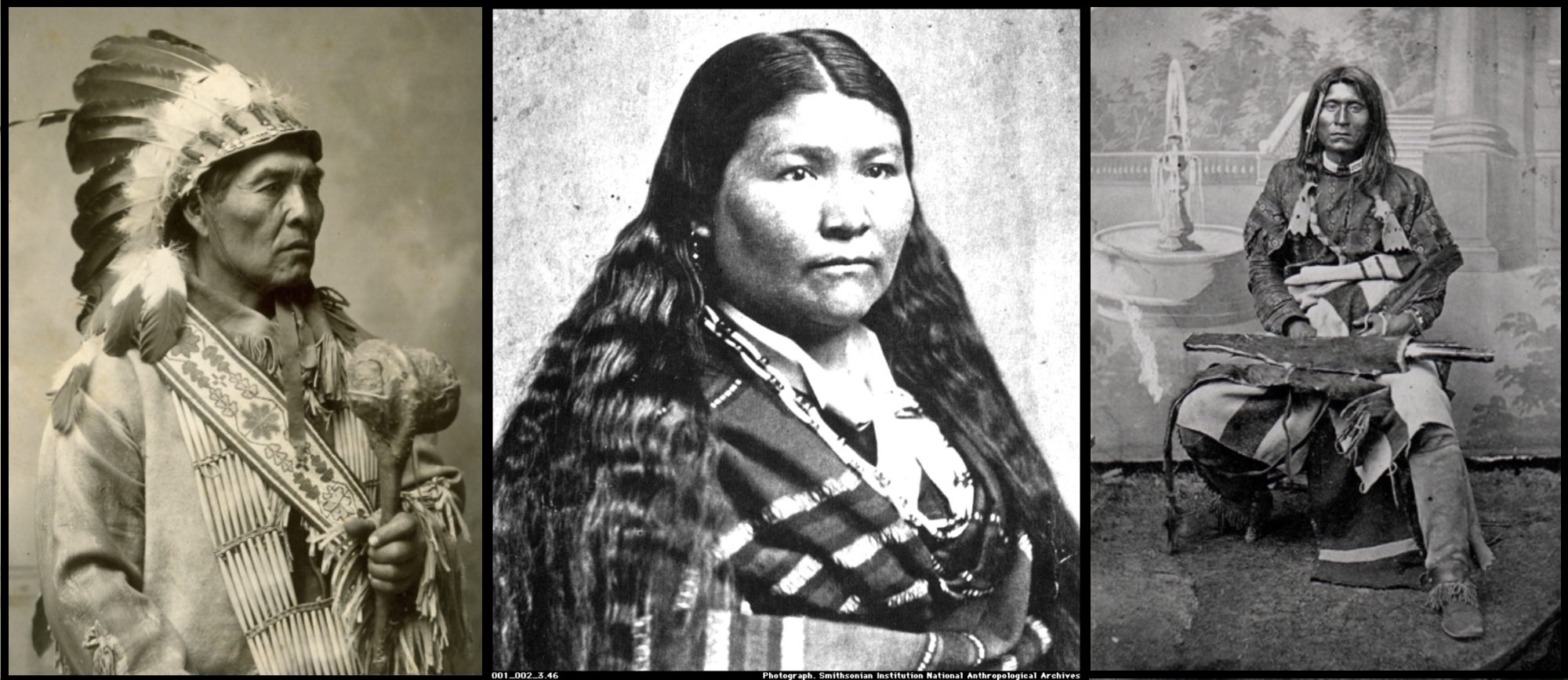
The Modoc are a Native American people who are believed to have originally lived in the area which is now northeastern California and central Southern Oregon. However, they are descended from one of the
Sons of Hadoram, likely chief Kalapuya, and who as a group had as there ancestral home along the coasts of modern day Washington, Oregon and California; who also spread out into the large lake basin areas as the lakes (known then as
Ta-Maschilamek Menuppek and the Great South Lake,
Scawaneu Menuppek), long before both of these lakes began to dry up and/or drain.
After the
Bridge from God, collapsed, and the great inland lake began to shrink, some of this nation of people would follow the water and become Lutuami, meaning Lake Dwellers.
One of the more famous chiefs was known as Kintpuash (Captain Jack) who, with several other chiefs, lead their tribe during the Modoc War, the only major Indian war fought in California by the regular US Army. With the Modoc being defeated, many of those taken as prisoners of war were transported to the Quapaw Reservation in Oklahoma. Some of their descendants reside there today, while others remained in their California homeland.
Currently, the Modoc are divided between Oregon and Oklahoma, where they are enrolled in two federally recognized tribes, those who never left the Klamath Reservation still reside in Oregon are the Klamath Tribe and those in Oklahoma, who are the descendants of the prisoners taken to the Quapaw Reservation are known as the Modoc Tribe of Oklahoma. Now, the two separate tribes are together now known as the Modoc Nation.
photo credit: G. W. James
George Wharton James Collection, Autry Museum of the American West
Public Domain, https://commons.wikimedia.org/w/index.php?curid=7761455
Early Conflict
When European explorers first encountered the Modoc, they were like many of the other Plateau indigenous people who caught salmon during the salmon runs and then migrated seasonally to hunt and gather other foods. Winter normally found them in earthen dugout lodges with a shape similar to a beehive, which had been built with sticks that were then covered with mud. These lodges would have been built near the shore of the lake where there were good fishing and a source of seed from aquatic plants such as yellow lily call wokas.
Neighboring tribes include the Klamath, Shasta, Northern Palute, Karuk, Yurok and Achomawi.
From about 1840 forward, there was a large influx of European emigrants entering the lands previously know as belonging to the Modoc. By 1847, the Modoc, under leadership of Old Chief Sconchin, began raiding these invading emigrants wagon trains. Then, in September 1852, the Modoc destroyed an emigrant wagon train near the east shore of Tule Lake and killed all but three of the 65 people in the party. Two of the ones remaining alive where young girls who were taken as captives. The only man who survived the massacre made his way to an European settlement in Yreka, California. There, a militia under Sheriff McDermit including Ben Wright. The militia traveled to the scene of the attack to bury the dead and avenge their deaths.
Wright, a notorious Indian hater and a small group stayed on to avenge the deaths. Wright′s party met the Modoc near Lost River where Wright had planned to ambush them and succeeded in November 1852 at which time the party killed forty Modoc in what later was called the Ben Wright Massacre.
After this, the United States signed a treaty under the leadership of Chief Schonchin, with the Modoc, the Klamath and the Yahooskin band of the Snake tribes in 1864 establishing the Klamath Reservation. This treaty required the tribes, which had a population of about 2000, to surrender the land near lost River, Tule Lake and Lower Klamath Lake in exchange for land in the Upper Klamath Valley.
In 1870, Kintpuash led a band of Modoc, who claimed that they were not adequately represented in the treaty negotiations and wanted to leave the harassment by the Klamath in the reservation. They departed the reservation, returned to their traditional homelands and there built a village near Lost River.
Modoc War
In November 1872, the US sent the Army to Lost River in order to attempt to force Kintpuash′s band back to the reservation. A battle broke out, and the Modoc escaped to what is called Captain Jack′s Stronghold, which is now located in Lava Beds National Monument. The band of fewer than 53 warriors was able there to hold off the three thousand regular U.S. Army troops for several months, defeating them in combat after combat.
The band of Modoc, after splintering, ended up surrendering on 4 June 1837. The US Army tried, convicted and executed Kintpuash and three of his warriors in October 1873 for the murder of Major General Edward Canby, because he had violated agreement made with the Modoc. The result was the the remaining members of the Modoc were sent to Oklahoma as prisoners of war.
In 1909, the group of Modoc in Oklahoma was given permission to return to Oregon; several of these did but most remained in their Oklahoma homes.
Kintpuash
Kintpuash, also known as Captain Jack was born in 1837 and died on 3 October 1873, was a chief of the Modoc tribe in California and Oregon. His name in the Modoc language means, Strikes the water Brashly. He was the only native American ever to be charged with war crimes and subsequently execute by hanging. He was 36 years of age at his death.
He is buried in a marked grave at Fort Klamath county park in Klamath County, Oregon. Beside him lies John Schonchin, one of his warriors also executed along with Kintpuash.