The indigenous people known as the Tonkawa belonged to a larger group of linguisticly similar tribes that lived primarily in the
Coastal Plains region of Texas, but had previously lived further north, possible as far north as northwestern Oklahoma. However, due to the Tonkawa being a nomadic tribe, and because of invading Athabascan cultures which arrived upon the scene in the 1500s, particularly the Apache tribe, the Tonkawa were forced by the more aggressive Apache to leave Oklahoma and retreat to below the Red River into the area now known as Texas.
The Name
The Tonkawa′s name for themselves is Tickanwa·tic which in English translates to: Real People. This is an autonym used by many of the other tribes in the nations of the Algonquian people across the American continent.
A close relative, the Waco tribe call them in the Waco laguange: Tonkaweya, which in English means, They all stay together. It is from this Waco name which is likely how they came to be called the Tonkawa.
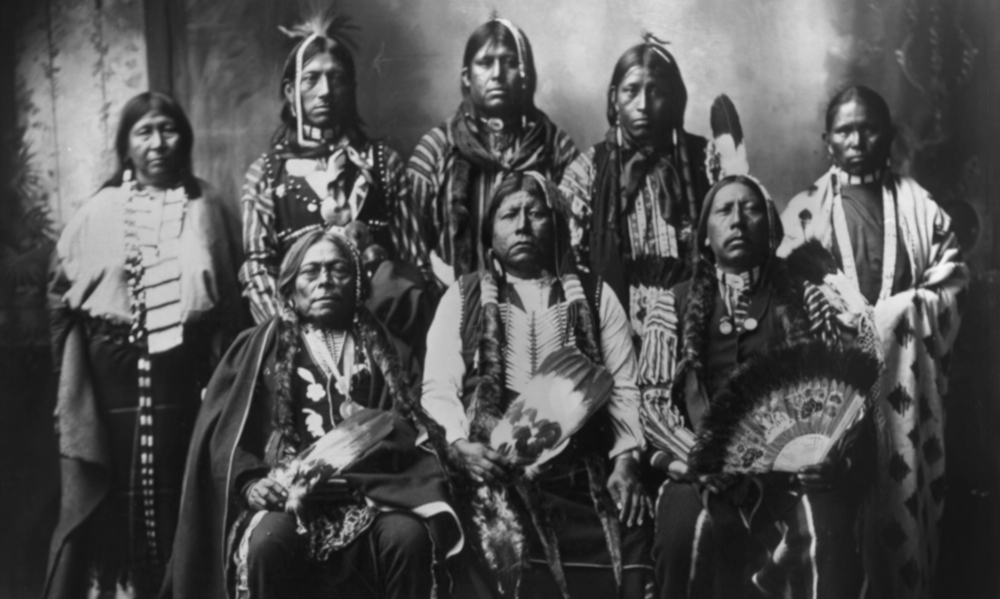
(m1-first-fm-diklah-tonkawa) Tonkawa
Photo Credit: Tonkawa Tribe of OK. Photo by Rhinehart in 1898.
Standing L-R: Winnie Richards, John Rush Buffalo, William Stevens, John Allen and Mary Richards. Seated L-R: John Williams, Grant Richards and Sherman Miles.
A Nomadic People
The Tonkawa were nomadic in their early years, moving their villages according to the desires of their leaders. Although they would plant some crops, they were better known as successful hunters of buffalo and deer, being experts at using bows and arrows as well as spears for weapons. Later, they became skilled riders and owned many good horses.
Sometime later, the Tonkawa tribe migrated into central Texas and some of the clans expanded southwest into what is now know as Coahuila, Mexico. Before and during the days of the Republic of Texas (1836-1846) the Tonkawa joined the Anglo-American immigrants to fight against the Comanche Indians. After Texas acquired statehood within the United States, the Tonkawa together with a number of other Texas Indian tribes were moved to the Indian Territory some time after 1859.
The Tonkawa Massacre
During the US Civil War, in October 1862, at the Wichita Agency, a Confederate held post, not far from Fort Cobb near the present day Anadarko Oklahoma, a detachment of irregular Union Indian troops, made up of the Tonkawa′s long held tribal enemies, attacked the home of the Tonkawa where around about four hundred tribal members lived. Those of the Union Indian troops, according to one reference account, included members of the Caddo, Comanche, Delaware, Kickapoo, Kiowa, Osage, Seminole, Shawnee and Wichita tribes.
The entire Tonkawa tribe fled southward towards the Confederate held Fort Arbuckle, however, the Tonkawa were caught by the Union Indian troops near the banks of the Washita River in Oklahoma. The fight, known as the Tonkawa Massacre killed nearly half of the remaining Tonkawas, leaving them with little more than 100 people. The tribe returned to Fort Griffin, Texas where they remained for the rest of the Civil War.
The Tonkawa Trail of Tears
In October, 1884, the United States removed the Tonkawa from Fort Giffin and transported them by rail car from a station in Cisco, Texas to the new Oakland Agency in northern Indian Territory, where they remain to this day. This journey took them first to a temporary stop near Stroud, Oklahoma in Indian Territory, where they arrived at the Sac and Fox Agency.
The entire Tribe wintered at the Sac-Fox Agency until spring, at which time, they traveled the last 100 miles of their journey by wagon, fording many rain-swelled rivers and axle-deep mud caused by severe spring rains. They reached the Ponca Agency on June 29th, and then finally to Oakland on June 30th, 1885. The place that they call Oakland is where they have lived since, it is their new homeland.
This last 100 miles was know to the Tonkawa as their “Trail of Tears.” Too, it has become a time in their history that they have chosen to commemorated, lest it be forgotten. The Tribe has changed the date of its annual powwow to coincide with this historic date.
|