|
The Choctaw People:
The Choctaw, or Chahta in the language of the people, originally lived in southeastern North America, in the area which is now in the states of Alabama and Mississippi. The language spoken by the people is from the parent language known as Western Muskogean and sharing this language group with the Chickasaw and Chacato.
The Choctaw today are federally recognized in three tribes: The Choctaw Nation of Oklahoma; Mississippi Band of Choctaw Indians, and Jena Band of Choctaw Indians in Louisiana.
As of early 2023, the total population is from 215,000 to as many as 228,000 enrolled in the Choctaw nation as a whole. The largest group of about 212,000 are in the Nation of Oklahoma; the Mississippi Band is in next with about 11,000 enrolled; The MOWA Band of Alabama has just under 4,000 enroled and the Jena Band of Louisiana has about 300 enroled.
The Homeland of the Choctaw:
In 1675, the French recorded that the Choctaw considered
Nanih Waiya as the original mound of the Choctaw and Chickasaw tribes. This mound is an earthwork platform located in Central Mississippi (32.921389, -88.948611).
The Nanih Waiya mound is about 25 feet tall, 140 feet wide and 220 feet long. There is some evidence that suggests this mound was originally larger but has eroded into the present size and shape. Too, at one time, this platform mound was bounded on three sides by a circular earthwork enclosure of about ten feet tall, which was about one square mile in total area.
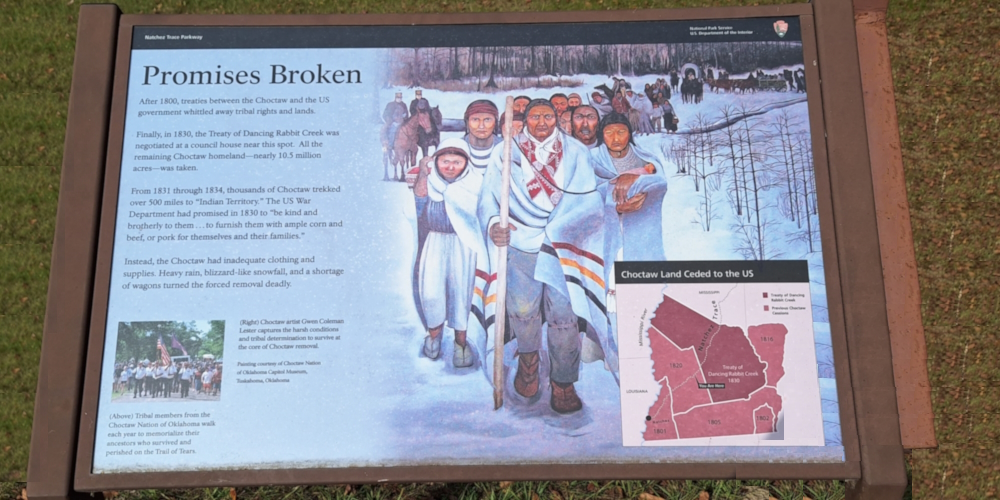
The Choctaw lost control of this earthwork during the 1830s when they were removed to Indian Territory. The site of the earthwork was afterward privately owned, the under the ownership of the state of Mississippi and later maintained as a park. In 2973, the site was listed on the National Register of Historic Places and in 2008, the site was deeded to the Mississippi Band of Choctaw Indians.
The Choctaw believe that Nanih Waiya is the Mother Mound, (Inholitopa iski) and the stories told vary greatly but one in particular is worthy of considering. This story is that Nanih Waiya is the location where the Choctaw tribe ceased their wandering from the west and settled in this location for it to become their homeland.
The Choctaws a great many winters ago commenced moving from the country where they then lived, which was a great distance to the west of the great river and the mountains of snow, and they were a great many years on their way. A great medicine man led them the whole way, by going before with a red pole, which he stuck in the ground every night where they encamped. This pole was every morning found leaning to the east, and he told them that they must continue to travel to the east until the pole would stand upright in their encampment, and that there the Great Spirit had directed that they should live.
They story says that Nanih Waiya could possibly means Leaning Hill or Stooping Hill, or Place of Creation in the Choctaw language, but one thing is consistent in all variations of the origin story, and that is Nanih Waiya was the final destination of their migration.
Archaeological Study:
The earliest archaeological evidence of occupation at Nanih Waiya is dated to about 300 to 600 CE during the middle
Woodland Period when it was probably built.
However, the dating was based on surface artifacts, as no archeological excavation of the mound has ever been undertaken. Its occupation apparently continued at least until 700 CE, well into the Late Woodland period.
Contemporty Cultures:
Nanih Waiya is contemporaneous with the other southern (lower Mississippi valley) Hopewell cultures, including ancient sites such as the Pinson Mounds in Tennessee and Ingomar Mound in Mississippi both of which mounds were further north of Nanih Waiya in the Miller cultures.
Another Hopewell area culture that Nanih Waiya is contemporary with, is the Marksville culture in the lower Mississippi valley, the Porter culture to the east and the Swift Creek cultures further to the east.
All of the above cultures were located on all sides of Nanih Waiya making this culture somewhat as set apart from the other Hopewell southern cultures.
|