The Wayƒarers Journal ©

The Journal

The Wayƒarers

The Selƒ

The Journey

The Burden

The Mountain

   The Ancients
   The Earth
   The Life

     The Animals

       Annelida
       Arthropoda
       Chordata

         Amphibians
         Birds
         Fish
         Mammals

           Aardvarks
           Armadillos
           Bats
           Carnivores
           Elephants
           Hedgehogs
           Hyraxes
           Manatees
           Marsupials
           Platypus
           Primates
           Rabbits
           Rodents
           Sloths
           Ungulate-Even

             Antilocaprids
             Bovids
             Camelids
             Cervids
             Giraffe, Okapi
             Hippos
             Musk Deer
             Hogs, Pigs
             Peccary
             Mouse Deer

           Ungulate-Odd
           Whales

         Reptiles

       Cnidaria
       Echinodermata
       Mollusca
       Nematoda
       Platyhelminthes
       Porifera

     The Archaea
     The Bacteria
     The Chromista
     The Fungi
     The Plants
     The Protozoa

   The Modern Man
   The Nonpareils
   The Steps
   The Way

The Appendix

The Wayƒarer
The Mountain
Go to bottom of this page
THE UNGULATES, EVEN-TOED
The Family Antilocapridae

The Antilocaprids, Genus Antilocapra Go Down Go Back
Pronghorn
The American pronghorn is the only living species of the Antilocapridae family, all other members are extinct. The pronghorn is a small ruminant mammal which bears small forked horn and which resembles an antelope.
The horns resemble other bovids in that they have a horny sheath but the horns are shed outside the breeding season and subsequently regrown.
Antilocapra americana
The pronghorn is the sole extant member of the family antilocapridae. The pronghorn is indigenous to interior western and central North America.
Though not an antelope, it is often known colloquially in North America as the American antelope, prong buck, pronghorn antelope, or simply antelope because it closely resembles the true antelopes of the Old World and fills a similar ecological niche on this continent.
First Sighting
While driving through the Great Divide Basin, I saw many pronghorn, some even close to the road making good photos possible. Most times, these animals are reclusive and stay far from any contact with humans.
While driving through the Great Divide Basin in the Wyoming Basin Ecoregion, I saw many pronghorn, some even close to the road making good photos possible. Most times, these animals are reclusive and stay far from any contact with humans

The 2016 Journey, Pronghorn Go Down Go Up
Pronghorn Buck
The Pronghorns
Buck The Pronghorns
Buck
This buck was about one hundred feet from the highway when I slowed to a stop. He started to walk off but I called out with my squeal and he stopped and looked my way. That is when I took the first photo. He did not stand there very long but turned and began walking away, which is when I took the second photo above.

Pronghorn Doe
As the buck was walking away, something else, a movement caught my attention. I pointed my camera toward the place where I saw the movement and when the focus came in, I snapped this photo.
The Pronghorns
The Doe
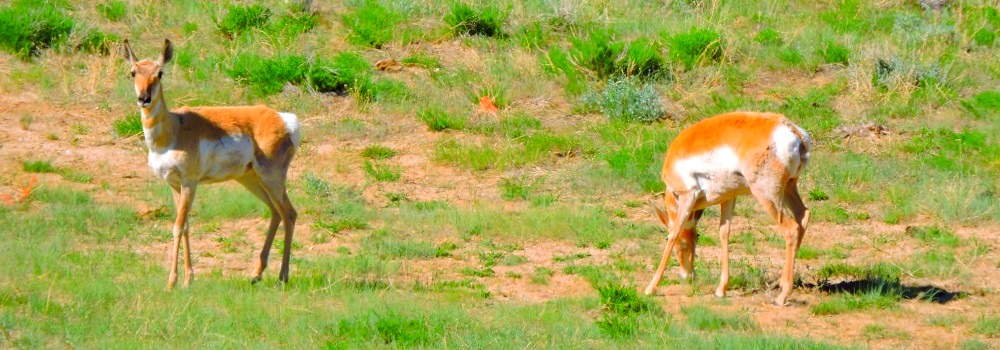
Later, I see a couple more females grazing on the grass.
The Pronghorns
Two Young

Pronghorn Fawn
The Pronghorn
Fawn
(m3an-chm-unge-an.fawn) The Pronghorns photo credit:Larry Lamsa

To go back to the Families Index Page, click on down arrow. Go Back Go to previous section
on this page

Thank you for visiting The Wayƒarers Journal.

See Ya above the Treeline!

This Page Last Updated: 31 March 2026


To continue to the next Episode Level page, Click here go to top
 
The Wayƒarers Journal © ::: Come Join the Journey ™
by Thom Buras
Come Join the Journey ™