|
Java Sparrow Story:
The Java Sparrow, also known as the Java finch or Java rice bird is a small passerine bird.
In captivity, a variety of colorations have been bred, including an all white, silver and several pale and cream colors.
Taxonomy:
The scientific name combines Latin oryza meaning rice with Latin -vorus meaning eating.
This bird was first described in 1758 by Carl Linnaeus, a Swedish biologist and physician who was instrumental in formalizing binomial nomenclature, which is the practice of giving each species a name composed of two parts, both of which use Latin grammatical forms. Binomial nomenclature became eventually called a binomial name and even later, just a binomial. I have come to call this name the scientific name or more informally, the Latin Name.
Some taxonomists place this and the Timor sparrow in their own genus Padda.
Conservation Status:
EN
Order:
Passeiformes
Family:
Estrildidae
Genus:
Lonchura (Padda)
Species:
Pryzivora
Description
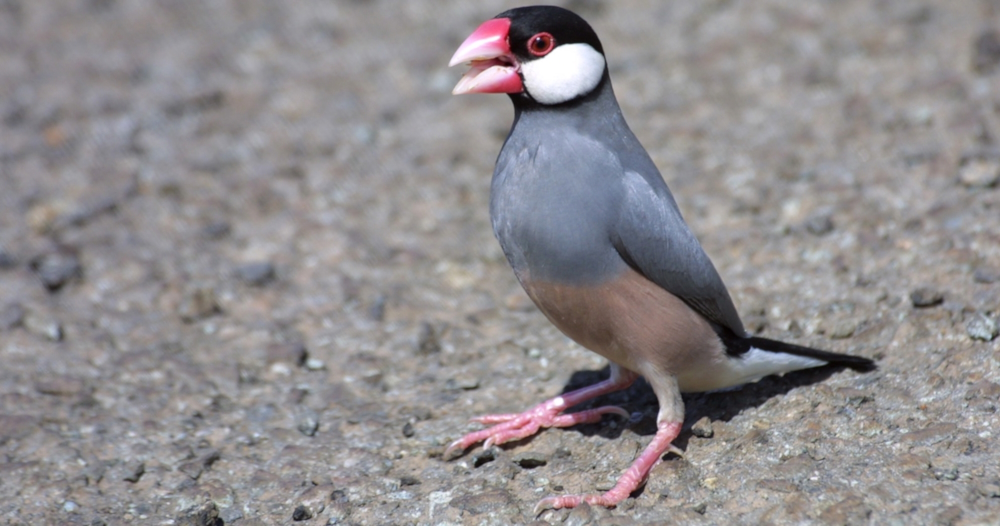
The adult is unmistakable, with its grey upper bodyparts and breast, pink belly, white-cheeks, black head, red eye-ring, pink feet and thick red bill.
The Java sparrow is about 5.9 to 6.7 inches in length from the beak to its tip of tail feathers. Although only about the size of a house sparrow, it may be the largest species in the estrildid family.
The body mass amounts to less than an ounce, (0.86 oz), making it slightly heavier than its nearest known rival, the black-bellied seedeater.
Length:
6 inches
Habitat
The Java sparrow is a very gregarious bird which feeds mainly on grain and other seeds. It frequents open grassland and cultivated fields, and was formerly a pest in rice fields. The nest is constructed in a tree or building, and up to eight eggs are laid.
Range
This estrildid finch is a resident breeding bird of Java, Bali and several countries with Indonesia. It has long been a popular cage bird and has been established in the wild around Miami, Florida as well as several of the Hawaiian Islands, especially Oahu.
Introduced widely across the globe Including: Christmas Island, India, Jamaica, Phillippines, Puerot Rico, Thailand, Venezuela
Migration (fall and spring):
Breeding (summer):
Winter:
All Year:
|