|
Taxonomy:
Kingdom:
Animalia
Phylum:
Chordata
Class:
Aves
Order:
Passeriformes
Family:
Passerellidae
Genus:
Junco
Species:
J. hyemalis
Common Name:
Dark-eyed Junco
Conservation Status:
LC
Subspecies:
fifteen
Slate-colored group
Slate-colored dark-eyed junco (J. h. hyemalis)
Carolina dark-eyed junco (J. h. carolinensis)
Cassiar dark-eyed junco (J. h. cismontanus)
Oregon dark-eyed junco (J. h. oreganus)
White-winged group
white-winged dark-eyed junco (j.h. aikeni)
Oregon or brown-black group
Montana dark-eyed junco (j.h. montanus)
Nevada dark-eyed junco (j.h. mutabilis)
Oregon dark-eyed junco (j.h. oreganus)
Point Pinos dark-eyed junco (j.h. pinosus)
Labuan Hanson dark-eyed junco (j.h. pontilis)
Thurber′s dark-eyed junco (j.h. shufeldti)
Townsend′s dark-eyed junco (j.h. townsendi)
Pink-sided group
Pink-sided dark-eyed junco (j.h. mearnsi)
Gray-headed group
Gray-headed dark-eyed junco (j.h. caniceps)
Red-backed group
Red-backeed dark-eyed junco (j.h. dorsalis)
The dark-eyed junco is a small grayish New World bird in the sparrow family. The genus name: junco is a Spanish word for rush, which is from the Latin: juncus. The species name hyemalis is from the Latin word heymalis meaning: of the winter.
Description
Length:
5.1 to 6.9 inches
Wingspan:
7.1 to 9.8 inches
Male:
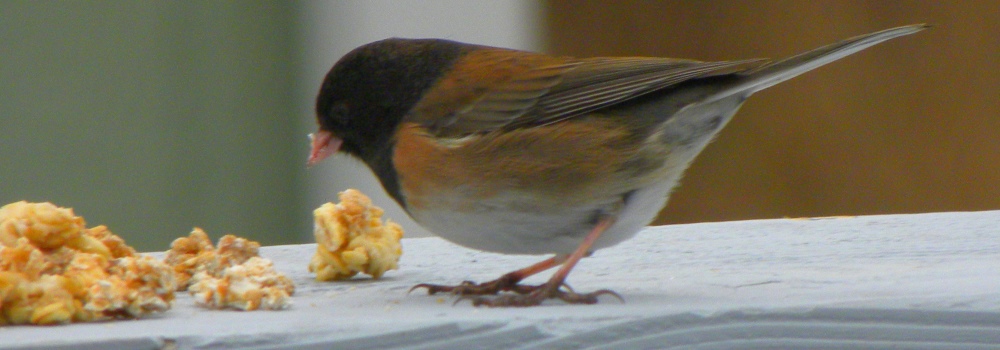
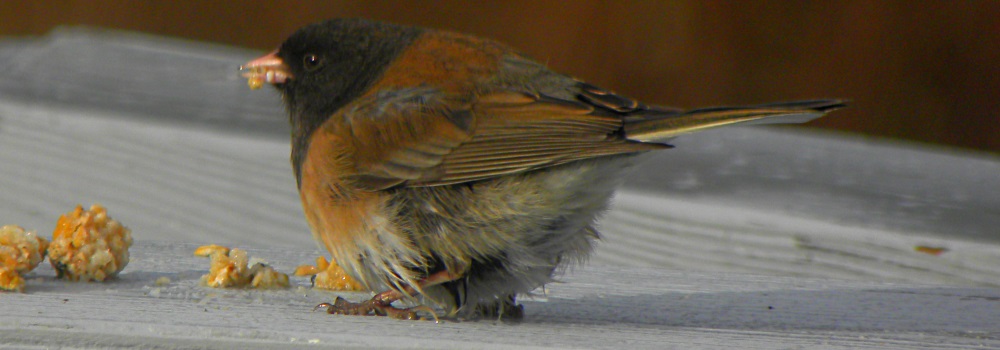
Adult dark-eyed juncos generally have gray or black heads,
necks and breasts, gray or brown backs and wings, and a white belly,
but show a confusing amount of variation in plumage detail.
White outer tail feathers flash distinctively in flight and while hopping.
The bill is usually pale pinkish.
Female:
Have less conspicuous marking than males.
Juvenile:
Often have pale streaks on their underparts.
Habitat:
Breeds in coniferous or mixed forest area throughout N. America.
Feeds on ground hopping about searching for seed and
insects at forest edges and/or clearings.
Range:
Year-round:
Seen on the west coast of the continent,
including California, Oregon, Washington, British Columbia.
Breeding:
Summer and nesting areas to include Idaho
and western Montana and western Wyoming.
Seen also in Nevada and northern Utah.
Wintering
Juncos are familiar in and around towns at bird feeders.
|