|
The National Road Story:
The National Road, (originally known as the Cumberland Road and/or the National Pike and later celebrated as the Main Street of America) was the first major improved highway in the United States built by the federal government. The constructed continued between 1811 through to 1837, and which connected the Potomac River and the Ohio River. After a financial panic in 1837, construction stopped at Vandalia, Illinois, the then-capital of the state, and some 68 miles short of St. Louis, Missouri on the Mississippi River.
This road became a main transport path to the West for thousands of settlers. In the 1900s, the National Road was connected with other historic routes which eventually routed travelers to California.
In 1976, the American Society of Civil Engineers designated the National Road as a National Historic Civil Engineering Landmark. In 2002, the entire road, including extensions east to Baltimore and west to St. Louis, was designated the Historic National Road and given the coveted designation of All-American Road.
History:
In 1751, the Ohio Company opened the Braddock Road, a road which left the most western limit of navigation on the upper Potomac River and continue west afield to Fort Cumberland and then later, north to Fort Duquesne on the Ohio River, the present day location of Pittsburgh, Pennsylvania.
The Nation Road was the vision of George Washington, championed by Thomas Jefferson, who, on 29 March 1806, signed An Act to regulate the laying out a road from Cumberland... to the State of Ohio. This roadpath which would replace the wagon trails and footpaths of the Braddock Road to provide a roadpath for travel between the Potomac River and the Ohio River.
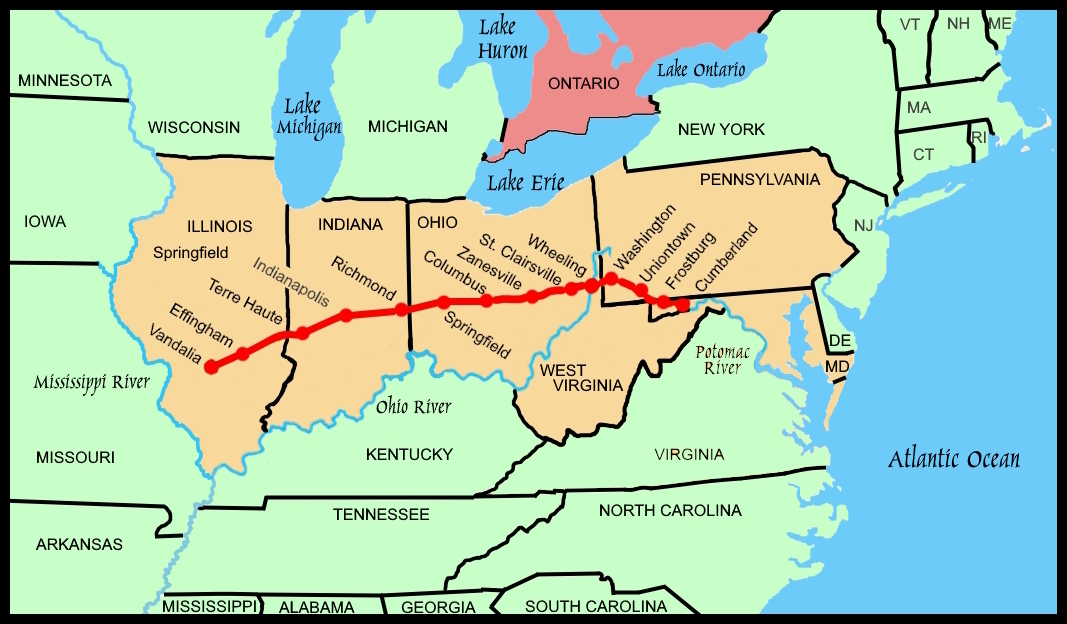
Actual construction work began in the summer of 1811 at the what later came to be know as the Zero Mile Marker. The new roadpath followed the same same alignment of the Braddock Road until arriving at Uniontown, Pennsylvania. From this location, the National Road, (also called the Cumberland Road) would depart from the Braddock Road, and instead continue northwest across Pennsylvania to Wheeling, Virginia on the Ohio River.
1
First, surveyors ran an alignment for 131 miles from Cumberland, Maryland, over the Allegheny Mountains to Wheeling, Virginia on the Ohio. Following the surveyors, the construction crew began building a stone-surfaced, cambered roadway, with culverts, masonry bridges, and cast-iron mileposts. Congress continued to approved successive appropriations from then through to 1838 which extended the highway westward into and across Ohio, then Indiana, and on into Illinois. The construction crews arrived at Zanesville, Ohio in 1933, Columbus, Ohio in 1834, the eastern outskirts of Indianapolis, Indiana in 1836, Terre Haute in 1838 and (the capitol of the state at that time), Vandalia, Illinois by 1839.
Up to this time, congress had appropriated about 6.8 million dollars for the work to build the National Road, and now, with widespread debates over the constitutional scope of federal internal improvements, and so, with the route at 591 miles in length, the federal contracts was terminated.
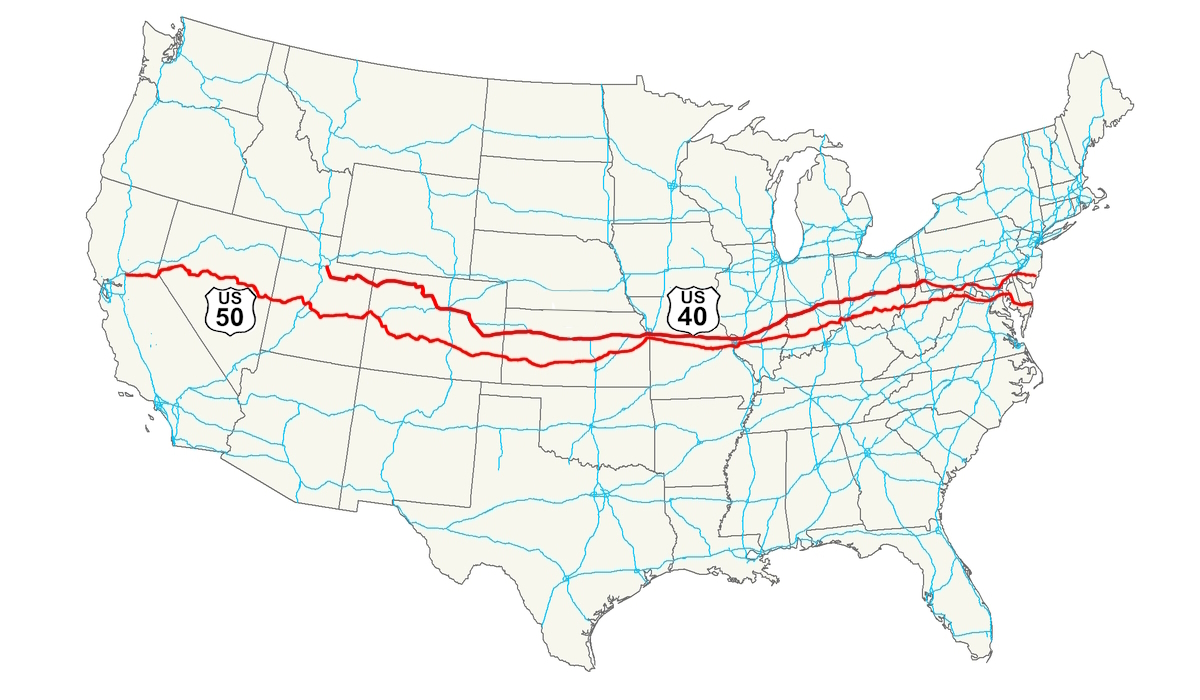
Finally, the federal government, transferred the operation and maintenance of all completed segments were to the states, beginning with Maryland in 1833, Pennsylvania in 1836, Virginia (now West Virginia) in 1838, Ohio in 1849, Indiana in 1849, and Illinois in 1856. The individual states then decided and funded any future construction of the National Road, and many portions were rebuilt in concrete and/or brick during the 1910s through to the 1930s and most were later incorporated into U.S. Route 40 highway.
Description:
Roadpath Type:
HHistoric, All American Road, 2002
Roadpath Built:
1811-1838
Rebuilt: 1910 through 1930s
Roadpath Materials:
1811-1839: stone surface, cambered, with culverts
1910-1930s: concrete foundation, with brick overlay
Roadpath Total Length:
1835: 591 miles, 951 km
1918: 621.4 miles, 1000 km
Roadpath Use:
Intra and Inter state transportation and commerce
Roadpath Waymark:
National Road Historic Sign, Varies with States
1839: cast-iron mile markers
1930 to present: US 40 signs
Roadpath State Length (original):
Roadpath Length in Maryland:
40 miles
National Pike, US Alt 40,
Roadpath Length in West Virginia:
16 miles
Roadpath Length in Pennsylvania:
90 miles
National Pike, Summit Inn 2424 feet
Roadpath Length in Ohio:
225 miles
Roadpath Length in Indiana:
150 miles
Roadpath Length in Illinois
89 miles
Roadpaths Terminus Points:
Eastern Terminus Point:
Location:
Cumberland, Maryland
Coordinates:
39.6497248, -78.7647979
Elevation:
657 feet
Western Terminus Point:
Location:
Vandalia, Illinois
Coordinates:
38.9607610, -89.0934200
Elevation:
525 feet
Roadpaths Elevations:
Roadpath Highest Elevation:
2,906 feet
(39.7064392, -79.2111821)
Keysers Hill, Maryland
Roadpath Lowest Elevation:
504 feet
(38.9614359, -89.0960134)
Vandalia, Illinois
Geographical Regions:
Geographical Region:
Interior Lowlands
Illinois, The Central Low Plains Ecoregion and
along the southern edge of Western Corn Belt Plains Ecoregion
Indiana, The Eastern Corn Belt Plains Ecoregion
Western Ohio, The Eastern Corn Belt Plains Ecoregion
Appalachian Mountains
Eastern Ohio, The Interior Plateau Ecoregion and
the West Allegheny Plateau Ecoregion
West Virginia, The West Allegheny Plateau Ecoregion
Pennsylvania, The West Allegheny Plateau Ecoregion, and
the southernmost area of the state′s Central Appalachian Mountains
Maryland, The Central Appalachian Mountains Ecoregion and
the western area of the Ridge and Valley Ecoregion.
Roadpath National Map:
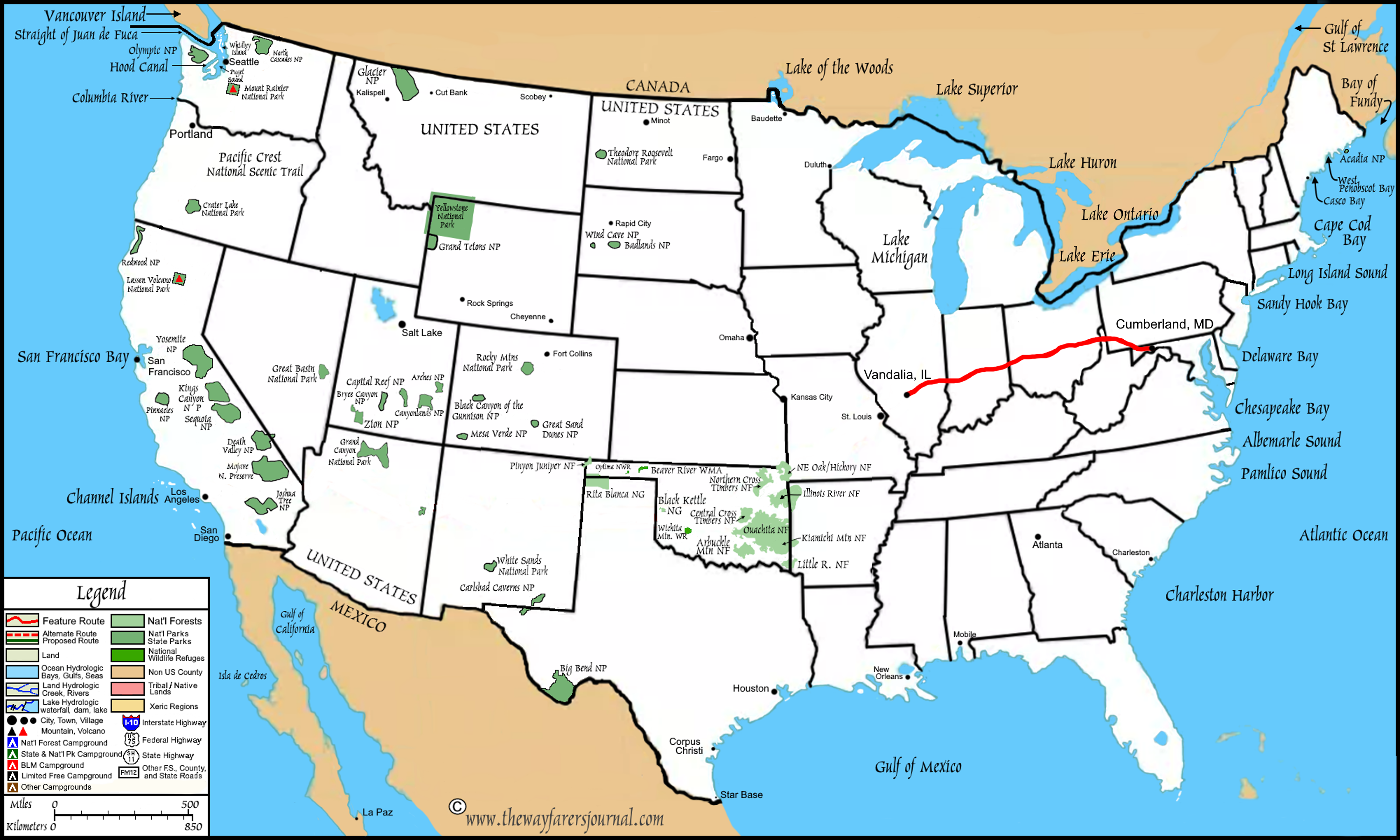
(m0-maps-us-road-nationalroad) National Road Map, 621.4 miles
|