|
A total solar eclipse occurs when the the Moon is at New Moon, and the Moon is at or very near to it′s
perigee. Further, the moon must be in one of it′s
orbital nodes, either ascending or descending, which occur only twice in the Moon′s orbit, and only when the Moon crosses the ecliptical plane.
When a total solar eclipse occurs, a portion of the Earth is engulfed in a shadow cast by the Moon which fully blocks sunlight in the shape of a disk and the shadow travels along a specified path across the surface of the Earth, a path whereupon from the observers view point, the Moon has totally obscured the entirety of the Sun′s disk.
The disk of the Moon′s shadow that travels across the Earth′s surface can travel at at a speed of more than 1,500 mph, always moving in a west-to-east direction. Further, the time that the Moon′s shadow is covering any one location varies greatly but averages from two to three minutes along the outer edges of the shadow in the path of totality, but always a longer time along the centerline of the path of totality. The maximum time that any one location will ever experience in the umbra shadow is about 7.5 minutes.
The Tip of the Moon′s Umbral Cone
The diameter of the tip of the Umbral Cone (Moon′s shadow) on the Earth′s surface also varies greatly. When the total eclipse occurs upon the earth at a latitude between the two tropics (tropic of Cancer and tropic of Capricorn), the diameter can be from about 75 miles in diameter to possible as much as a 100 miles in diameter and sometimes a little more.
Other latitudes closer to the north and south poles, can have a shadow of a very large diameter reaching as much as 600 miles (1000 km) wide, but in those locations, the speed of the travel of the shadow also greatly increases.
During a total eclipse, in areas outside of the path of totality, an observer sees the ongoing solar eclipse only as a partial eclipse, and this region of available viewing of a partial eclipse can often be thousands of miles wide.
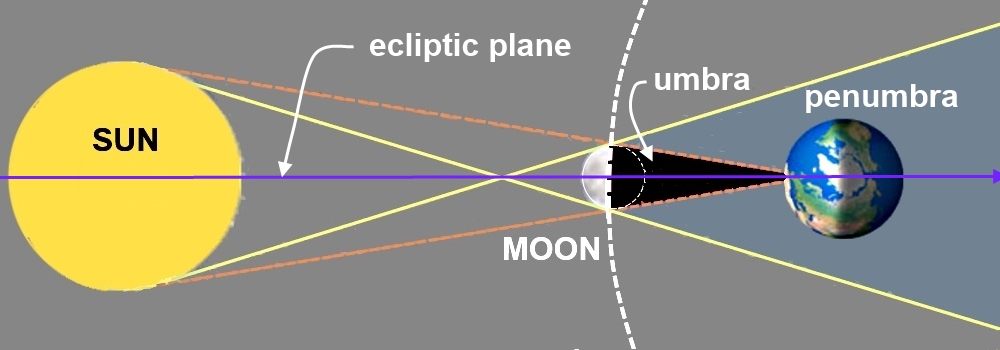
(m5pr-sun-total-eclipse) Total Solar Eclipse, Tip of Umbral Cone
Only In the Nodes
A total eclipse of the sun can only occurs when the Sun, Moon and Earth are precisely aligned in a straight line. Such alignment coincides with a new moon indicating the Moon is closest to the ecliptic plane and within one of it′s nodes. (See
Orbital Nodes)
The specified path upon the Earth where the Sun is fully obscured by the Moon is the only place where the total eclipse can be seen in totality. This location is commonly called The Path of Totality. (more below)
Diamond Ring Effect
Of all the phenomena you will witness during a total solar eclipse, the diamond ring effect will be perhaps the most striking celestial event. The diamond ring effect occurs just as the last bit of exposed Sun is extinguished before totality and often a second time at the moment when totality ends and the Sun reappears. While the diamond ring effect will be very brief, it will likely be one of the most lasting memories you will have from the eclipse.
The Double Diamond Ring
Sometimes, a total solar eclipse when the Diamond Ring effect occurs, it will create a double diamond ring. What that means is, there will be two brilliant bits of the Sun being simultaneously extinguished at the beginning of total eclipse, or two brilliant bits appearing when the Sun returns at the end of totality.
Just before the diamond ring effect, often, what is seen is series of fine bits of sunlight, a phenomena known as Baily′s Beads. The Baily′s Beads will quickly vanish one by one until only one bead is left, which is usually the Diamond Ring effect. Using precise elevation models of the irregular topography on the Moon, it can now be predicted exactly where the Baily′s Beads converge into two beads instead of just one. This is how the phenomena known as the double diamond ring appears.
The best location to see the double diamond ring is when the viewer is nearest to the center of The Path of Totality.
|