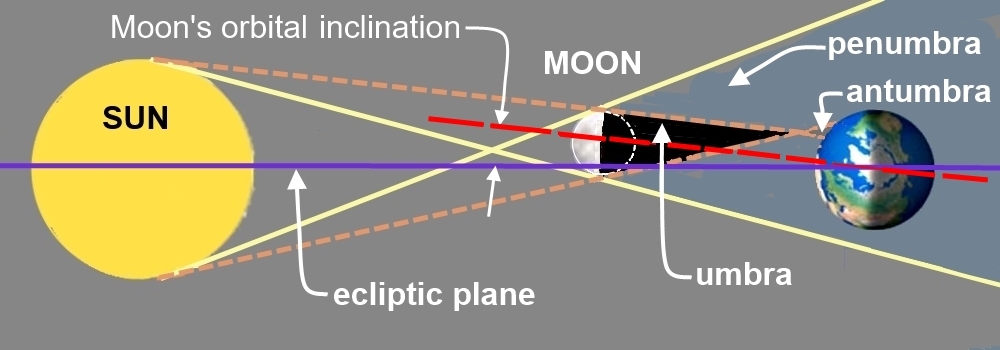
A Partial solar eclipses happen when the Moon comes between the Sun and Earth, but the Moon only partially covers the Sun′s disk, caused by not having a perfect alignment of the three celestial objects into a straight line. In most cases, this perfect alignment is not achieved because the Moon, in it′s orbit, is not in one of the
orbital nodes, but instead, is in a position of it′s orbit which is above or below the ecliptical plane.
The amount of the Sun′s disk that is covered varies and depends on how far the moon is located from the ecliptical plane, which is due entirely to the Moon′s orbital inclination. The amount of brightness is referred to as eclipse magnitude.
During a partial solar eclipse, the Moon′s umbra or antumbra, the shadow′s center portion, is cast onto one of the polar regions of the Earth, or it is cast into space just outside of that polar regions, missing Earth by a narrow margin.
This means that partial solar eclipses, while potentially being visible at all latitudes, usually center around a place close to one of the poles.