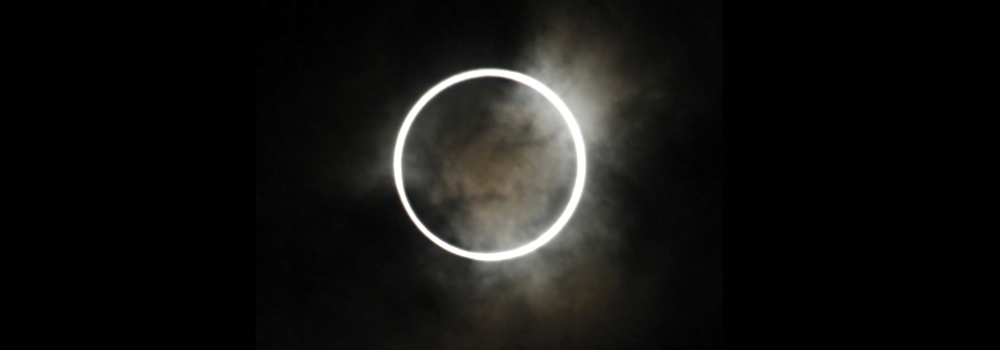
An annular solar eclipse occurs when a portion of the Earth is engulfed in a shadow cast by the Moon which partially blocks sunlight. Normally, an annular solar eclipse occurs when the Sun, Moon and Earth are closely aligned and such alignment coincides with a new moon
(syzygy) indicating the Moon is closest to the ecliptic plane.
Unlike a total eclipse when the disk of the Sun is fully obscured by the Moon, it is different with annular eclipses. During an annular solar eclipse, the Moon′s diameter appears to be smaller than the Sun′s diameter, resulting in the Moon obscuring all but a thin outer edge of the Sun.
(m5pr-su-annular.20120520) 20 May 2012 Annular Solar Eclipse
photo credit:Wikipedia
Annular Eclipse.
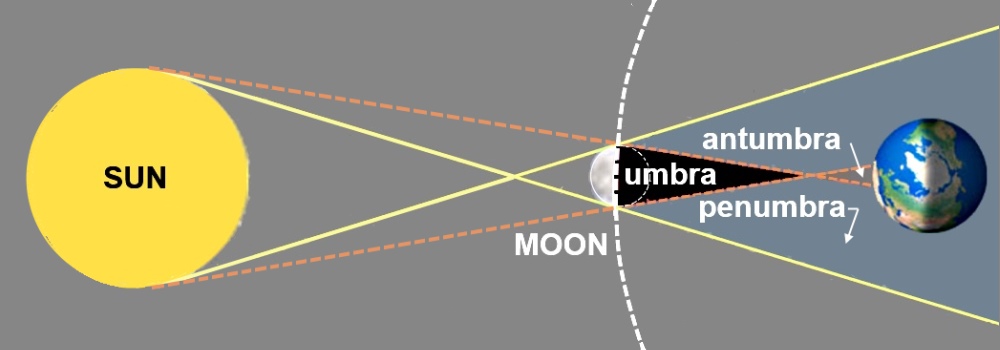
An annular solar eclipse occurs when the umbra portion of the Moon′s shadow does not reach the surface of the earth. However, the antumbra portion of the shadow that the Moon casts does fall upon the surface of the earth, and when this happens, the resulting eclipse will have a ring around the Moon.
An annular solar eclipse occurs because the Moon is at or near to the it′s
apogee, the location in its orbit which is the farthest distance from the Earth.
Also, an annular solar eclipse occurs when the moon is a New Moon, and is in or very near to one of the
orbital nodes, with the alignment in a perfectly straight line or very close to it.
(m5pr-sun-annular.eclipse) The Moon at or near to Apogee