|
Neptune is the eighth planet from the Sun and most distant known planet. In the Solar System, it is the fourth-largest planet by diameter, the third-most-massive planet, and the densest giant planet. It is 17 times the mass of Earth, slightly more massive than its near-twin Uranus. Neptune is denser and physically smaller than Uranus because its greater mass causes more gravitational compression of its atmosphere.
Neptune, at 2.8 billion miles from the sun, is not visible to the unaided eye and is the only planet in the Solar System found by mathematical prediction rather than by empirical observation.
The distance of Neptune from Earth gives it a very small apparent size, making it challenging to study with Earth based telescopes. Neptune was visited by Voyager 2 when it flew by the planet on 25 August 1989 and Voyager 2 remains the only spacecraft to visit Neptune. The advent of the Hubble Space Telescope and large ground based telescopes with adaptive optics has recently allowed for additional detailed observations from afar.
Some of the earliest recorded observations of Neptune ever made through a telescope were done by Galileo when he made drawings on 28 December 1612 and 27 January 1613 containing plotted points that match up with what is now known to be the position of Neptune. On both occasions, Galileo seems to have mistaken Neptune for a fixed star when it appeared close—in conjunction to Jupiter in the night sky. Hence, he is not credited with the discovery of Neptune. At his first observation in December 1612, Neptune was almost stationary in the sky because it had just turned retrograde that day.
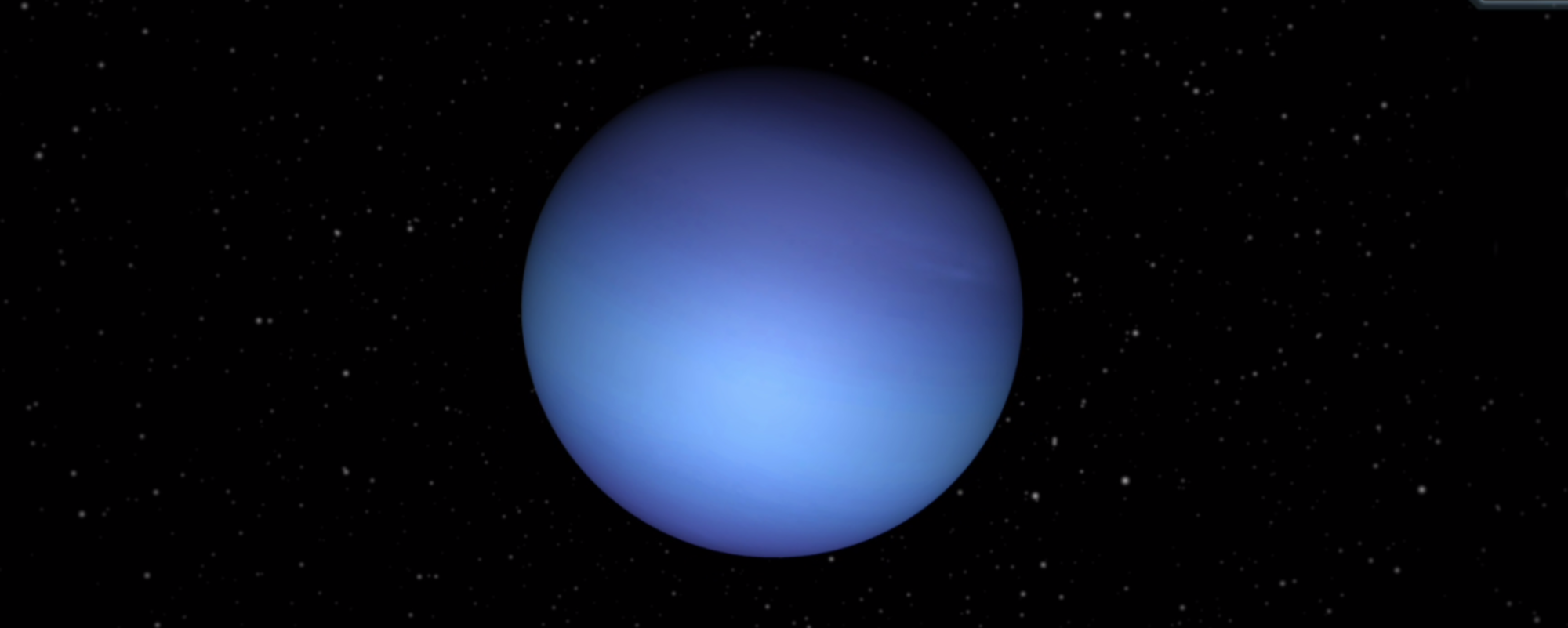
(m5pr-planet-neptune-aa.image) The Planets, Neptune
Credit: Solar System Scope
Facts about Neptune
Discovered: Johann Galle and Urbain Le Verrier
Date Discovered: 23 September 1846
Planet Type: Gas-ice Giant
Average Distance from Sun: 2.8 billion miles
Equatorial Diameter: 30,760
Axil Tilt (to orbit): 28.32 °
Inclination to Ecliptic: 1.767975 °
Length of Day (rotation period): 16.11 hours
Length of Year (orbital period): 164.8 years
Orbital Eccentricity: ~0.009
Surface Gravity (amount times Earth gravity): 1.14
Surface Temperature: -346 ° F.
Moons: 14
Rings: Faint and Fragmented
Moons of Neptune
The two largest moon are Tritron and Proteus. Triton, the larger of the two is much further out from Neptune than Proteus is. Too, the orbit of these moons each have a different inclinations from Neptune.
Neptune′s Moons:
Naiad, Thalassa, despina, Galatea, Larissa, Hippocamp,
Proteus,
Triton,
Nereid, Halimede, Sao, Laomedela, Psamathe, and Neso.
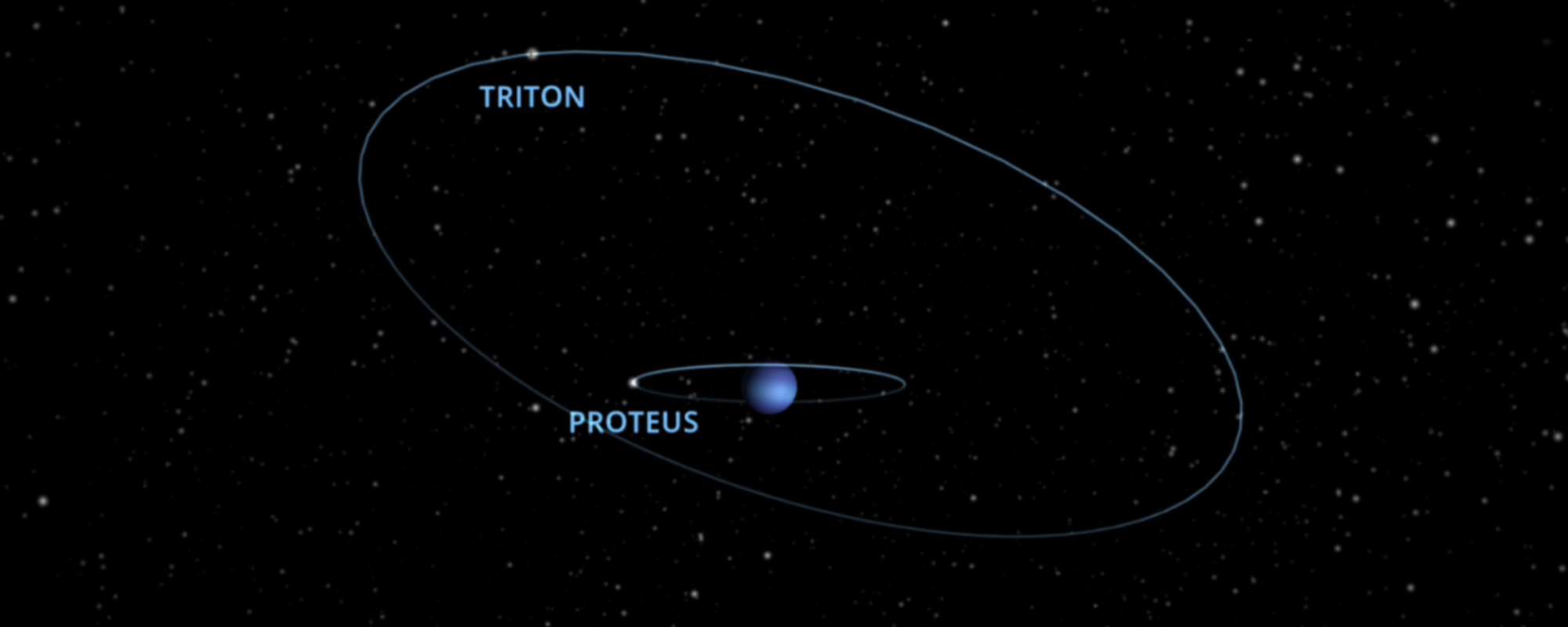
(m5pr-planet-neptune.moons) Moons of Neptune
Credit: Solar System Scope
|