|
Triton is the largest natural satellite of Neptune and the first moon of Neptune to have been discovered. Triton is the seventh largest moon in the solar system and the only large moon in the solar system that has a retrograde orbit, and orbit that is opposite to the planet that it orbits. Because of its retrograde orbit and composition similar to Pluto, Triton is thought to have been a dwarf planet captured from the Kuiper belt.
Triton, along with Io, Venus and Earth are the only celestial bodies in the solar system that are currently volcanically active. Due to the high reflectivity of Triton, it is one of the coldest celestial objects in the solar system.
During the 1989 flyby of Titon, Voyager 2 found active geysers and the extremely low surface temperature, but Voyager 2 was only able to study about forty percent of the surface of Triton.
In the photo bolow and to the left of Triton, Proteus is see orbiting closer to Neptune.
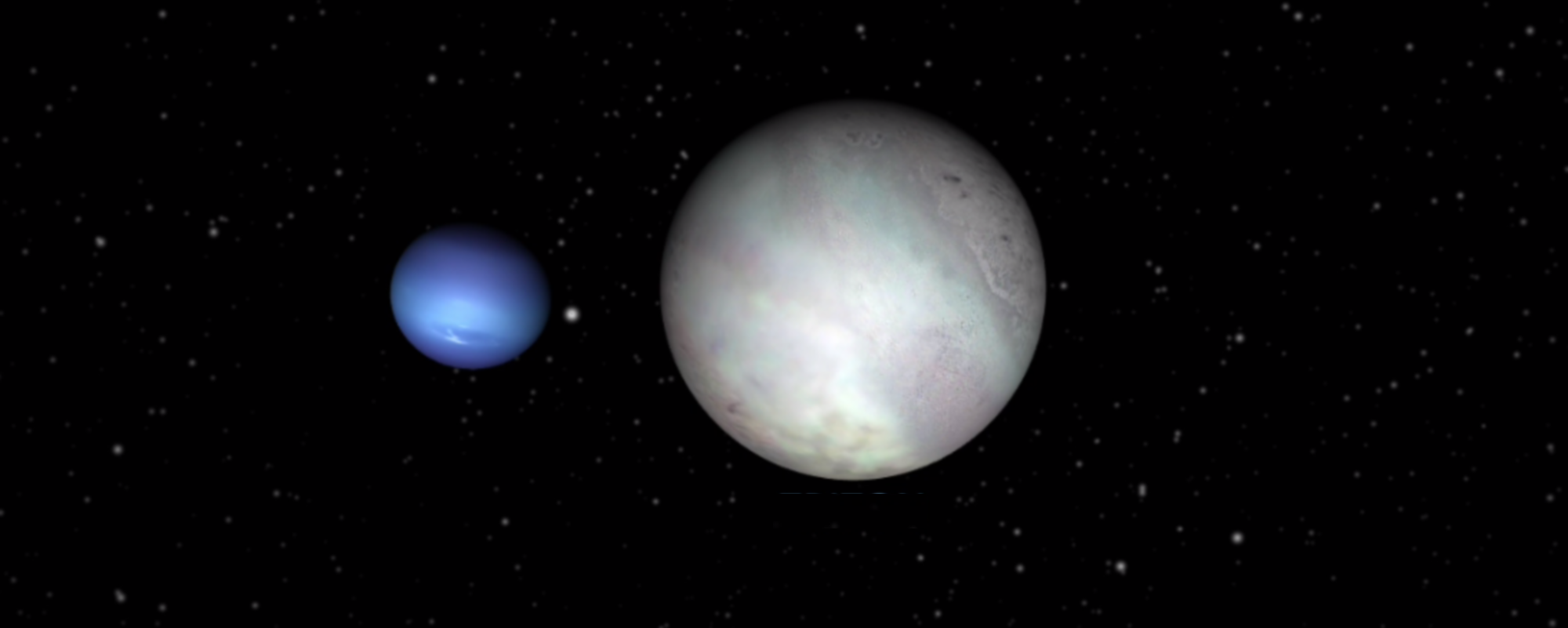
Facts about Triton
Discovered by: William Lassell
Date of Discovered: 10 October 1846
Planet Orbital Position: 7
Equatorial Diameter: 1682 miles
Average distance from Planet: 221,066 miles
Axil Tilt to orbit: 0 °
Inclination to ecliptic: 129.812 °
Rotation Period: 5.9 days
Orbit Period: 5.9 days
Surface Temperature: -391 ° F.
|