|
Total Lunar Eclipse
A Moon that is said to be in total eclipse, is completely within the umbra shadow of the Earth. At this time, the Moon is sometimes referred to as a
Blood Moon because of it having a reddish color. This red color of the Moon is caused when the Earth completely blocks direct sunlight from reaching the Moon and then, the only light seen upon the lunar surface is that light which has been refracted by the atmosphere of the Earth.
This refracted light appears red-orange in color for the same reason that a sunsets and/or sunrises appears red-orange. This principle of refracted light is called the
Rayleigh scattering of blue light.
The type and length of a lunar eclipse depend upon the proximity of the Moon to either of it′s two orbital nodes, or, said another way, the extent of a lunar eclipse depends upon how close the Moon is to the
ecliptic plane.
Eclipses: Lunar verses Solar
Typically, lunar eclipses, which are more common than solar eclipse may be viewed from anywhere on the night side of the Earth when the weather is clear. The duration of lunar eclipses is much longer than the solar eclipses, lasting up to nearly two hours, because the earth is larger than the moon. Unlike solar eclipses, lunar eclipses are safe to view without any eye protection or special precautions, as these eclipses are dimmer than the full Moon.
In contrast, a solar eclipse can only be viewed from a relatively small area of the world, an area commonly called the
path of totality, typically have a short duration and require the use of special viewing glases.
A solar eclipse, at the very longest will have a duration of only seven minutes and 29.22 seconds. However, that particular solar eclipse event will not occur until 16 July 2186 as part of the solar saros series 139. Currently, during the 21st century, the longest solar eclipses had a duration of a little under four and a half minutes, with was the total solar eclipse seen on
08 April 2024.
What is A Lunar Eclipse?
The moon does not have any light of its own but shines because its surface reflects sunlight. Thus, when the Moon passes directly behind the Earth into its
umbra most all sunlight is blocked and a lunar eclipse occurs.
During a total lunar eclipse, the Earth moves between the Sun and the Moon and in doing this cuts off the light supply from the Sun to the Moon. When this happens, the light that makes it through the atmosphere of the Earth causes the moon takes on a reddish glow instead of going completely dark.
The shadow that the Earth casts can be divided into two distinctive parts: the umbra and penumbra. Earth totally blocks direct solar radiation within the umbra, which is the central region of the shadow. However, the Earth only partially blocks direct sunlight within the penumbra, the outer region of the shadow.
Total Lunar Eclipse
A total lunar eclipse occurs when the entire Moon enters the darkest part of the shadow of the Earth and the Moon is entirely within the region of the shadow called the umbra.
Three celestial events must occur at the same time for a total lunar eclipse:
1. The Moon must be in one of its two orbital nodes.
2. The Earth must be between the Sun and the Moon,
3. The Moon must be in the Full Moon phase, and
4. The Sun, Earth and Moon must be in
syzygy.
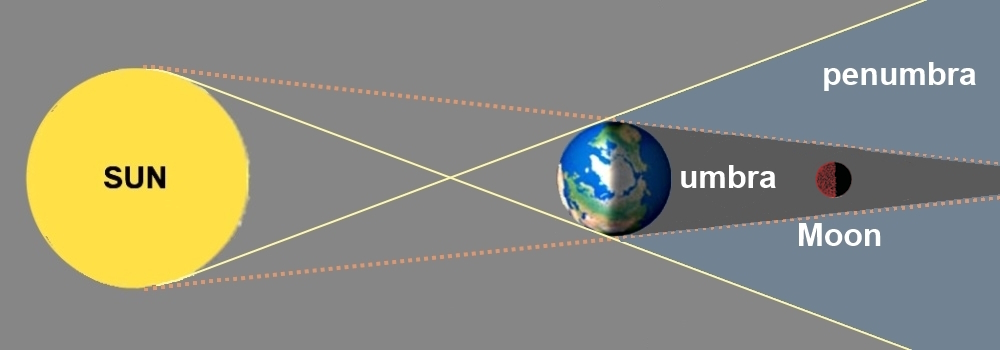
(m5pr-moon-total-umbra) The Lunar Total Eclipse
|