|
All lunar eclipses occur at the full moon phase when the Earth is positioned precisely between the Moon and the Sun. Earth′s shadow falls upon the surface of the Moon, dimming the light upon the Moon and sometimes turning the lunar surface to a striking red color.
Each lunar eclipse is visible from only half of the Earth and this half is always the night side.
Partial Lunar Eclipse
A partial lunar eclipse occurs when there is an imperfect alignment of the Sun, Earth and Moon which results in the Moon passing though only part of the umbra region of the Earth′s shadow. The shadow of the Earth on the moon grows and then recedes without ever completely covering the Moon.
When a partial lunar eclipse occurs and the umbra shadow of the Earth does cover a portion of the surface of the Moon, the light of the Sun is totally blocked in that portion only. However, the rest of the surface of Moon is usually covered by the outer part of the shadow of the Earth, that portion of the shadow which is called the penumbra.
For a partial lunar eclipse to occur, four celestial events must happen at the same time:
1. The Moon must be in one of its two orbital nodes.
2. The Earth must be between the Sun and the Moon; and
3. The Moon must be in the Full Moon phase.
4. The Sun, Earth and Moon must be aligned close to
syzygy.
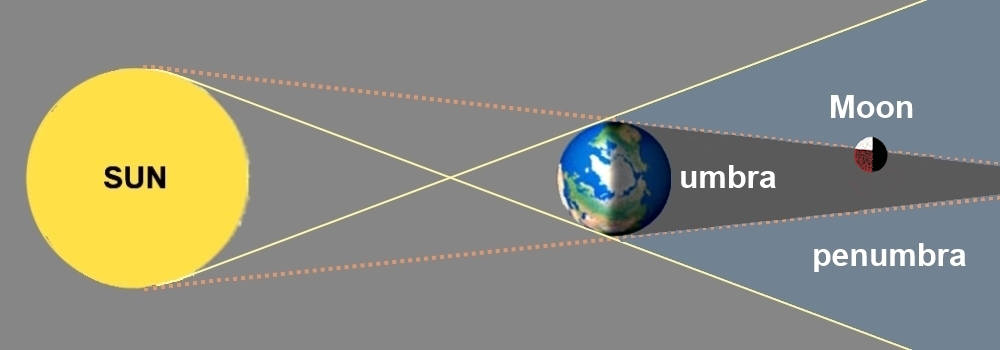
(m5pr-moon.partial) The Lunar Partial Eclipse
|