|
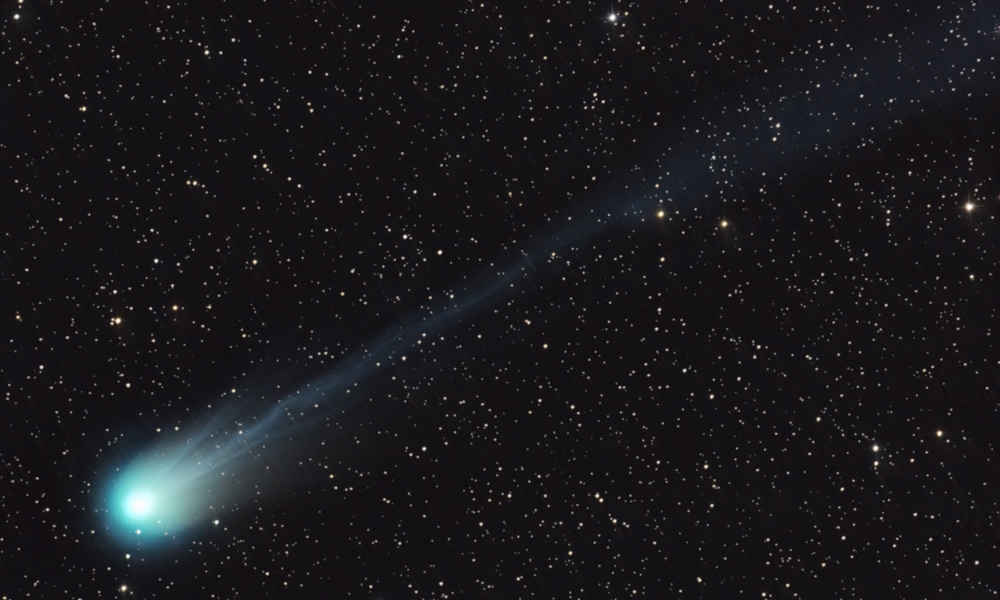
Comet Ponds-Brooks
Comet Description:
This comet, designated 12P/Pons-Brooks is a periodic comet with an orbital period of 71 years.
1 It is one of the brightest known periodic comets, reaching an absolute visual magnitude of about 5 in its approach to perihelion. Comet Pons-Brooks was discovered at Marseilles Observatory in July 1812 by Jean-Louis Pons, and then, on its next appearance in 1883 by William Robert Brooks. There are some ancient records of comets that could have been 12P/Pons–Brooks.
The next perihelion passage has been calculated to be on 21 April 2024 with its closest approach to Earth occurring on 02 June 2024 at a distance of about 144.16 million miles (232 million km or 1.5 AU), with the maximum brightness of magnitude 4.5, making it visible with the naked eye.
Comet Specifications:
Comet Designation:
12P/Pons-Brooks
Discovery:
Discovery Date:
12 July 1812 by Jean-Louis Pons
Independently, this comet was found by Vincent Wisniewski on 01 August, and Alexis Bouvard on 02 August of the same year. Then, on 13 August 1812, the comet was spotted with the naked eye and by the end of the month a tail measuring 2 degrees in length was reported.
Discovery Date:
02 September 1883 by William Robert Brooks
Then, on 20 November 1883, the comet became visible with naked eye and brightened to a magnitude of 3 with occasional outbursts.
Orbital Characteristics:
Orbital Type:
Periodic Comet
Orbital Period:
71.32 years
Inclination:
74.191°
Date of Next Perihelion:
21 April 2024
Date of Last Perihelion:
22 May 1954, 25 Jan. 1884, 15 Sept. 1812
Physical Characteristics:
Comet Dimensions:
21 ± 6 mile (34 ± 12 km)
Comet Magnitude:
Apparent Magnitude:
4.5
Total Magnitude
5
Object it Orbits:
Sun
Ancient Passages:
A comet that was observed by Paolo dal Pozzo Toscanelli in January 1457 (and mentioned in Chinese documents) has been identified as comet 12P/Pons–Brooks.
A comet that was observed in 1385 and recorded by the Chinese in Ming Shilu has been identified as 12P/Pons-Brooks. The apparition of the comet during this perihelion was very favorable, one which was also mentioned in some European records. In both the above apparitions the comet had a magnitude of 3 or brighter.
It is also possible that it was also a comet that has been included in Chinese records during September 245 CE.
|