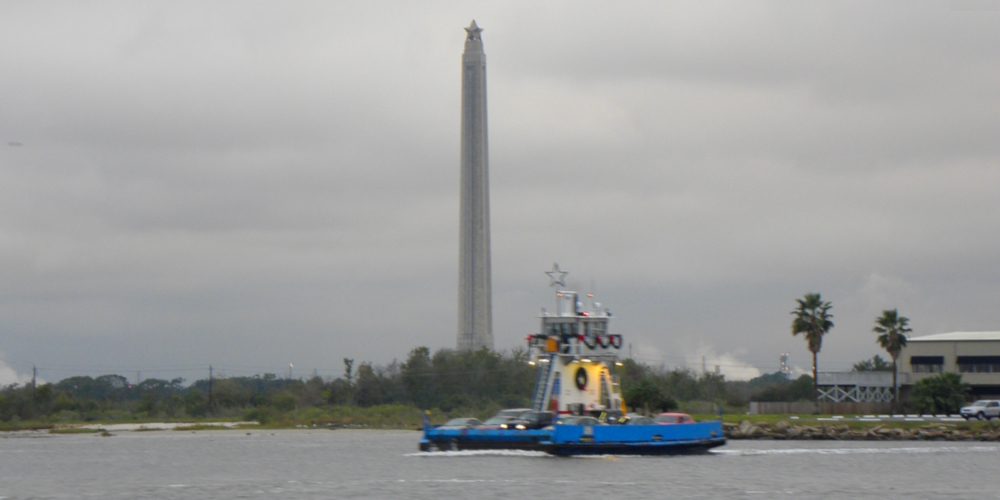
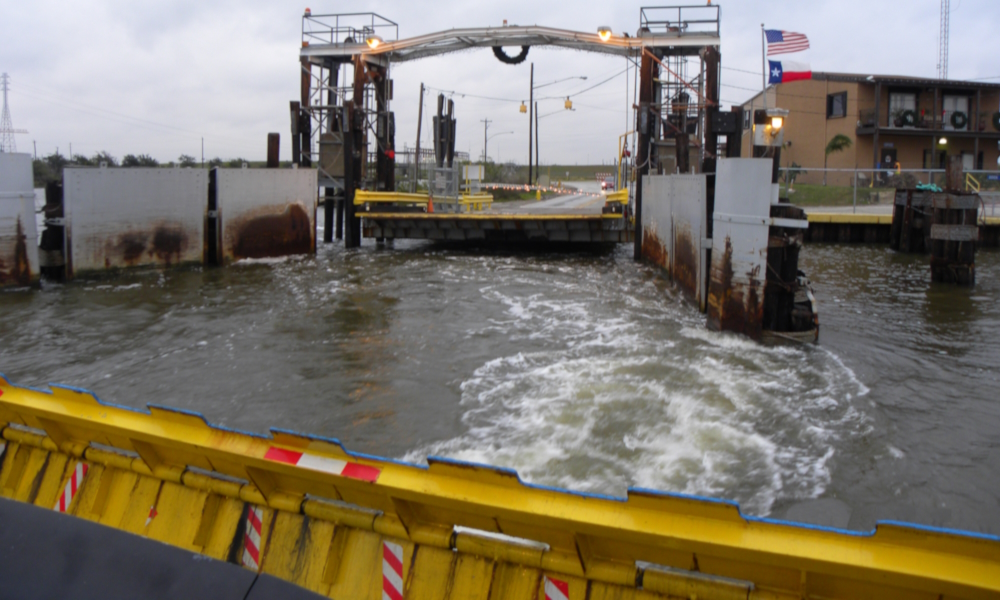
Lynchburg Ferry Story:
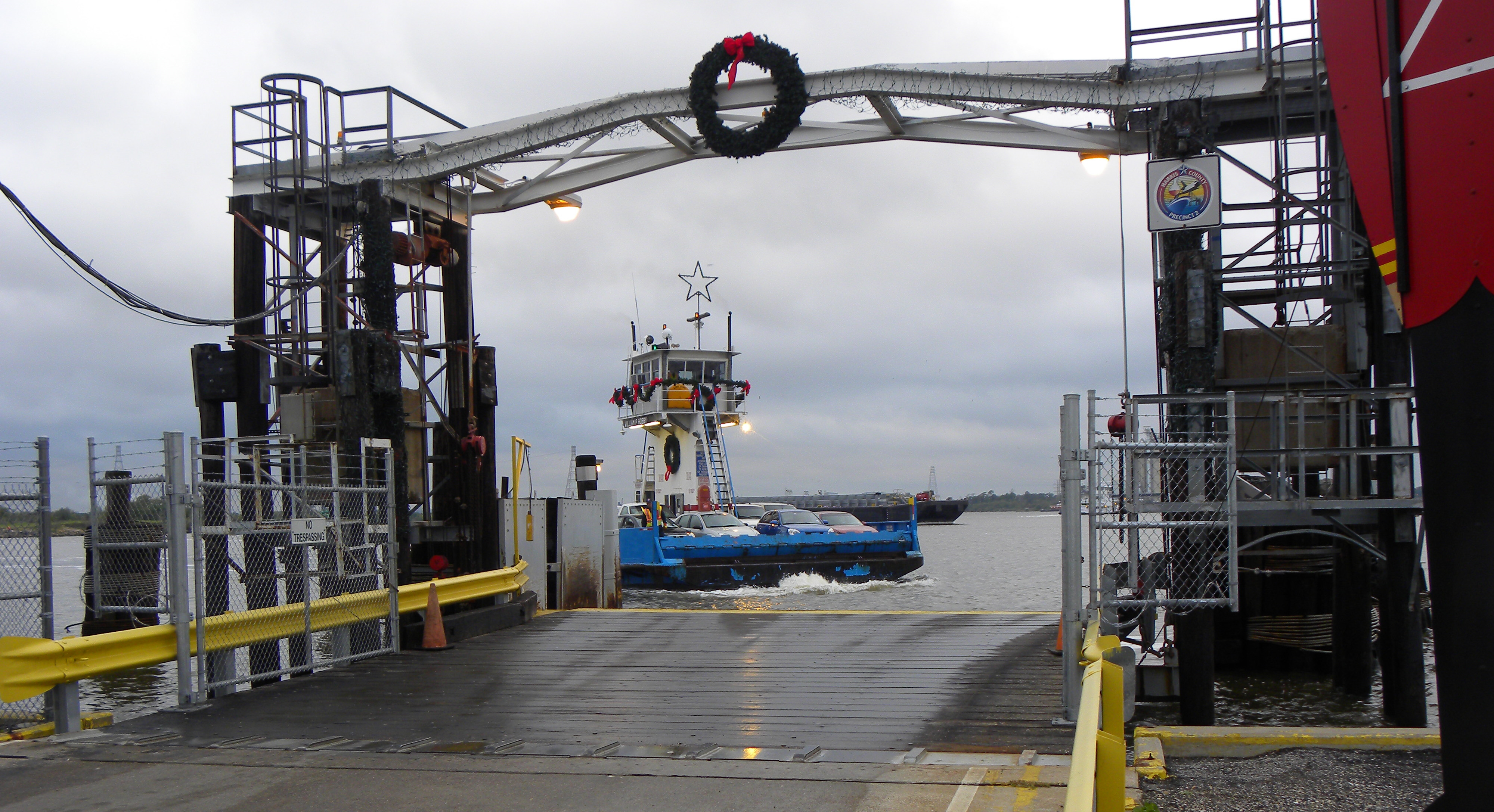
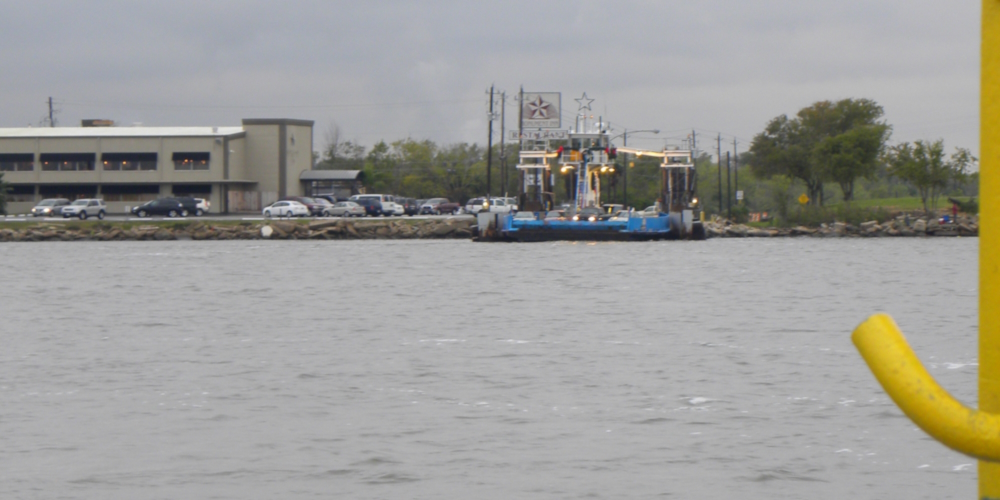
The Lynchburg Ferry is a free ferry across the San Jacinto River, also known as the Houston Ship Channel connecting Crosby-Lynchburg Road in Lynchburg to the north with the former State Highway 134 and San Jacinto Battleground State Historic Site in Deer Park-La Porte to the south. This ferry is operated by the Harris County Toll Road Authority, travels the 1,080 foot (330 m) crossing of this waterway and is the oldest operating ferry service within the state of Texas.
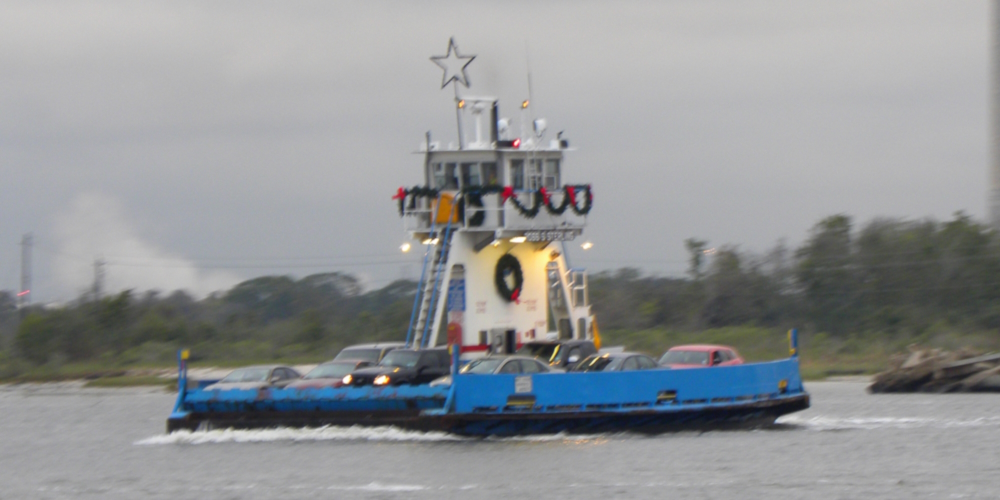
The ferry service has two primary ships in its fleet, both completed in 1964 by the Todd Shipyard. The two ferries are identical and named in honor of former Texas governors William P. Hobby and Ross S. Sterling. The ferries depart from opposite landings and cross rotationally each traverse, beginning at 04:30 CT and continuing until 20:15 CT every day. The ferries each have a maximum capacity of 10 vehicles, less if large trucks cross and averages between 1,500 to 2,000 vehicles per day.
A third ferry with a capacity of 9 vehicles, a ship dating from 1937 is available on standby if needed.
Todd Shipyard built the William P. Hobby and Ross S. Sterling ferryboats in 1964. Both ferries are 61'8" x 40'5" in length and 8'9" in depth. Their weight is 85 gross registered tonnage, and a capacity of 10 vehicles. Depending on the wind, currents and traffic the ferry can take up to 5-10 minutes to cross the ship channel.
History
The present-day location of the Lynchburg ferry can trace its origins back to 1822 when it was founded by Nathaniel Lynch just below the confluence of the San Jacinto River and the Buffalo Bayou, at which time, this crossing was known as Lynch′s Ferry.
In 1830, Lynch moved his ferry upstream to a peninsula formed by a meander of the San Jacinto River, near the present landing. Lynch passed away in 1837 and his family continue to operate the ferry service until 1848.
After the fall of the Alamo in March 6th, 1836 the colonist living in Texas started a mass exodus, known as the Runaway Scrape, the movement of thousands of Texans who were fleeing eastward towards the Sabine River just ahead of the Mexican Army. At times there were as many as five thousand men women, children, wagons and livestock waiting to board Lynch′s Ferry.
The ferry was used by the Republic of Texas troops when fighting the Mexican forces during the Battle of San Jacinto which occurred on 21 April 1836.
The area along Buffalo Bayou had many thick oak groves, separated by marshes. This type of terrain was very familiar to the Texans but not at all familiar to the Mexican soldiers. Houston′s army, comprising around 800 men, reached Lynch′s Ferry site mid-morning on the 20th of April. The Texans made camp in a wooded area with the bank of Buffalo Bayou to the west behind them, which location provided good cover and helped to hide their full strength, but it left the Texans no room for retreat. The advancing 700 man force under the Mexican General Antonio Lopez de Santa Anna arrived at the Lynch′s Ferry site a few hours later and made camp in a vulnerable location, on a plain east of the Texans and near to the San Jacinto River. Their camp was bordered by woods on one side with a marsh and lake on the other. The two camps were about 500 yards apart, separated by a grassy area with a slight rise in the middle.
Although there were a few skirmishes on this day, during which the Texans used their Twin Sisters cannons to defeat the Mexican artillery causing them to withdraw. The rest of the evening was spent in fortification for the opposing camps. Then, at 09:00 am the next morning, the Mexicans received over 540 reinforcements of mostly raw recruits.
At 16:30, the Texan Twin Sisters fired beginning the battle and after a single volly, the Texans broke ranks and swarmed over the Mexican breastworks to engage in hand-to-hand combat, yelling: Remember the Alamo! Remember La Bahia! (Goliad)
The Mexican soldier were taken by surprise and the Texan infantry forces advanced until they had taken the Mexican breastwork and woodland areas. Within 18 minutes, Mexican soldiers abandoned their campsite and fled for their lives, but the killing of the Mexican soldiers lasted for hours in one of the most one-sided victories in history, There were 650 Mexican soldiers killed, 208 wounded and 300 captured. The Texans only had 11 soldiers killed and 30 wounded.
The Texas army lead by Sam Houston, defeated Santa Anna at San Jacinto, a defeat which resulted in the independence of Texas from any and all Mexican influence. Still, Houston knew well that there were still another 4,000 troops within Texas that were under the command of two other Mexican Generals. Also, Santa Anna had escaped and headed towards Vince′s bridge, but Houston had previously had the bridge burned, so Santa Anna hid in the march and was captured the following day disguised in the uniform jacket of a private, which subterfuge was uncovered when other Mexican prisoners cried out in recognition of their General.
The Texan soldiers gathered around and began calling for the immediate execution of Santa Anna, who volunteered to order the remaining Mexican troops to stay away. This did occur and most of the Mexican forces retreated to Béxar to await further instructions. Santa Anna continue to negotiate with Houston, Rusk and Burnet during which two treaties, known as the Treaties of Velasco, including a public version between the two countries and a private agreement of Santa Anna′s personal agreements. These treaties required that all Mexican troops withdraw south of the Rio Grande river, all private property be restored and respected, prisoners of war would be released unharmed and Santa Anna would be given immediate passage to Veracruz.
By late May, the Mexican troops retreated under General Filisola amd had crossed the Nueces River, but the General fully expected that the defeat was temporary and a second campaign would be launched to retake Texas. Within months, General Urrea had gathered 6,000 troops in Matamoros and was poised to reconquer Texas, but instead was redirected to address federalist rebellion in other regions. Still, out of caution, Béxar remained under martial law throughout 1836. On 01 June 1836, Santa Anna boarded a ship to return to Mexico. Meanwhile, there was a call for elections to ratify the constitution and elect a Congress for Texas during which convention, Houston was overwhelmingly chose as the first president of the Republic of Texas.
In 1837, the county commissioners court set a rate fee for using the ferry service, but later during 1890, that same court eliminated the fee schedule and the ferry service has been free ever since.
In 1888, Harris County purchased the ferry service and in 1920, put the diesel powered Chester H. Bryan Boat into service. In 1945, the Tex Dreyfus boat was added. By 1949, the ferry service was renamed the Lynchburg Ferry at which time was serving as the first vehicular crossing of the Houston Ship Channel.
By the 1950s, the town of Lynchburg had begun to grow and new businesses were opened including a shipyard and other marine service companies. Also, the Coastal Water Authority began operations. The ferry continued to serve county residents throughout the 1950s and 1960s who worked at the port of Houston and the many petrochemical plants along the ship channel. The Lynchburg Ferry remains as an important economic contributor to the south Texas coast area.
Then, In 1964, both the Chester H. Bryan and the Tex Dreyfus were replaced by the William P. Hobby and the Ross S. Sterling, which began daily service under the operation of Harris County, operating 24 hours a day, 365 days a year. This full time service continued until June 2004 when the hours of operation were reduced to their current times.
On 01 March 2020, the operations of the Lynchburg Ferry together with the Washburn Tunnel were both transferred from Harris County to the Harris County Toll Road Authority, but there has been no plans to implement tolls on either the ferry nor the Washburn tunnel.
Much of the above information was found on a Texas Historical Marker, one which is located north of Lynchburg Ferry at 800 Independence Parkway N in Lynchburg, Texas at coordinates: 29.7650617, -95.0772191. Too, this ferry service is in a location which is called The Birthplace of Texas.
Driving Directions:
The south landing of the ferry is accessed from Deer Park, Texas.
Access to the south landing of this ferry crossing is by taking the Independence Parkway exit from Texas SH 225, and then driving north on Independence Parkway to the ferry landing.
Location:
Coordinates:
29.7619559, -95.0806565
Elevation:
2 feet
Boat Construction:
Boat Names:
William P. Hobby USCG Doc 545784
Boat Names:
Ross S. Sterling, USCG Doc 545783
Builder:
Todd Shipyards
Site:
Galveston, Texas
Construction Material:
Steel
Year Built:
1964
Boat Specification
Date Commissioned
1964
Boat Class and Type:
Both ferries are identical.
Boat Class:
Motor Powered
Boat Type:
Passenger Ferry Boat
Boat Capacity:
Net Capacity:
57 tons
Load Capacity:
12 Short ton
Cargo, Vehicles:
10 auto and/or trailers
Cargo, Passengers:
48
Boat Crossing Time:
5 to 10 minutes
Boat Measurements:
Displacement:
85 gross registered tonnage
Overall Length:
61 feet, 8 inches
Beam: (Breadth)
40 feet, 5 inches
Load Draft:
5 feet
Light Draft:
3 feet
Boat Engines:
Installed Power:
165 horsepower
Propulsion:
Speed:
knots ( km/h).
Rante:
miles ( km).
Complement:
officers and men
Coast Guard Number:
545783
29.763, -95.0803
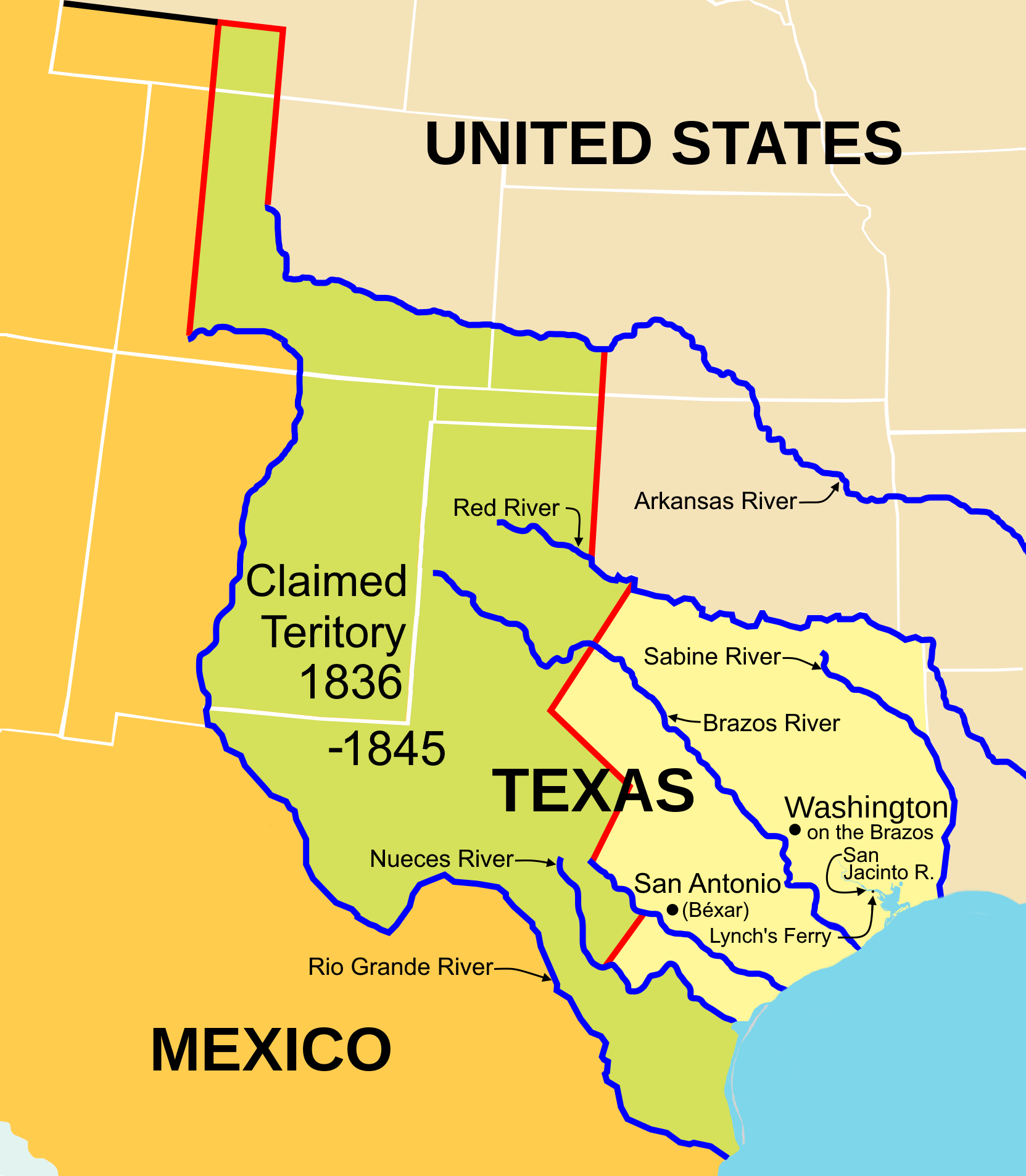
(m0maps-texas-1836) Texas during 1836