|
Pluto is a dwarf planet in the Kuiper belt and was the first and largest Kuiper belt object to be discovered. When it was discovered in 1930, it was declared to be the ninth planet from the sun. In 2006, the International Astronomical Union formally declared the definition of a planet, which definition excluded Pluto as a planet and reclassifying it as a dwarf planet.
Pluto is the ninth-largest and tenth-most-massive known object directly orbiting the Sun. It is the largest known trans-Neptunian object by volume but is less massive than Eris. Like other Kuiper belt objects, Pluto is primarily made of ice and rock and is relatively small, being only one-sixth the mass of the Moon and one-third its volume.
Pluto has a moderately eccentric and inclined orbit, which means that periodically, Pluto comes comes closer to the sun than Neptune.
Pluto has five known moons, Charon, Nix, Hydra, Kerberos, ans Styx. The largest moon, Charon has a diameter just over half that of Pluto which is often considered to be a binary system because the barycenter of their orbits does not lie within either body.
The spacecraft, New Horizons, performed a flyby of Pluto on 14 July 2015, and became the first and only spacecraft to do so. During this brief flyby, the New Horizons spacecraft made detailed measurements and observations of Pluto and its moons.
Discovered in 1930, Pluto has yet to complete a full orbit of the Sun since its discovery, as one Plutonian year is nearly 250 years long
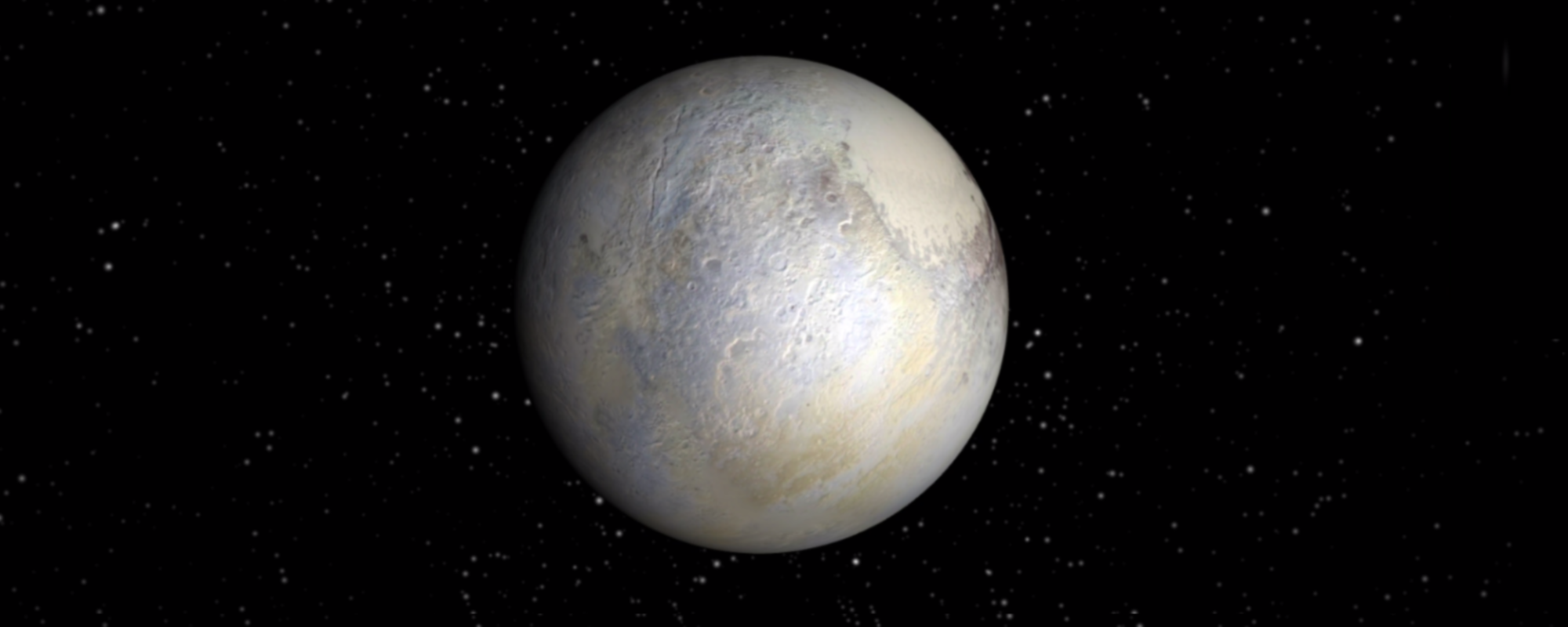
(m5pr-planet-pluto.01) The Dwarf Planet, Pluto
Facts about Pluto
Discovered: Clyde Tombaugh
Discovery Date: 18 February 1930
Planet Type: Dwarf Planet, Kuiper Belt Object
Average Distance from Sun: 3.67 billion miles
Perihelion: 2.757 billion miles
Aphelion: 4.583 billion miles
Equatorial Diameter: 1473 miles
Axil Tilt (to orbit): 122.53 °
Inclination to Ecliptic: 17.16 °
Length of Day (rotation period): 6.387 days, retrograde
Length of Year (orbital period): 247.94 years
Orbital Eccentricity: ~0.249
Surface Gravity (amount times Earth gravity): 0.08
Surface Temperature: -380 ° F.
Moons: 5
Rings: None
|