|
Mercury is the smallest and closest planet to the sun in the Solar System. Its orbit around the Sun is the shortest of all the planets in the Solar System. Like Venus, Mercury orbits the Sun inside of the orbit of the Earth, and its apparent distance from the Sun, as viewed from Earth and measured as a vector angle, never exceeds 28° from the sun.
This proximity to the Sun means the planet can only be seen near the western horizon after sunset or eastern horizon before sunrise, usually in twilight. At this time, it may appear as a bright star-like object, but is often far more difficult to observe than Venus. The planet telescopically displays the complete range of phases, similar to Venus and the Moon.
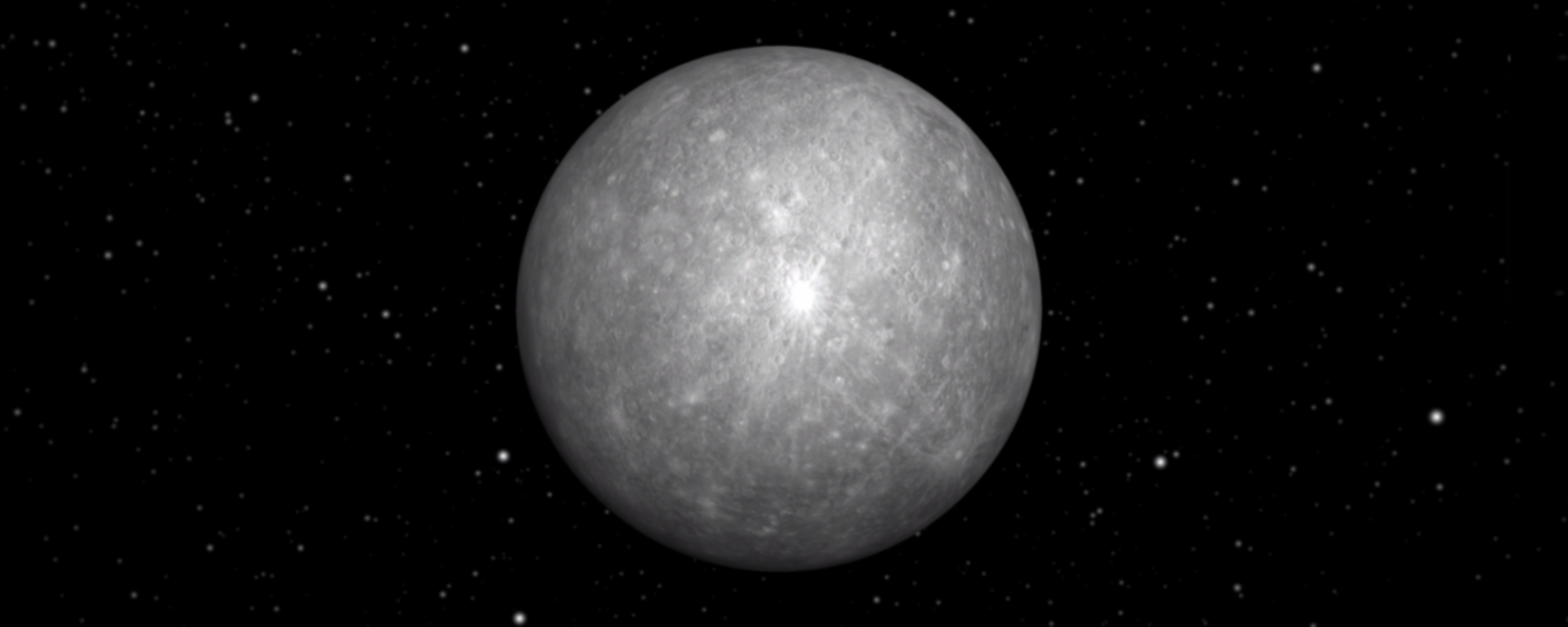
(m5pr-planet-mercury.mercury) The Planets, Mercury
Credit: Solar System Scope
Facts about Mercury
Discovered: Known to the Ancients
Planet Type: Terrestrial Planet
Average Distance from Sun: 29 million miles
Equatorial Diameter: 3032 miles
Axil Tilt (to orbit): 2.04 °
Inclination to Ecliptic: 7.005 °
Length of Day (rotation period): 56.85 days
Length of Year (orbital period): 87.9691 days
Orbital Eccentricity: ~0.206
Surface Gravity (amount times Earth gravity): .38
Surface Temperature: 800 ° F.
Moons: None
Rings: None
|