|
Moons of Mars
The two moons of Mars are Phobos and Deimos, both are irregular in shape, and both were discovered by American astronomer Asaph Hall in August 1877.
There are no total solar eclipses on Mars, as the moons are far too small to completely cover the Sun. On the other hand, total lunar eclipses of Phobos happen almost every night. Both moons are tidally locked, always presenting the same face towards Mars.
As with most of the celestial objects in our solar system, these two moon are named after the Greek mythological twin characters. These two are, Phobos (fear and panic) and Deimos (terror and dread) who accompanied their father Ares into battle. Ares, is the god of war and was known to the Romans as Mars.
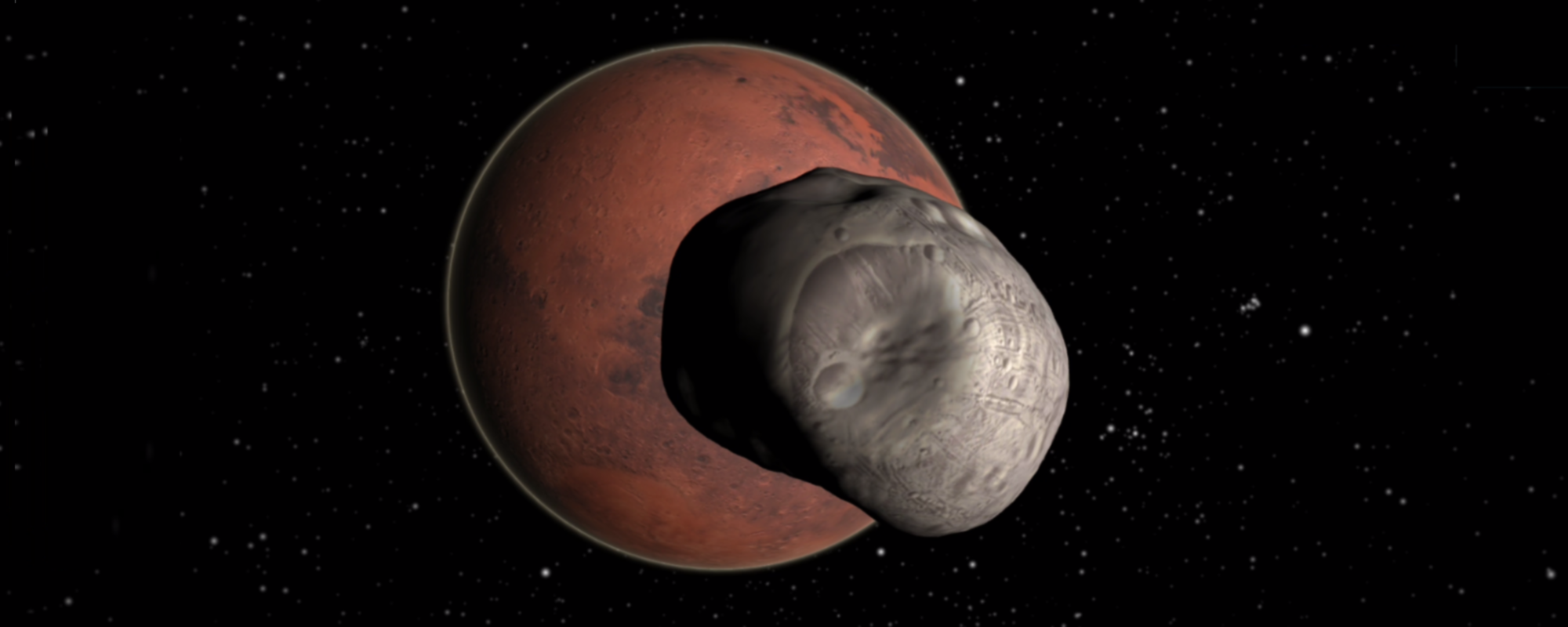
Facts about Mars I: Phobos
Equatorial Diameter: 16.8 miles.
Rotation Period: 7.3 hours
Orbital Period: 7.3 hours
Orbital Distance: 5,832 miles
Surface Temperature: -40°F
Phobos is so close to Mars that it orbits Mars faster than Mars rotates and appears to rise and set twice each Martian day.
General Information: Phobos
Speedy Phobos rises in the west, sets in the east, and rises again in just eleven hours.
Since Phobos orbits Mars faster than the planet itself rotates, tidal forces are slowly but steadily decreasing its orbital radius. At some point in the future, when it approaches Mars closely enough, Phobos will be broken up by these tidal forces and form a ring around Mars or will crash into Mars.
Several strings of craters on the Martian surface, inclined further from the equator the older they are, suggest that there may have been other small moons that suffered the fate expected of Phobos, and that the Martian crust as a whole shifted between these events.
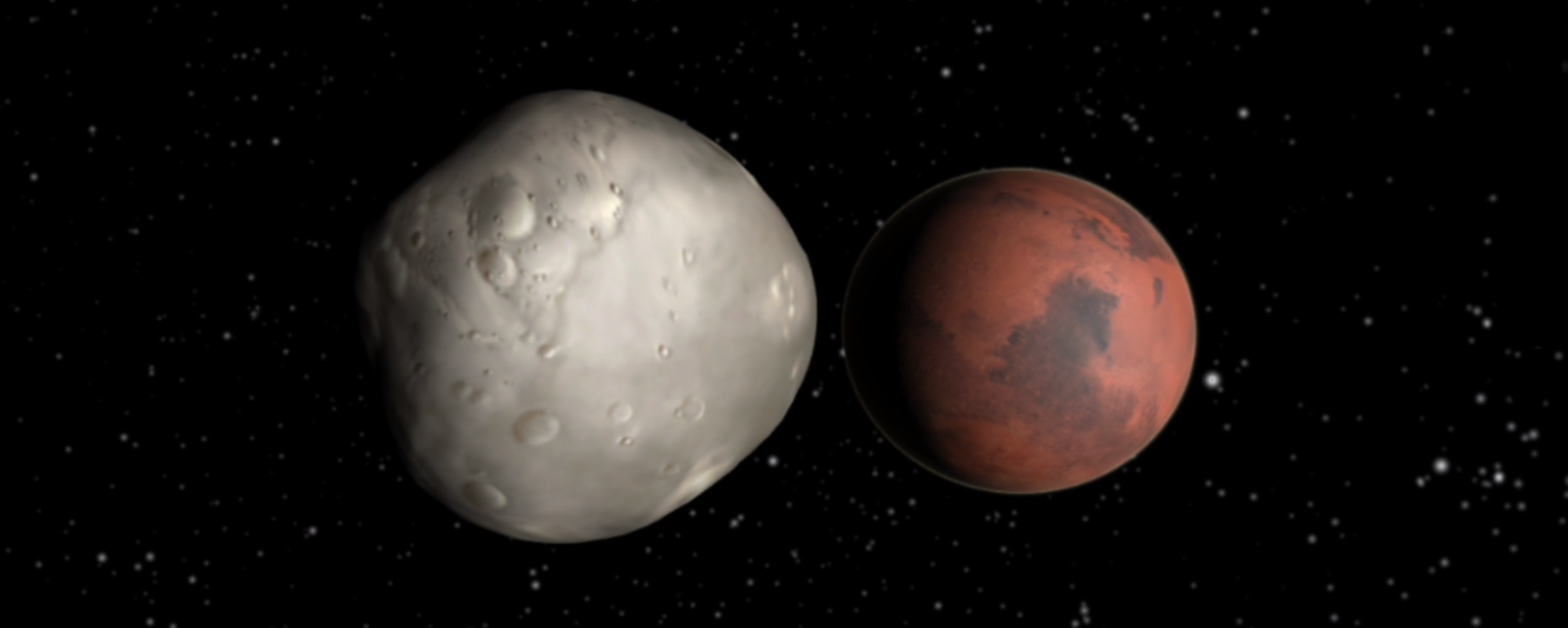
Facts about Mars II: Deimos Moons
Equatorial Diameter: 9.31 miles.
Rotation Period: 30.3 hours
Orbital Period: 30.3 hours
Orbital Distance: 14,580 miles
Surface Temperature: -40°F
Deimos is slowly moving farther away from Mars and it is believed that it will eventually leave orbit from Mars.
General Information: Deimos
Deimos, being only just outside synchronous orbit, rises as expected in the east but very slowly. Despite its 30-hour orbit, it takes 2.7 days to set in the west as it slowly falls behind the rotation of Mars.
Deimos is far enough away that its orbit is being slowly boosted instead, as in the case of Earth's Moon.
|