|
Haumea is a dwarf planet located beyond Neptune's orbit. It was discovered in 2004 by a team headed by Mike Brown of Caltech at the Palomar Observatory in the United States and independently in 2005 by a team headed by José Luis Ortiz Moreno at the Sierra Nevada Observatory in Spain, though the latter claim has been contested. Haumea is the third closest closest dwarf planet and fastest spinning known large object in the solar system.
It is probably the third-largest known trans-Neptunian object, after Eris and Pluto. Haumea′s mass is about one-third that of Pluto, and less than one-thousandth of Earth. Although its shape has not been directly observed, calculations from its light curve are consistent with it being a Jacobi ellipsoid, with its major axis twice as long as its minor. Haumea is the third brightest object in the Kuiper belt after Pluto and Makemake and easily observable with a large amateur telescope.
In October 2017, astronomers announced the discovery of a ring system around Haumea, representing the first ring system discovered for a trans-Neptunian object.
Haumea, currently above the ecliptic, passed aphelion in early 1992, and is currently more than 4.65 million miles from the sun. It will return to the ecliptic around the year 2019 and then continue
Haumea has two moons, the large is Hi′iaka which is about one percent the size of Haumea, while Namaka, the smaller weights only about one-tenth the amount of the larger moon. Both moons are believed to be composed of almost all water-ice, which may have originally have come from this dwarf planet.
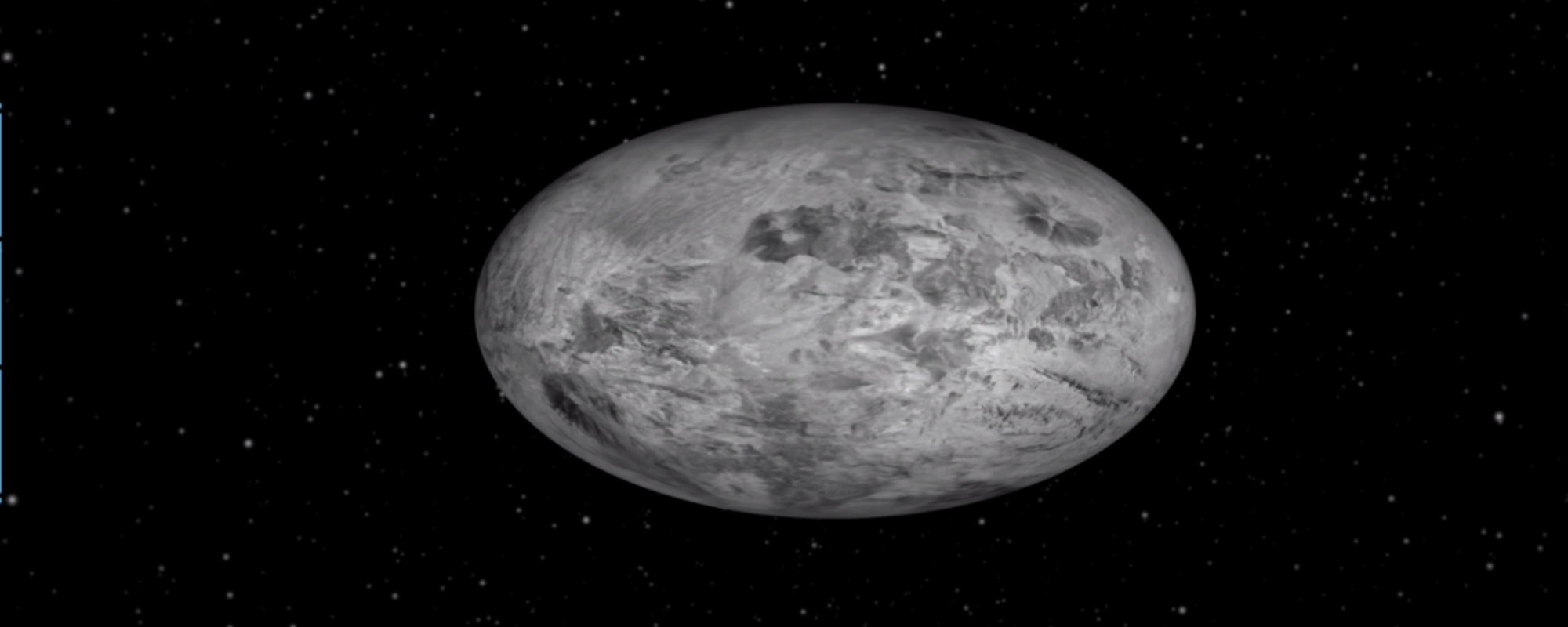
(m5pr-planet-haumea.01) The Dwarf Planets, Haumea
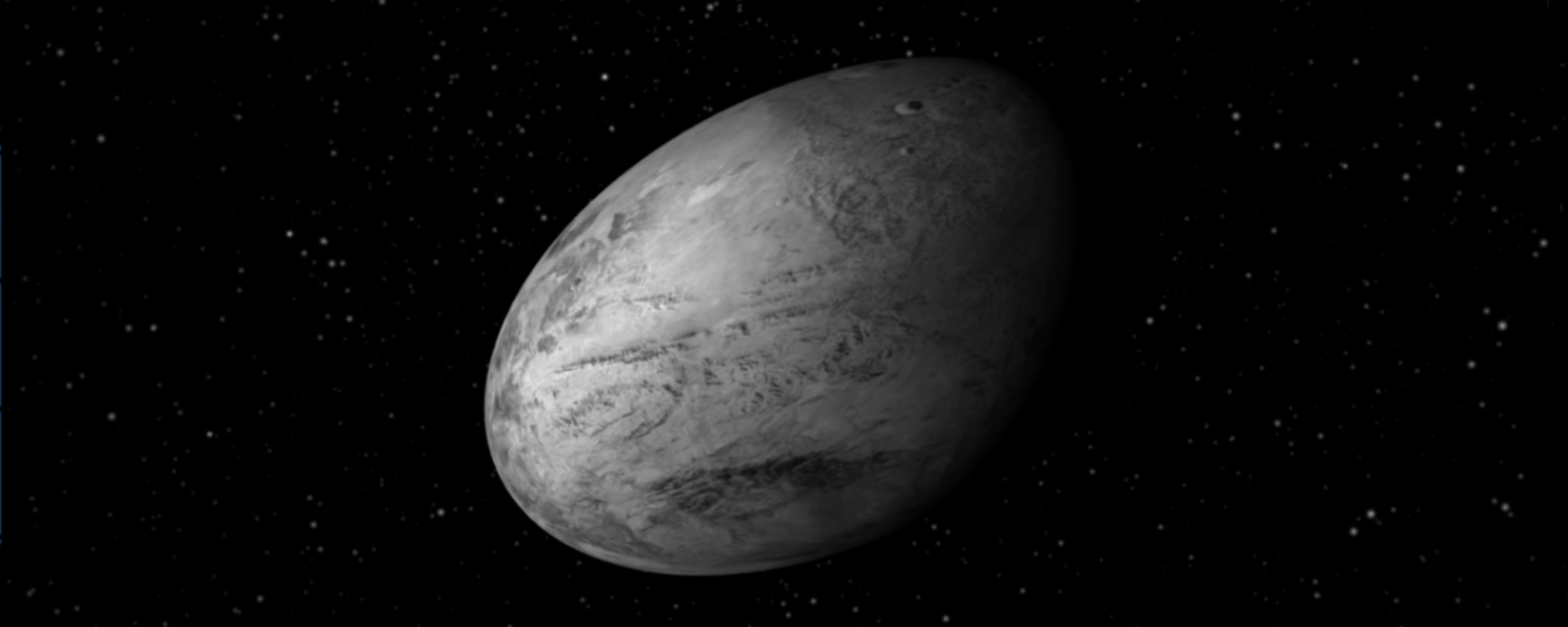
(m5pr-planet-haumea.02) The Dwarf Planet, Haumea
Credit: Solar System Scope
Facts about Haumea
Discovered: Mike Brown and Jose Ortiz
Discovery Date: 28 December 2004 (Brown) 27 July 2005 (Ortiz)
Planet Type: Dwarf Planet, Kuiper Belt Object
Average Distance from Sun:
Perihelion: 3.26 million miles
Aphelion: 4.79 million miles
Equatorial Diameter: 1014 miles
Axil Tilt (to orbit): unknown
Inclination to Ecliptic: 28.214 °
Length of Day (rotation period): 3 hours, 54 minutes
Length of Year (orbital period): 283.77 years
Orbital Eccentricity: ~0.191
Surface Gravity (amount times Earth gravity): 0.045
Surface Temperature: -369 ° F.
Moons: Hi'iaka and Namaka.
Rings: Yes
|