|
Eris is the most distant dwarf planet from the sun. It is the second-largest known dwarf planet in the Solar System. Eris was discovered in January 2005 by a Palomar Observatory-based team led by Mike Brown, and its discovery was verified later that year. Eris is the ninth-most massive known object directly orbiting the Sun, and the sixteenth-most massive overall in the Solar System (including moons).
Eris is also the largest object that has not been visited by a spacecraft. Eris has a mass that is 0.27 percent that of the Earth and 127 percent that of dwarf planet Pluto, though Pluto is slightly larger by volume.
The orbit of Eris is highly eccentric, and brings Eris to within 3.6 billions miles of the Sun at its perihelion during the year of 1698 CE. Some time after that, when Eris crossed the ecliptic, it was in the Kuiper belt just within the orbit of Pluto but well outside of the orbit of Neptune. When Eris reached aphelion around 1997, this dwarf planet was well outside the Kuiper belt. Currently, Eris in its orbit, is 8.95 million miles from the sun, is below the ecliptic and will cross the ecliptic again sometime during the year 2068 CE, after which, it will return to its perihelion around 2258 CE.
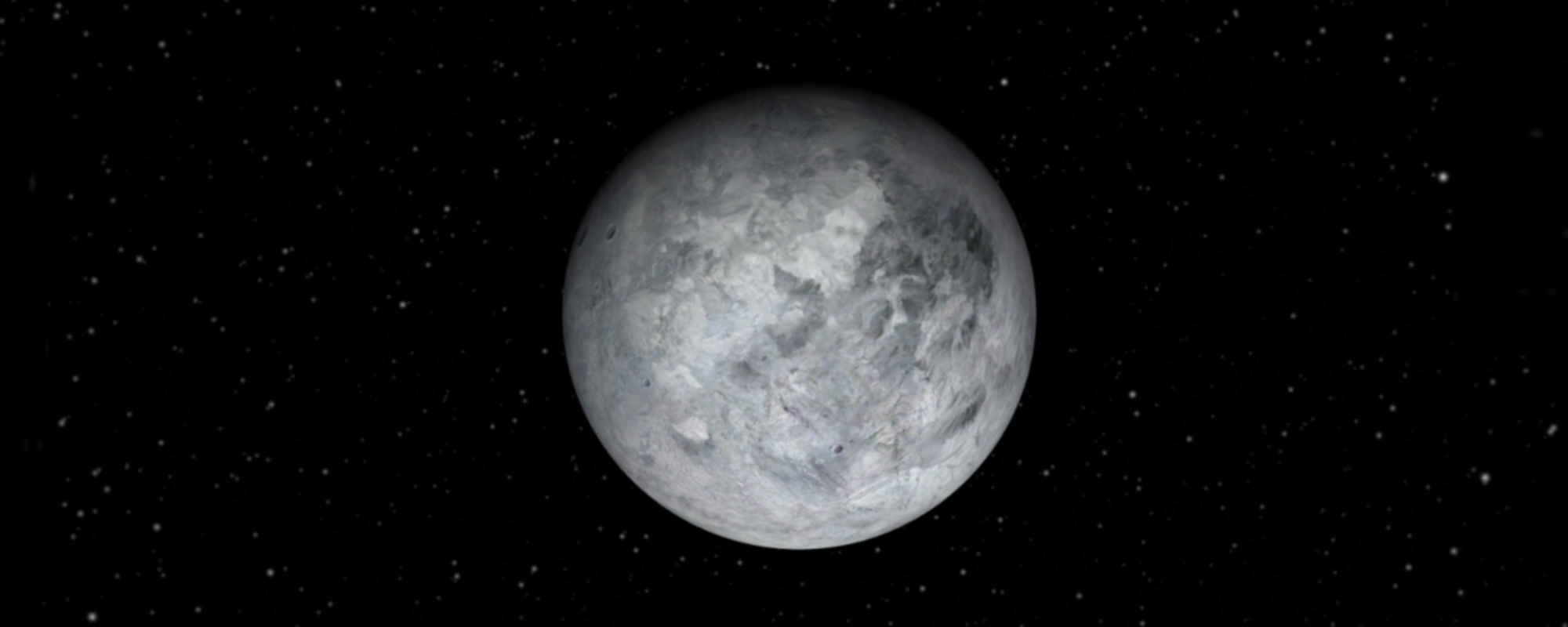
(m5pr-planet-eris.eris) The Dwarf Planet, Eris
Credit: Solar System Scope
Facts about Eris
Discovered: Mike Brown, C. Trujillo and D. Rabinowitz
Discovery Date: 05 January 2005
Planet Type: Dwarf Planet, Kuiper Belt Object
Average Distance from Sun: 6.29 billion miles
Perihelion: 3.557 billion miles
Aphelion: 9.06 billion miles
Equatorial Diameter: 1445.3 miles
Axil Tilt (to orbit): 78 °
Inclination to Ecliptic: 44.040 °
Length of Day (rotation period): 25.9 days
Length of Year (orbital period): 559.07 years
Orbital Eccentricity: ~0.44
Surface Gravity (amount times Earth gravity): unkown
Surface Temperature: -359 ° F. to -405 ° F.
Moons: Dysnomia
Rings: None
|