|
Ceres, being located between Mars and Jupiter, is the only dwarf planet located in the inner solar system. Although Ceres is the smallest dwarf planet, it is the largest object located within the region of asteroid belt but due to its 10.5 inclination to the ecliptic, it only crosses the asteroid bets twice during its orbit.
Ceres was originally considered a planet but in the 1850s was reclassified as an asteroid when many other objects in similar orbits were discovered. Even at its brightest, Ceres is too dim to be seen without aid of a telescope except possibly under extremely dark skies/
The 2006 debate surrounding Pluto and what constitutes a planet led to Ceres being also considered for reclassification as a planet. On 24 August 2006, the definition of a planet was upgraded to include, "A planet must have cleared the neighborhood around its orbit." By this definition, Ceres is not a planet because it does not dominate its orbit, but shares it with thousands of other asteroids.
The robotic NASA spacecraft Dawn entered orbit around Ceres on 6 March 2015. Due to the abundance of ice, water and minerals, NASA believes that Ceres could serve as a potential site for manned landings and as a launching point for deep space missions.
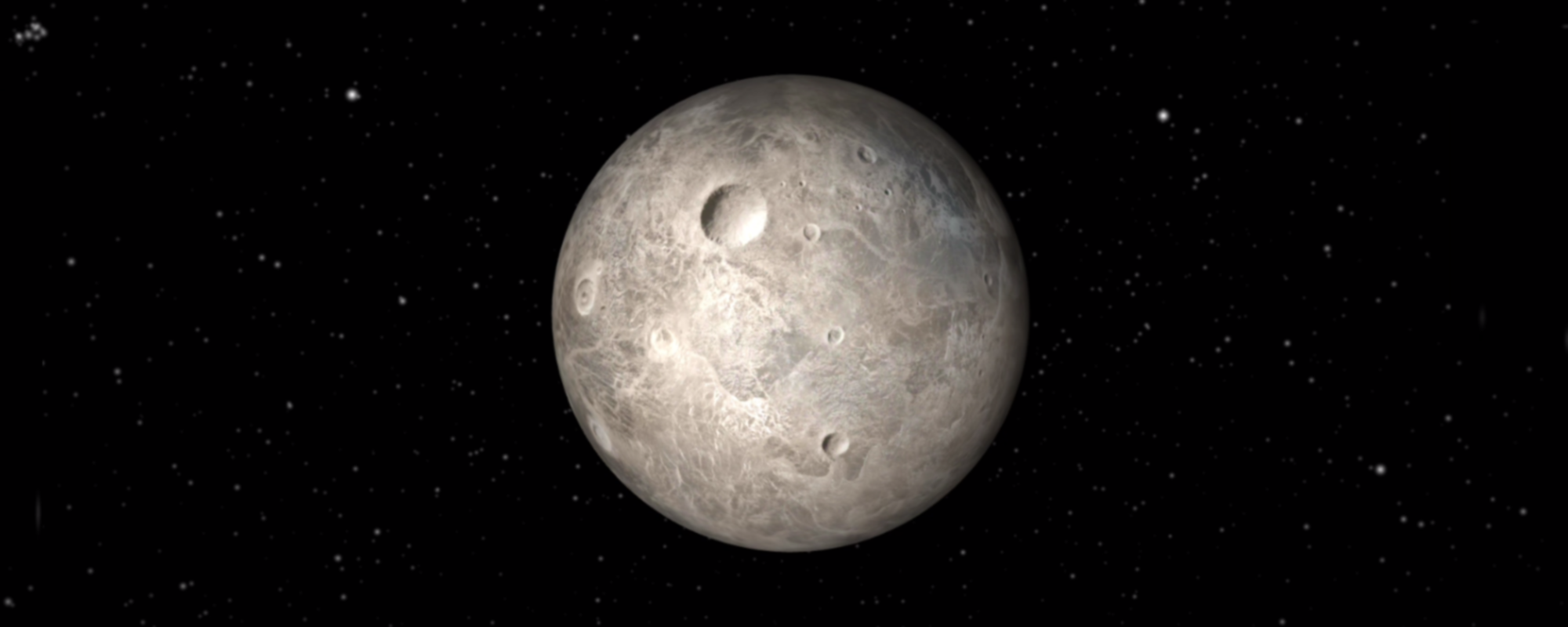
(m5pr-planet-ceres.ceres) The Dwarf Planet, Ceres
Credit: Solar System Scope
Facts about Ceres
Discovered: Giuseppe Piazzi
Date Discovered: 1 January 1801
Planet Type: Dwarf Planet, Asteroid Belt Object
Average Distance from Sun: 258 million miles
Equatorial Diameter: 605 miles
Axil Tilt (to orbit): 4 °
Inclination to Ecliptic: 10.594067 °
Length of Day (rotation period): 9 hours, 4 minutes
Length of Year (orbital period): 4.6 years
Orbital Eccentricity: ~0.0789
Surface Gravity (amount times Earth gravity): .03
Surface Temperature: -159 ° F.
Moons: None
Rings: None
|