|
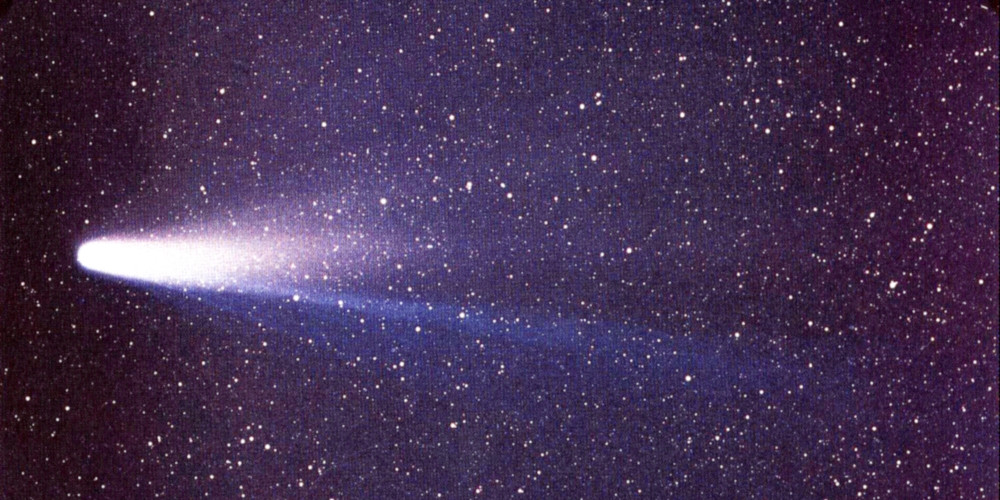
Halley′s Comet
Halley's Comet, or Comet Halley is officially designated 1P/Halley. It is definitely the most famous comet, one which is a short period comet visible from Earth every 75 years. Halley is the only known short period comet that is regularly visible to the naked eye.
Halley was discovered by Edmund Halley in 1682 and was seen again in 1758, 1835, 1910 and 1986. It's next predicted perihelion is on July 28, 2061.
Despite having been discovered in 1682, this comet has been observed and recorded by astronomers since as early as 240 BCE. Clear records of this comet have been made by Babylonian, Chinese, and medieval European chroniclers.
However, the periodicity of the comet, that is, it's reappearing nature was not recognized until determined by English astronomer Edmond Halley in 1705 when he used the laws of motion to predict the comet's return in 1758, which he did not live to see. It was named after him when the comet returned as he had predicted.
Comet Specifications:
Comet Designation:
1P-Halley
Discovery:
Discovery Date:
Prehistoric Observations
Modern: 1682
Discovered By:
Recognition of Periodicity, Edmund Halley
First predicted perihelion, 1758
Orbital Characteristics:
Orbital Type:
Short Periodic
Orbital Period:
74.7 years
Inclination:
161.96 °
Aphelion:
35.14 AU (astronomical unit)
Date of Last Aphelion:
09 December 2023
Perihelion:
0.59278 AU
Date of Last Perihelion:
09 February 1986
Date of Next Perihelion:
28 July 2061
Physical Characteristics:
Comet Dimensions:
9.3 miles by 5 miles (15 km x 8 km)
Mean Diameter:
6.83 miles, 11 km
Comet Apparent Magnitude:
1986: 2.1
Comet Apparent Magnitude at Aphelion:
2003: 28.2
Comet Apparent Magnitude:
Expected, 2061: -0.3
During the next perihelion of Halley′s Comet, it will be in a better position than it was in 1986, as it will be on the same side of the Sun as the Earth will be. The closest approach will be one day after the perihelion.
Object it Orbits:
Sun
Comet Radius:
3.4 miles, 5.5 km
Argument of Perihelion:
111.33 °
|