|
A moon dog, moondog, or mock moon, (Latin: paraselene, plural paraselenae, beside the moon) is a relatively rare bright circular spot on a lunar halo caused by the refraction of moonlight by hexagonal-plate-shaped ice crystals in cirrus or cirrostratus clouds
Moon dogs appear as part of the 22° halo, roughly 10 Moon diameters outside the Moon and are exactly analogous to sun dogs, but are rarer because the Moon is most often not at bright as the sun. The moon, to have a paraselene, must be bright, about quarter moon or more, for the moon dogs to appear. Moon dogs show little color to the unaided human eye because their light is not bright enough to activate the cone cells.
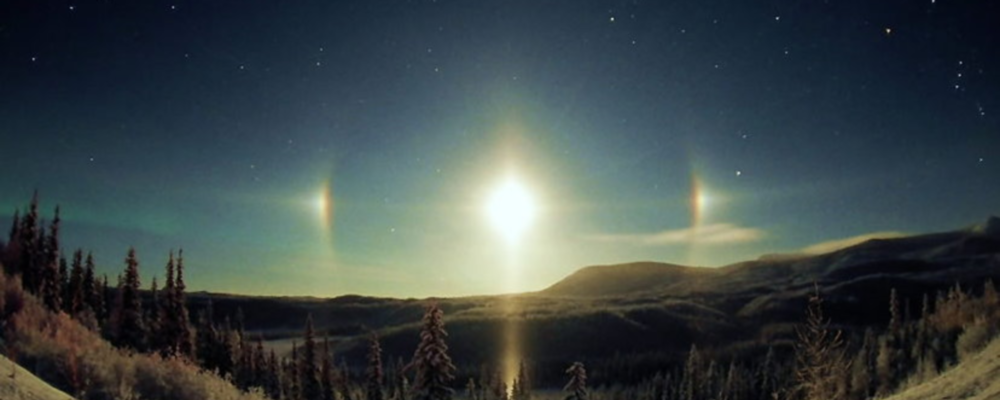
(m5ph-halo-moondog The Moondog
photo credit: Wikimedia
Viewing Paraselene
Moondogs can be seen anywhere in the world during any season, but are not always obvious or very bright, but are best seen and most conspicuous when the Moon is near the horizon. Too, the season to see a moondog at it′s brightest and fullest is winter when there is plenty of ice crystals in the atmosphere, especially in cirrus or cirrostratus clouds.
|