|
Information:
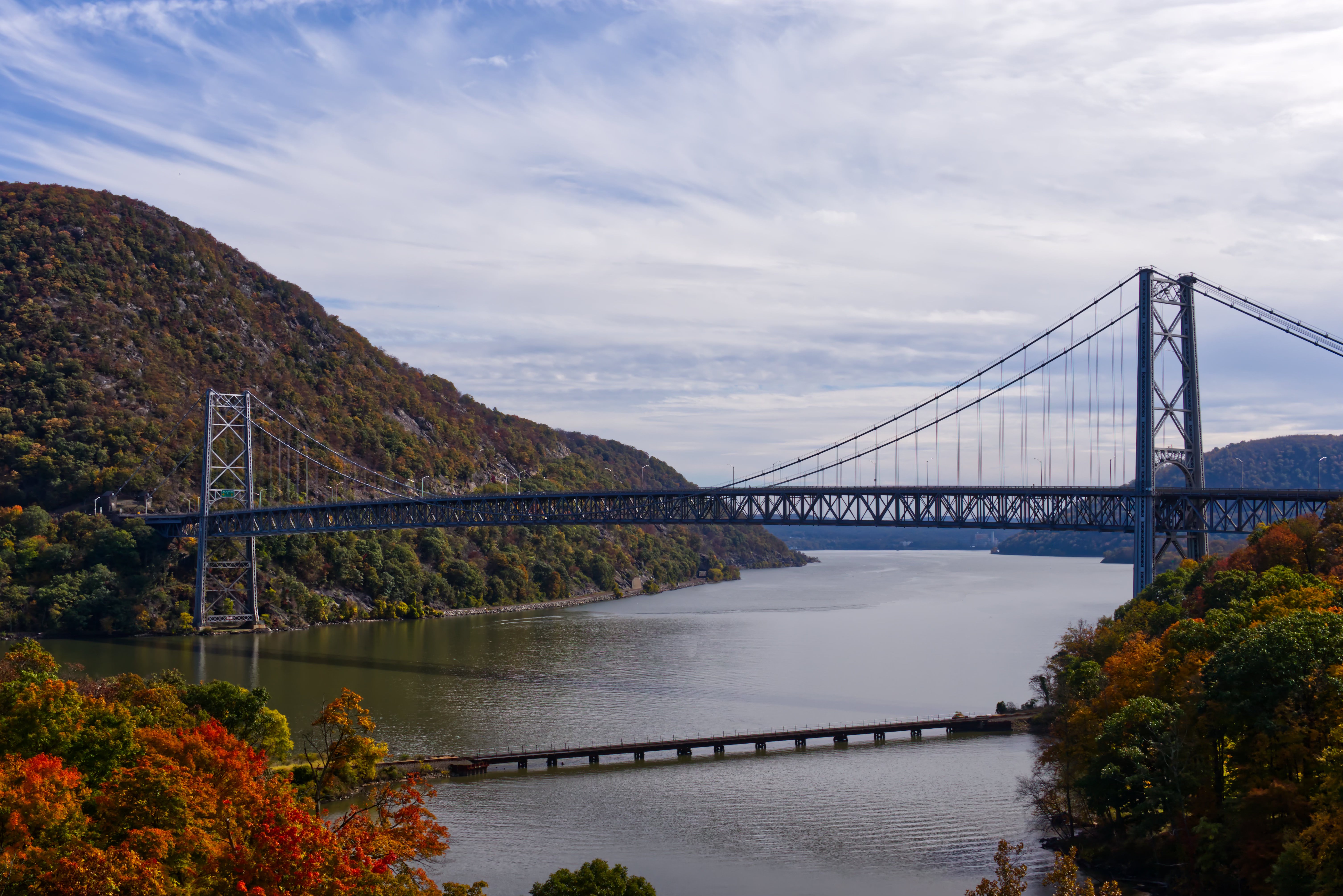
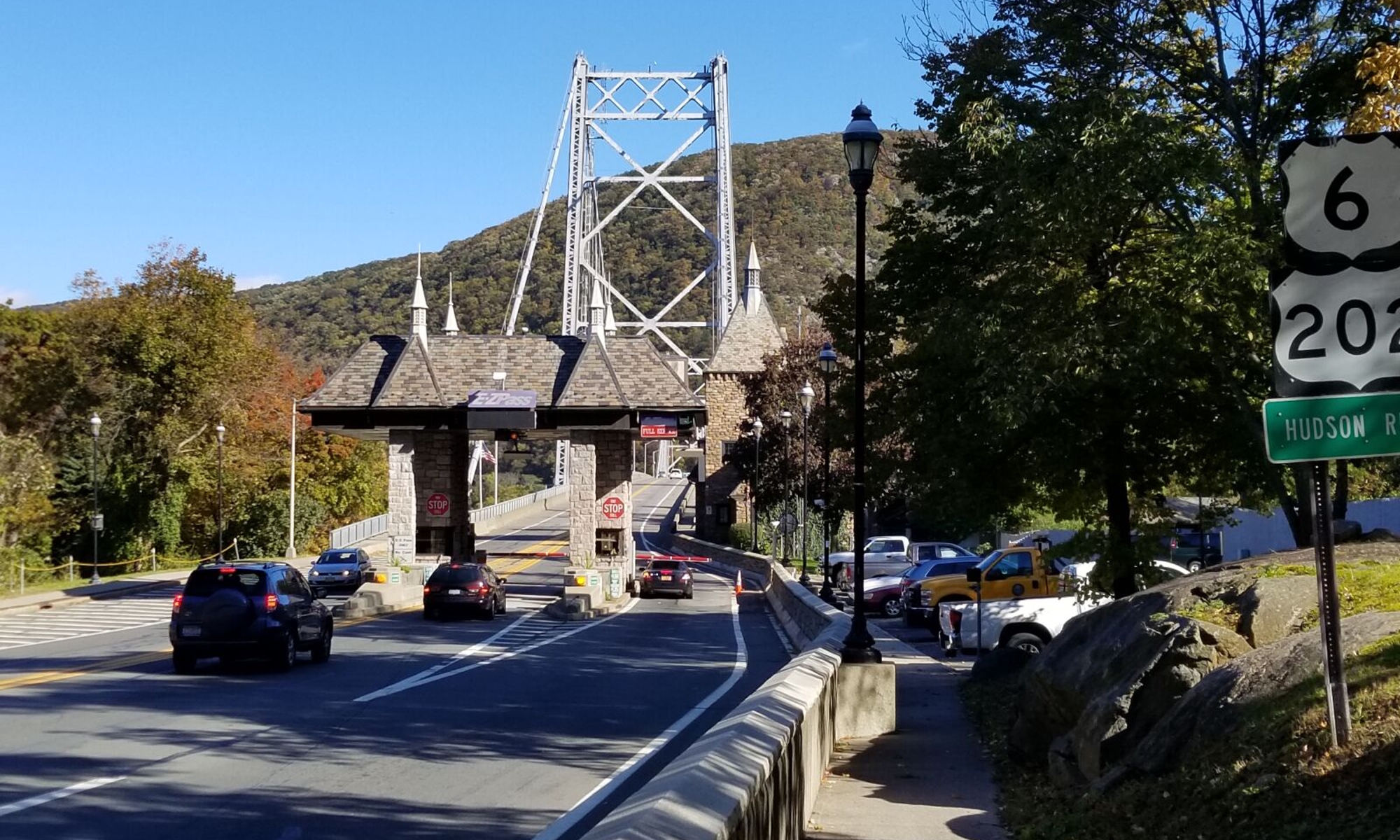
The Bear Mountain Bridge, which is also named ceremonially the Purple Heart Veterans Memorial Bridge, is a toll suspension bridge in New York State. It carries US 6, US 202, the Appalachian Trail, and the State Bike Route 9 across the Hudson River between Bear Mountain State Park on the west side of the Hudson river in Rockland and Orange County, to and Cortlandt in Westchester County on the east side of the Hudson river. The bridge has two vehicle lanes divided in the middle by a painted double yellow strip. The outside edge of each traffic lane has a painted white stripe and is flanked with enough room aside the vehicle traffic lanes for foot and/or bicycle traffic.
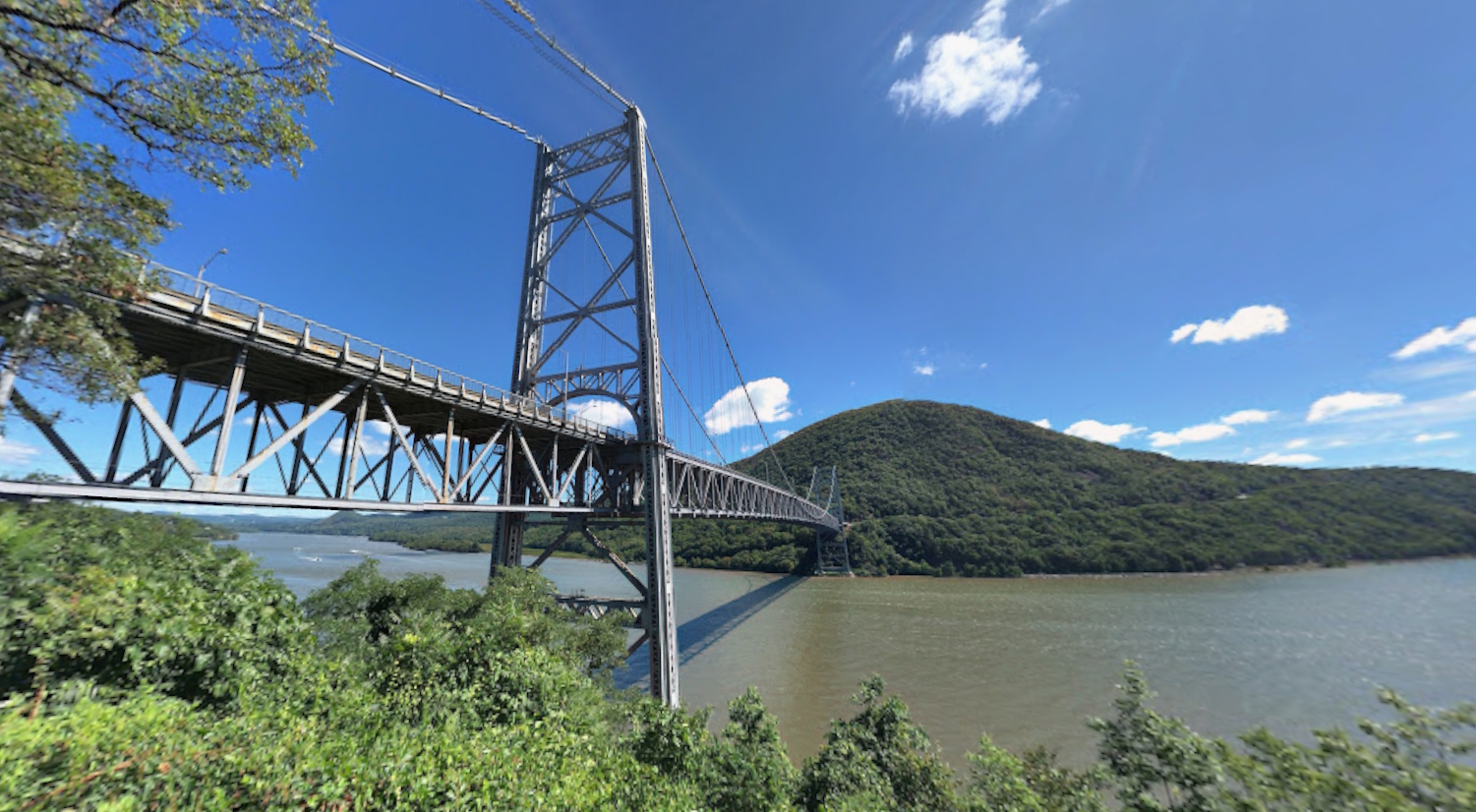
The Bear Mountain Suspension bridge only has suspension cables between its two towers and not on either of the two approach spans which extend the bridge to each bank. This is similar to the Williamsburg Bridge in New York City.
In 1924, upon its completion in 1924 it was the longest suspension bridge in the world. However, that record was surpassed just 19 months later by the Benjamin Franklin Bridge between Philadelphia and Camden, New Jersey.
Location:
Driving Directions:
The bridge can be accessed from the west on US 9, US 9W, US 202, as well as the Appalachian Trail and/or the New York State Bike Route number 9. There are no immediate interstate highway access to this bridge.
Coordinates:
41.32, -73.9803
Elevation:
58 feet
History:
The original plans for a bridge at this location began with the charter of the Hudson Highland Suspension Bridge Company in 1868 after a bill was pass by the New York legislature and signed by then Governor Fenton, which bridge was to be for a railroad bridge. Several attempts were then tried throughout the rest of the 1800s but none of them succeeded, with only foundation preparations having progress made. Then, in 1916, the charter for construction of that bridge expired.
In 1922, another bill was introduced which resulted in the creation of the private Bear Mountain Hudson River Bridge Company to build the bridge, which would now be for automobiles instead of rail and include a three mile approach road connecting to existing roadpaths. Under the 1922 charter, ownership of the auto bridge was to revert to New York State by 1962. A $4.5 million bond issue was completed in April of 1922 and construction was begun.
When the Bear Mountain Bridge formally opened on 27 November 1924, it was the longest suspension bridge span in the world, the first of its type to have a concrete deck, and it was the first automobile bridge to cross the Hudson south of Albany, which surpassed the 1888 Poughkeepsie Railroad Bridge as the southernmost crossing of the river.
On 26 September 1940, ownership was transferred to New York State Bridge Authority and the toll was reduced to a flat rate of 50 cents per automobile. Originally, tolls were collected in both directions, but in August of 1970, the toll was abolished for westbound drivers and at the same time, the eastbound drivers saw the toll doubled. Many other Hudson River crossings also changed to eastbound only tolls.
At midnight on 01 October 2021, the bridge was converted to all-electronic tolling which still remained only in the eastbound direction. Motorist can use their E-ZPass to pay the toll, or those without E-ZPass are sent a bill in the mail.
Bridge Specification
Bridge Type:
Parallel Wire Cable Suspension Deck Bridge
Bridge Body:
Steel truss, steel pylons
Bridge Deck:
Hard Surface (concrete and/or asphalt)
Bridge Foundation:
Two Pylons Towers, each Supported by Two Concrete Piers
Bridge Structure:
Steel Deck Truss Bridge with Two Vertical Support Pylons
Bridge Measurements:
Deck Width:
37.7 feet
Total Length:
2,258 feet (687 meters)
Number of Spans:
1
Main Span Length, 1 each (center):
1,632 feet (497 meters)
Total Height:
360 feet (110 meters)
Clearance Above (Vehicle Clearance)
19.6 feet
Clearance Below (Vessel Clearance)
155 feet (47 meters)
Weight Limit:
112,000 pounds
Vehicle Height Restriction:
14 feet
Carries:
Two Lanes of US 6, US 202
Appalachian Trail, State Bike Route 9
Crosses:
Hudson River
Construction:
Builder:
Terry &: Tench Construction Co.
Engineer: Howard C. Baird
Cost to Build:
2.9 million
Date Construction Began:
June 1923
Date Open:
24 November 1924
Daily Traffic:
22,000 (2026)
Toll
Eastbound Traffic Only
E-Z Pass Holders:
$1.65
Tolls-By-Mail
$2.15
Improvements/Rehabilitations
Purchased by NY State Bridge Authority
Purchase Date:
26 September 1940
Purchase Cost:
$2.9 million
Major Rehabilitation:
2006
|