|
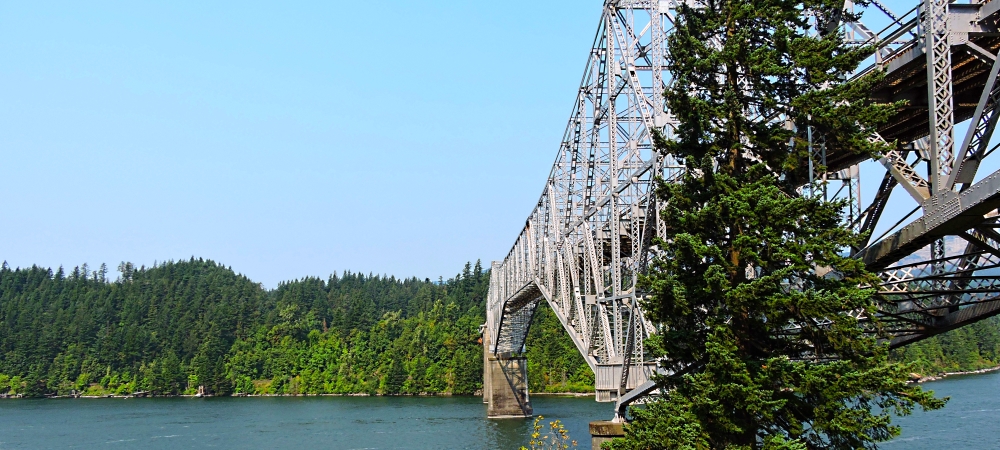
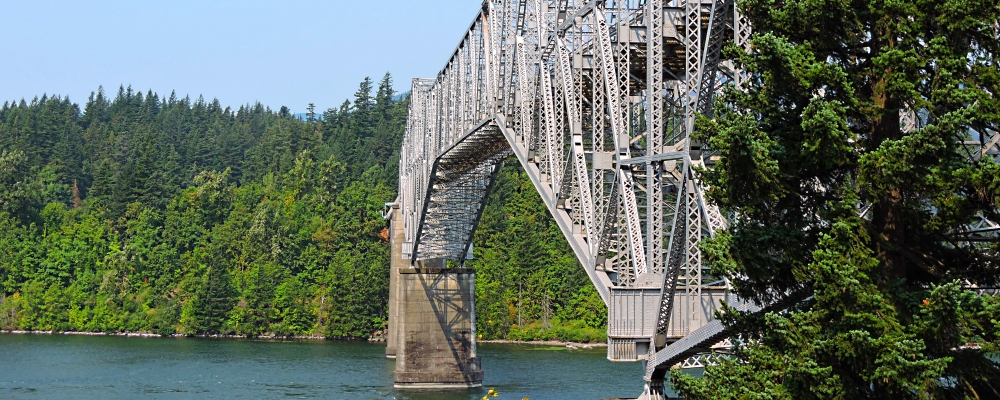
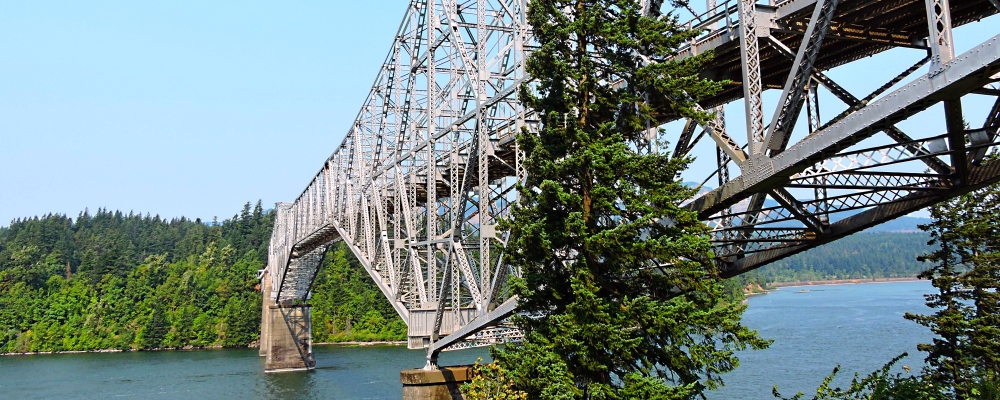
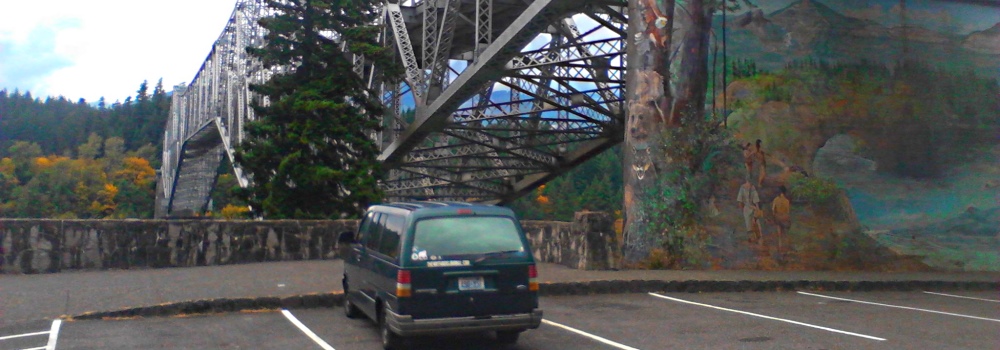
The modern day bridge across the Columbia Gorge, which is referred to as The Bridge of the Gods, is, in fact, a steel cantilever through truss, concrete deck bridge that was built in 1926.
From a handout I received at the Bridgeside Restuarant Gift Shop, I have learned the following:
During 1920, the US War Department issued a construction to the Interstate Construction Corporation, to build the current bridge, however, in the five years that followed, this company managed to only acquire the right-of-way and construct one pier.
At that time, Wauna Toll Bridge Company then purchased Interstate′s interest in the bridge, completed the remainder of the construction and in October 1926 at a cost of just over six hundred and two thousand dollars, the bridge was opened to traffic.
Construction of Bonneville Dam
After the construction of the Booneville Dam was completed in 1938 the water level of Bonneville Reservoir began to rise. So, in 1938, in order to accommodate the rising backwater, it was required for the bridge to be further elevated by 44 feet (13 m) and extended to its current length of 1,858 feet (566 m).
The federal congress allocated over seven hundred and sixty thousand dollars to have the bridge raised 44 feet and extended to its current length. Later, the bridge was purchased in 1953 by the Columbia River Bridge Company who began to operate it.
Bridge Re-decking
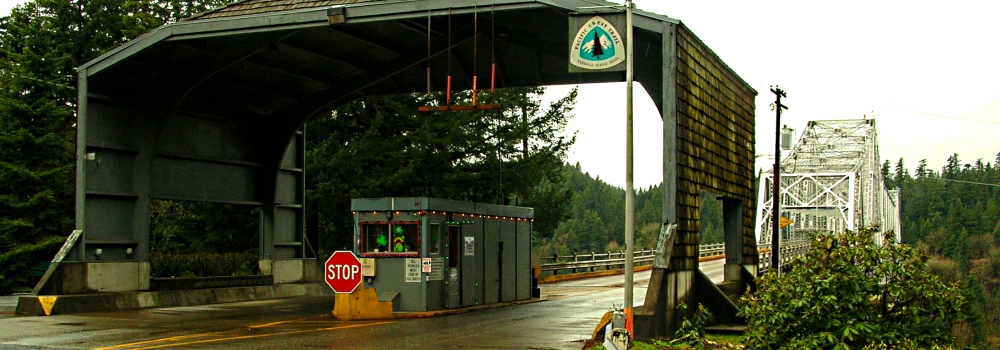
Then, in 1961, the bridge was acquired by the Port of Cascade Locks Commission with almost a million dollars of revenue bonds, issued on 01 November 1961. Later, in April, 1966 the Commission authorized a second $300,000 revenue bond was issued for re-decking, painting and a new toll canopy. The re-decking was accomplished by closing the bridge at night only. The night shift removed a section of the old wood deck, cleaned and prepared the bridge steel for laying the new metal deck grating. The grating was laid in panels across the full width of the roadway and tack welded in place. Final welding of the plates was carried out during the day. The entire re-decking with the metal deck grates was completed in just twelve day.
The Bridge
The Bridge of the Gods is the third oldest bridge over the Columbia River and it plays a major role in the Pacific Crest Trail by allowing free passage for the backpackers to cross the mountain gap between Oregon and Washington states.
Revenues from the bridge pay for maintenance, painting, inspections and for the repayment of the bonds. While the original cost to build the bridge was over $602,000.00, it would cost more than 14 million to replace it as it stands today.
Today, the bridge tollhouse is open 24 hours every day for the collection of tolls. Too, the tollhouse serves as the emergency relay station for the police department on both sides of the river. In 1991, the Port authorized the painting of the entire bridge, which was painted at a cost of $800.000.00. The Port of Cascade Locks Commission owns and operates the bridge still today.
For many years, the bridge toll was $1 per crossing; In 2016, it was raised to $2 due to the increased traffic after the release of the 2014 film Wild. The toll was increased to $3 in July 2022.
In September 1927, it was been reported that onlookers saw Charles Lindbergh from Portland fly the Spirit of St. Louis low over the then new bridge and then in a bit of barnstorming, make a 180 degree turn and fly back under the the bridge. After that, he returned to the Portland airport, after which he flew to Swan Island on the Willamette river.
Location:
Coordinates:
45.6619841, -121.8981254
Elevation:
174 feet
Driving Directions:
The bridge spans the Columbia River connecting SR-14 in Washington to I-84 in Oregon.
Bridge Specification:
Bridge Type:
Steel Cantilever Through Truss Concrete Deck Bridge
Year Open:
1926
Cost to Build:
$602,077.58
Raised 44 feet: 1938-1940
Raised to accommodate water rise due to Bonneville Dam.
Cost to Raise:
$762,276.00
Measurements:
Overall Bridge Length:
1858 feet
Total Cantilever Structure Length:
1,131 feet
Overall Width:
35 feet
Main (Longest) Span Length:
706 feet;
Clearance Above:
(Vehicle Clearance) 14 feet 6 inches.
Clearance Below:
(Vessel Clearance) 140 feet.
The namesake of the modern day bridge is from the legend that was passed down by those of the North American indigenous people who first made this land their homeland. Those native people, who are the descendents of
Saptin, who was one of the sons of Hadoram, son of Joktan; who are now referred to as the Confederated Tribes of the Warm Springs, the Yakima Nation, the Nez Perce Tribe and the Confederated Tribes of Umatilla Indian Reservation, all of which have strong ties to the lands along either side of the Columbia River where it passes through the gorge.
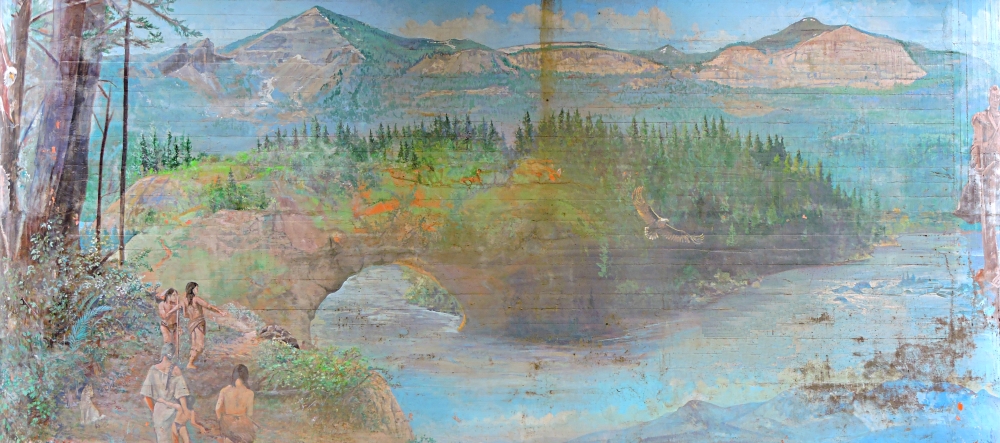
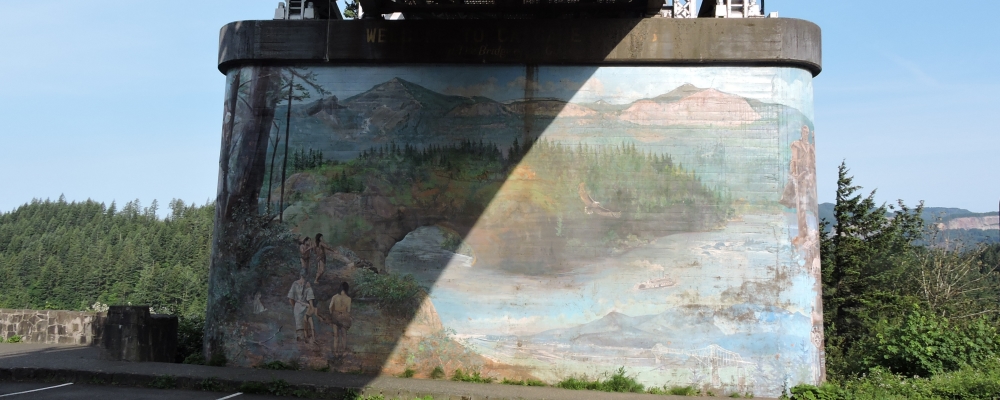
Long ago, before the steel and concrete found its place across this riverway, there was another bridge, a natural bridge and one that the ancestors of the above nations and tribes had then called the Bridge from God.
Ancient Steps:
Many moons ago, some time after the Great Flood, as the seasonal warming temperatures would cause the snow from the tops of the mountains to melt, the valleys and canyons in this basin between the mountains on the west coast of the continent and those inland mountains in the middle of the continent, began to fill from the waters flowing down from the snow melt.
Due to the fact that this great basin had no outflow to any ocean (endorheic), in time, the waters in the valley bottoms, became deeper and began to form into lakes. One by one, these many lakes merged into larger lakes as their depth became greater and greater. Much time elapsed and after the period of a thousand moons, all of the lakes grew into one large lake, which covered more land than could have been walked during many days. In fact, the lake filled the entire basin between the Coastal Mountains and the Great Inland Range and became a vast inland sea.
When the early indigenous people came upon this body of water, they found it to be teeming with a large fresh water fish that resembled what they had previously come to know as trout; but these fish were not trout. So, they named this lake by what they began to call this fish,
Ta-Maschilamek, which in their language means, Not-Trout. Later, when the fish that looked like trout, but were not trout, was given a name, the lake came to be known as Salmon Lake.
The indigenous people who had first walked across the Beringia land bridge, crossing from the Asian continent onto a new continent were all known as the sons of Joktan, who was brother of Peleg and who both were sons of Eber, son of Shelah, son of Arphachshad, son of Shem, Noah′s son. By the time Joktan′s family reached the Beringia land bridge, this family was a large and growing number of people, even a nation. As this group of thirteen sons, their wives and their children continued south from the Bering Sea, one of Joktan′s sons, Hadoram, his wife and their children decided to stay here and make the banks of Salmon Lake their homeland while the rest of the family continued east across the continent.
However, before Joktan and his twelve sons left Salmon Lake, it was early one morning, that there occurred a large earthquake that shook the entire camp. As the men emerged from their tents and came out into the open, they noticed that two of the mountains, one to the north and another to the south of their camp had both erupted and were spewing out great columns of smoke and ash. Also, the land nearby had developed a fissure where water from the lake was flooding down into an ever growing chasm. Before the end of that day, the cataract of water into the crevasse had grown to allow a huge flow of water to pass under the large range of mountains. As the wash of water continued into the hole, the cavity was to continue to grow larger and larger.
Bridge from God
By now, Joktan and his entire family decided to stayed for a while longer here along the south side of this newly forming river of water to see what would happen. Besides, the entire family has come to enjoy the fresh fish that was easy to catch from along the riverside and they were beginning to smoke much of it to carry with them when they leave to continue there migration. On the third day, at the end of the day, there was a light that began to shine out of the chasm from above the river of water. They recognized the light as being light from the setting sun which they were able to see through the tunnel that had been created by the water rushing through the mountain and to the ocean somewhere to the west.
They continued to stay another few days and would see that the water would continue to drain from Salmon lake through the ever growing tunnel. Too, as this river cut through the mountains, there was a large land mass remaining above the river, something none of these wayfarers had ever seen before.
Now, there on the banks of this new river, Joktan and his entire family watched this river cut a huge tunnel under the mountain and formed an archway above, one that some would use to cross this fast flowing river to walk to the north side. In fact, Hadoram and his family had already crossed over to the north side and set up their camp along the river′s banks. Before Joktan departed to continue the migration eastward, all of his family crossed over this archway to bid farewell to Hadoram, his wife and their sons and daughters. Finally, Joktan, his remaining sons, their wives and children crossed the archway back to the south side of the river and continued eastward on their migration.
This earth and rock archway is what came to be known by Joktan and his family as the Bridge from God. Furthermore, this story has been passed down by these indigenous people to their grand children and these to their grand children ever since.
The story of these people have continued to be passed down all throughout their generations. Please come read more of their story as it becomes available from this website. To learn more about the availability of this story, Please click on the following link:
Episode Three, Volume One: Journey to Lenapehoking, by Craig & Sandy Ojawashko
|