|
In 1604, over a hundred artisans, gentlemen, sailors and soldiers sailed here from France in a bold attempt to establish the first European colony north of Florida. Seventy-nine of those aboard remained to build a settlement on an island just offshore and came to the mainland to hunt and garden. The indigenous people, known as
Passamaquoddy (see Ancient Steps below) lived nearby and came to these shores to harvest fish and shell fish. Not much is know what the natives thought about the newcomers but we do know that at some time much later, these natives helped them survive and then left them in peace.
Pierre Dugua, Sieur du Mons had chosen this island site as the place to build a fort on the last day of August 1604 and then watched his two ships weigh anchor and set sail for France.
He and seventy-eight men including Samuel Champlain, remained to build a small town and determined that for safety reasons they would build on the very small island. He was expecting to be able to travel to the adjacent lands to hunt and trade with the local Passamaquoddy natives but the river froze and when the tides began upheaving large cakes of ice, the river became much too treacherous to cross. Thus, these French colonist were cut off from fresh water, game and fire wood needed for fuel.
Thirty-five died and twenty more were close to dying when, after the spring thaw, supplies came by way of the natives. The next year, 1605, after extensive surveying in the area, Pierre Dugua moves the town across the Bay of Fundy to Port Royal where the French not only survived but thrived.
This 1605 settlement by the French at Port Royal became the very first permanent European settlement in North America, even before Jamestown, Virginia was settled in 1607.
The Great Expulsion
The expulsion of the Acadians was the forced removal between 1755 and 1764 by Britain of the inhabitants of the North American settlers from the region knows as Acadia, which included areas of Nova Scotia, New Brunswick, Prince Edward Island and the US state of Maine. This expulsion occurred during the French and Indian War (1754-1763) which was the North American theater of the European Seven Years′ War.
Before 1758, the deportations were to the thirteen British colonies and after 1758, the deportee′s were transported to Britain or France. However, the British did not stop after the Seven Years′ War ended in 1763 but afterwards continued to deport the Acadians back to France until about the year 1795.
Capture of Port Royal
In 1710, the British captured Port Royal, capital of Acadia, and after the 1713 Treaty of Utrecht, Nova Scotia was ceded to the ownership of Great Britain, but the same treaty allows the Acadians to keep their lands. However, the now patrioted Acadians, refused to sigh an unconditional oath of allegiance to Britain, fearing that they could be drafted to fight against France. Further, some of these colonists participated in the French military operations and helped maintain supply lines to the French forts in North America. As a result, the British endeavored to eliminate the military threat posed by the Acadians and permanently cut the supply lines.
Without differentiating between the combatants and those who remained neutral, the British governor Charles Lawrence together with the local council ordered all Acadians to be expelled.
In the first wave of expulsion, Acadians were deported to the British colonies in North America. During the second wave, the Acadians were deported to Britain and France, from which a significant number migrated to Spanish Louisiana, where the Acadians eventually became the Cajuns.
The British by continuing the deportations achieved their military goals of destroying all of the French forts and weakening both the confederation of the Mi′kmaq and the Acadian militias as well as devastation of the primary Acadian civilian population as well as the economy of the region.
The Aftermath
Of an estimated 14,000 to 18,000 Acadians that were deported, some 5,000 died of disease, starvation, or drowning due to shipwreck. Their land was give to settlers loyal to Britain, mostly immigrants from New England and Scotland. Still, many, while the British ships in their ports but had yet come ashore, fled into the woods to avoid capture. A census in 1764 indicates that there were 2,600 Acadians still remaining in the colony, having eluded capture.
The Great Expulsion and it has come to be called is largely regarded as a crime against humanity, with some moderns using the term genocide.
Fort Acadia Today
Saint Croix Island is a small uninhabited island in Maine near the mouth of the Saint Croix River, one that forms part of the Canada–United States border separating Maine from New Brunswick. The 6.5 acre island measures approximately 600 feet long by 300 feet wide, and is located about 4 miles upstream from the mouth of the river on Passamaquoddy Bay.
The island is in the heart of the traditional lands of the Passamaquoddy people who, according to oral tradition, used it to store food away from the dangers of mainland animals.
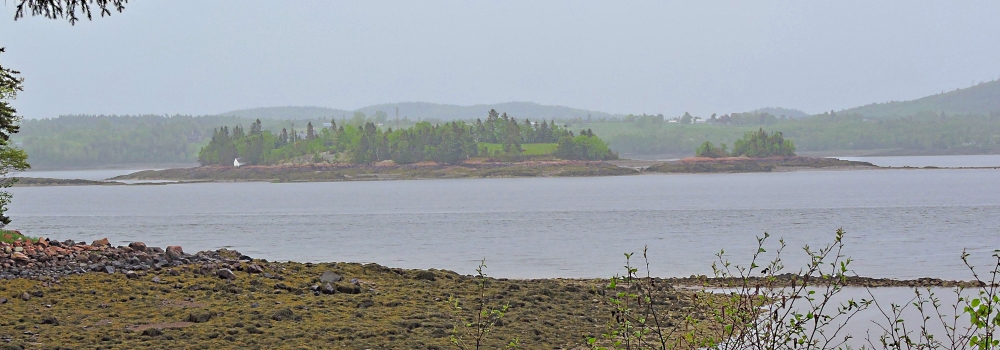
There is no public access to the island, but there is a visitor contact station on the U.S. mainland and a display on the Canadian mainland opposite the island.
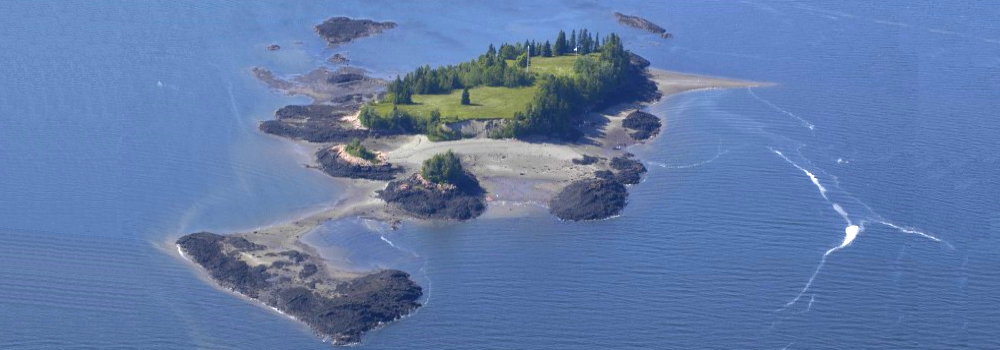
(m4fort-me-acadia-saintcroix) Saint Croix Island
Photo Credit: Wiki Commons
Fort Acadia Information:
Year Built:
1604
Year Closed:
1605
Settlers move to Port Royal.
Type Construction:
Wood Stockade
Location:
Coordinates Island:
45.1282529, -67.1336388
Coordinates Visitors Center:
45.1242465, -67.1471858
Elevation Island:
40 feet
Address:
84 St Croix Dr, Calais, ME 04619
Entrance Fee:
Visitors Center is Free
There is no access to the Island.
Ancient Steps:
The sixth of the thirteen sons of Joktan,
Uzal, himself had six sons: Beothunks, Maliseet, Micmac, Mi'kaq, Passamaquoddy, and Penobscot. Too, each of his sons proceeded to settle in an area not far from their parents.
Most of the sons of Uzal were hunters and fishermen who lived along the coastlands and rivers of the extreme northeastern area of the North American continent that is below the river known as the Big Waterpath.
|