|
Montana
At the point where the Yellowstone river merges with the Missouri river (47.9800848169242, that merger of those two great waterways is entirely within North Dakota, and about three miles, as the bird fly′s, east of the Montana-North Dakota state line as well as downriver nearly four miles on the Missouri river from the
Fort Union Trading Post, which itself is nearly on that state line.
For a person to follow the Yellowstone river upriver from its mount, one would have to follow its wide fertile valley in a southwesterly direction whilst the river itself meanders through that same wide valley. Today, there are modern roadpaths that one can travel in the valley and alongside the Yellowstone River. These roadpaths will travel in that southwesterly path for about seventy miles where is arrives in West Glendive, Montana. To continue along the river′s wide valley, one would then need to access IH 94 in order to follow the river further in that southwesterly direction through Montana for many more miles, in fact, about another two hundred and thirty more miles at which time you will have past by the city of Billings, Montana. At about fifteen miles west of Billings, Montana is the where the Clark Fork of the Yellowstone River merges with the Yellowstone River. This is where to take exit 434 from IH 90 and then take US 212 southbound, which for the purposes of this narative is considered the beginning of the Beartooth highway.
Oh, by the way, the Yellowstone River continues westward along IH 90 for more than a hundred more miles until Livingston, Montana, and if you wanted to continue following it from there, you would have to leave IH 90 and then take US 89 south for another sixty miles at which time, you will be following the Yellowstone River within the Yellowstone National Park. But that is a story for another time.

(m6fi-beartooth-01.20180711.1029) The Valley Path, The Yellowstone River
The Beartooth highway, at least for this journey, begins on US 212 at the junction of IH 90 in Laurel, Montana near where the Clark Fork of the Yellowstone joins the Yellowstone river. In Fact, US 212 travel south along the Clark Fork for a short time until arriving at the junction of Rock Creek and the Clark Fork. Here US 212 turns westerly along Rock Creek and continues for quite a while on the flat valley plain of which most all consists of farm land. However, it does pass several small communities as it follows Rock Creek upward towards the Beartooth Mountains that I continue to espy to the south.
The US 212
enters (or departs from) Yellowstone park in the very northeastern corner of the park which highway has it′s western terminus in the park at Tower Junction at the Grand Loop road. This entrance to the national park has the shortest open season of all of the highways that give access to this national park.
The note on my atlas page states Open mid-May to early October, or about 140 days. However, several of the store owners along the route stated that the time the road is open most years is one hundred and twenty day at best.
Methinks, many people travel this route to enter Yellowstone not as the route for the first visit, but rather, because they hear that this highways is a must see path. And that is precisely the reason why I am on this highway during this Journey On.
After driving for some time on IH 90 along the Yellowstone, I finally come upon my exit and begin my drive south on US 212, the Beartooth Highway.
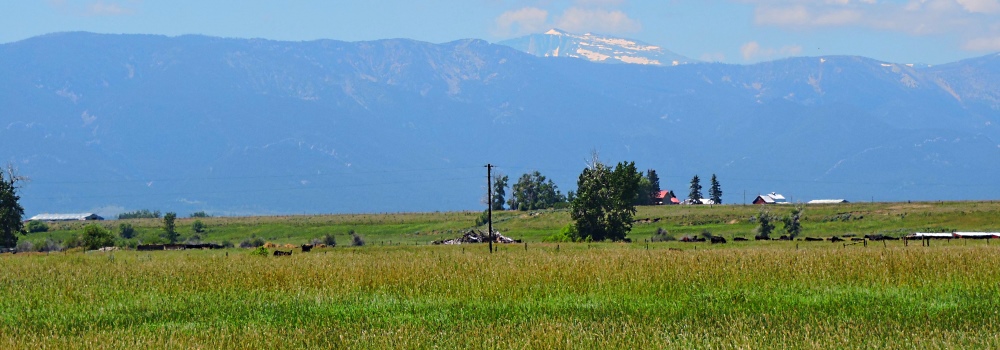
(m6fi-beartooth-01.20180711.1138) The Beartooth Highway, The Valley Path
|